
The Revenue Cycle Blog
Filter By
- ABA Therapy Billing
- AI in Medical Billing
- AI in Revenue Cycle
- ASC Billing Services
- Accounts Receivable Management
- Accounts Receivable Mangement
- Allergy and Immunology Billing Services
- Anesthesia Billing Services
- Back Office Revenue Cycle
- Bariatric Surgery Billing
- Billing For Physician Practice and Medical Groups
- Billing for Physician Practices and Medical Groups
- Blog
- COVID-19 Billing
- CPT Codes
- Cardiology Billing Services
- Cardiovascular Billing Services
- Charge Capture Services
- Charge Entry - Medical Billing
- Charge Entry Services
- Clinical Documentation Improvement - CDI
- Clinical Documentation Integrity
- Company News
- Credit Balance Services
- DME Billing Services
- Denial Code CO-97
- Denial Management - Medical Billing
- Dermatology Billing Services
- E&M
- E/M Coding
- Electronic Health Records
- Eligibility and Benefits Verification Services
- Emergency Department Billing Services
- FAQs
- Family Practice Billing Services
- G Code
- Gastroenterology Billing Services
- General Surgery Billing Services
- HCC Coding
- HCC Coding Services
- HCPCS
- Healthcare Collections
- Hospitals
- Internal Medicine Billing Services
- Medical Billing Company
- Medical Billing Services
- Medical Billing Services in California
- Medical Billing Services in Texas
- Medical Claim Submission
- Medical Coding Services

Obesity ICD-10 Codes and BMI Coding Guide
Understanding Obesity ICD-10 Codes and BMI coding guidelines is essential for accurate medical documentation and billing. This guide explains the E66 obesity category, Z68 BMI codes, documentation requirements, and coding best practices, helping healthcare providers ensure proper coding and reduce claim errors.

COPD and Asthma ICD-10 — Distinguishing Acute vs. Chronic
Understanding the differences between acute and chronic conditions is essential when reporting COPD and asthma ICD-10 codes. This blog explains how these respiratory conditions are classified under J44 and J45, how acute exacerbations are identified, and the key documentation elements that support proper diagnosis reporting.
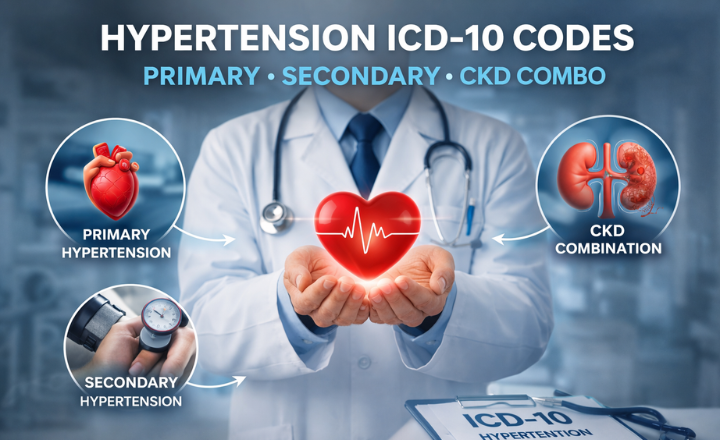
Hypertension ICD-10 Codes — Primary, Secondary, CKD Combo
Hypertension ICD-10 codes help classify different types of high blood pressure conditions in medical records and billing. This blog explains the codes used for primary hypertension, secondary hypertension, and cases associated with chronic kidney disease (CKD), along with commonly used code categories and documentation considerations.

Nephrology & Dialysis Billing Cheat Sheet (Simple Guide for Billers)
This nephrology and dialysis billing cheat sheet covers essential CPT codes, ESRD monthly services, documentation requirements, and billing tips to improve claim accuracy and reduce denials.

Low Back Pain ICD-10 : Complete M54 Coding Guide
Low back pain is a common condition in clinical practice. This guide explains the Low Back Pain ICD-10 classification and key M54 codes such as M54.5, M54.50, M54.51, and M54.59. Learn when providers use these codes and how they support clear documentation of back pain diagnoses.

Hepatocellular Carcinoma HCC in Medical Coding: Complete ICD-10 Guide
Hepatocellular Carcinoma HCC in medical coding involves assigning ICD-10 code C22.0 for primary liver cancer diagnosis. This guide explains ICD-10 codes, documentation, sequencing, billing, and reporting requirements for proper oncology coding and reimbursement.

Understanding Coding “Not Elsewhere Classifiable” (NEC) in ICD-10-CM
Understanding “Not Elsewhere Classifiable (NEC)” in ICD-10-CM is key to accurate medical coding. NEC is used when documentation describes a condition, but no specific code exists. This blog explains when to use NEC and how it supports accurate coding and compliant billing.

Understanding ICD-10 Coding for Opioid Use Disorder, Dependence
Learn how to apply ICD-10 codes for opioid use disorder and dependence with accuracy. This guide helps healthcare providers ensure compliance, optimize billing, and improve patient care outcomes.