
Obesity ICD-10 Codes and BMI Coding Guide

Obesity is one of the most commonly documented conditions in healthcare records, making standardized classification essential for accurate clinical documentation and medical coding. In the ICD-10-CM system, obesity diagnoses fall under the E66 category, while BMI ranges are captured using Z68 BMI codes. Together, these codes help healthcare systems classify the type of obesity and record the patient’s BMI range within medical records.
This guide explains the key Obesity ICD-10 codes, the E66 diagnosis category, BMI Z68 codes, and the documentation requirements used to classify obesity in healthcare records.
Table of Contents
What Are Obesity ICD-10 Codes?
Obesity ICD-10 codes are standardized diagnosis codes used in healthcare documentation and medical coding to classify obesity and related weight conditions. These codes belong to Category E66 – Overweight and Obesity in the ICD-10-CM classification system.
The purpose of these codes is to standardize obesity documentation across healthcare systems so that clinical documentation, electronic health records (EHR), medical billing, and insurance claims follow a consistent format.
Using these codes allows healthcare organizations to:
Record obesity diagnoses in patient documentation and clinical records
Support medical billing and insurance reimbursement processes
Maintain standardized clinical documentation and coding accuracy
Report population health data using recognized disease classifications
Each code in the E66 category identifies a specific type or cause of obesity based on provider documentation, which is essential for accurate medical coding and healthcare data reporting.
ICD-10 Category E66: Obesity Diagnosis Codes
The ICD-10-CM classification groups overweight and obesity conditions under Category E66, which includes multiple diagnosis codes used in healthcare documentation and medical billing.
These ICD-10 diagnosis codes for obesity differentiate obesity based on cause, severity, or other documented factors recorded in the patient's medical record.
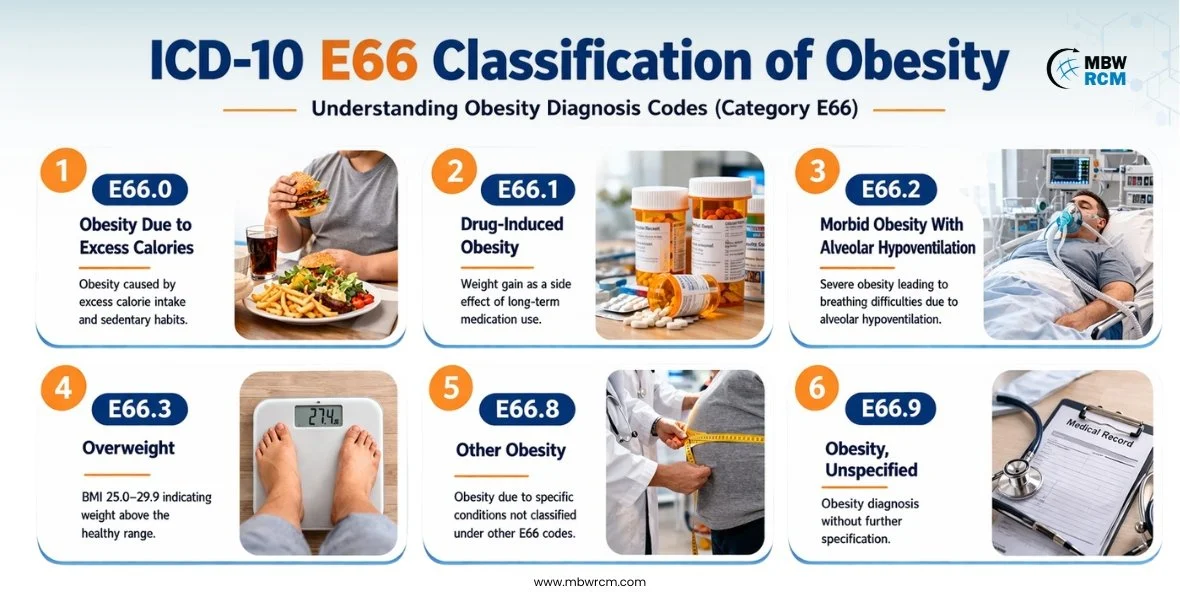
1. E66.0 – Obesity Due to Excess Calories
This code category is used when the healthcare provider documents obesity caused by excess caloric intake.
Subcodes include:
E66.01 – Morbid (severe) obesity due to excess calories
E66.09 – Other obesity due to excess calories
E66.01 is commonly reported when documentation indicates severe obesity or morbid obesity associated with excess calorie intake, which is frequently captured in clinical documentation improvement (CDI) programs and medical coding audits.
2. E66.1 – Drug-Induced Obesity
Code E66.1 is used when obesity is documented as being caused by medication or drug therapy.
When this code is assigned, healthcare records may also include an additional code from the T36–T50 category to identify the medication responsible for the weight gain.
Including these supporting codes ensures accurate medical coding documentation, diagnosis classification, and healthcare reporting.
3. E66.2 – Morbid Obesity With Alveolar Hypoventilation
This code is assigned when the medical documentation specifies morbid obesity associated with alveolar hypoventilation.
In medical coding documentation, this condition is often referenced as obesity hypoventilation syndrome (OHS) and is classified under this specific ICD-10 diagnosis code.
Correct reporting of this code supports accurate disease classification within the ICD-10 coding framework.
4. E66.3 – Overweight
Code E66.3 is used when the provider documents the patient as overweight rather than obese.
Although overweight is not classified as obesity, it is grouped within the same ICD-10 category to track weight-related conditions within clinical documentation systems and healthcare data records.
This code is often used in preventive care documentation and health monitoring records.
5. E66.8 – Other Obesity
Code E66.8 is assigned when obesity is documented but does not fall under the previously defined categories such as excess calorie intake or drug-induced obesity.
This code allows documentation of other specified obesity types recorded by the provider within clinical documentation and coding records. Need help understanding billing considerations related to obesity treatment and bariatric procedures? Check out our detailed guide to learn more about Bariatric Surgery Billing CPT Code Guidelines.
6. E66.9 – Obesity, Unspecified
E66.9 is used when obesity is documented in the patient record but the type or cause of obesity is not specified in the clinical documentation.
While this code is valid within ICD-10 classification, more specific documentation is generally preferred because it improves coding specificity, documentation clarity, and healthcare reporting accuracy.
Understanding BMI Codes in ICD-10 (Z68 Category)
Body Mass Index (BMI) values are also documented using ICD-10 codes. These codes fall under Category Z68 – Body Mass Index (BMI) within the ICD-10-CM system.
BMI codes provide additional documentation indicating the patient’s BMI range recorded in the clinical documentation or electronic health record.
Unlike obesity diagnosis codes, BMI codes are used as supporting or supplementary ICD-10 codes that provide additional information alongside the obesity diagnosis.
ICD-10 BMI Codes and Corresponding BMI Ranges
The Z68 category contains codes that represent specific BMI ranges recorded in patient documentation.
Examples include:
These BMI codes help provide structured BMI documentation within medical coding systems, helping indicate the severity level associated with obesity diagnoses. Want to understand how BMI documentation affects claim outcomes? Read our case study on resolving BMI diagnosis claim denials to see how improved physician education helped reduce billing issues and recover lost revenue.
How Obesity Diagnosis and BMI Codes Are Used Together
In healthcare documentation and medical coding workflows, obesity diagnosis codes and BMI codes are often reported together.
The obesity diagnosis from the E66 category identifies the condition, while the BMI code from the Z68 category indicates the patient's BMI range recorded in the medical record.
Example documentation may include:
E66.01 – Morbid obesity due to excess calories
Z68.41 – BMI 40.0–44.9
This combination allows healthcare systems, medical billing platforms, and electronic health record systems (EHR) to record both the diagnosis classification and BMI measurement associated with the condition.
If you are interested to read more about obesity and BMI Coding, please have a look at this blog on ‘‘Clarifying BMI and Obesity Coding Guidelines in ICD-10’’.
Documentation Requirements for Obesity ICD-10 Codes
Accurate documentation is essential for assigning the correct Obesity ICD-10 codes in healthcare systems.
Healthcare documentation should clearly indicate:
The diagnosis of obesity or overweight
The specific type of obesity if identified
The BMI value recorded in the patient chart when available
Provider documentation is required to confirm the obesity diagnosis before assigning an ICD-10 obesity diagnosis code.
Clear clinical documentation helps maintain coding compliance, documentation accuracy, and reliable healthcare reporting.
Why Proper Obesity Coding is Important in Healthcare Systems
Using the correct Obesity ICD-10 codes ensures consistent classification of obesity across healthcare systems, medical billing platforms, and clinical documentation systems.
Accurate documentation supports:
Reliable clinical documentation and patient records
Standardized ICD-10 disease classification
Accurate medical billing and insurance claim processing
Consistent healthcare analytics and population health reporting
Healthcare organizations also use these codes to analyze obesity prevalence, chronic disease patterns, and healthcare utilization trends.
Best Practices for Recording Obesity and BMI Codes
To maintain accurate documentation and coding consistency, healthcare organizations should follow several best practices.
Use the Most Specific Obesity Code Available
Whenever documentation provides details about the cause or type of obesity, selecting the most specific code from the E66 category improves coding accuracy, billing precision, and healthcare reporting.
Include BMI Codes When BMI Is Documented
BMI codes from the Z68 category provide additional clinical detail and help indicate obesity severity in medical coding documentation and health records.
Ensure Documentation Clearly States the Condition
Medical records should clearly state whether the patient is overweight, obese, or morbidly obese to avoid ambiguity in medical coding and clinical documentation.
For additional insights on improving obesity documentation and coding accuracy, explore our bariatric surgery denial rates and best practices guide, which highlights key RCM benchmarks and strategies to reduce billing errors and claim denials.
Simplify Coding and Claims With Bariatric Surgery Billing Services
Obesity diagnoses, BMI documentation, and bariatric procedure coding require precise coordination between clinical documentation and billing workflows. Coding gaps or incorrect claim submissions can slow reimbursements and increase administrative burden. Our Bariatric Surgery Billing Services support healthcare organizations with specialized coding oversight, streamlined billing processes, and optimized claim management for bariatric procedures and obesity-related care.
Connect With Our Bariatric Billing Experts →Final Thoughts
Understanding Obesity ICD-10 codes and corresponding BMI Z68 codes is important for accurate obesity classification in healthcare records. The E66 category identifies the type of obesity, while BMI codes indicate the patient’s BMI range, helping healthcare systems maintain standardized documentation and consistent disease classification.
Managing obesity-related coding and billing can be complex, especially for bariatric practices. Our Bariatric Surgery Billing Services help streamline coding, billing, and claims processes to improve efficiency and reimbursement outcomes.
Contact us today to learn how our bariatric billing experts can support your practice.
FAQs: Obesity ICD-10 and BMI Codes
Get A Quote
Identify potential documentation gaps and coding risks in obesity and BMI reporting with a free coding assessment. Our team will review your obesity-related ICD-10 coding and BMI documentation practices to highlight areas that may affect claim accuracy and reimbursement.
Fill out the form to connect with our specialists and learn how our bariatric and obesity billing services can help streamline coding, reduce denials, and support stronger revenue performance for your practice.
