Multi-Level Spinal Fusion Billing: Base Codes, Add-On Codes, and NCCI Bundling Explained
Multi-level spinal fusion procedures represent some of the most complex claims submitted by spine surgery practices. Unlike many orthopedic procedures, reimbursement depends on far more than selecting the correct CPT® code. The surgical approach, spinal region treated, number of fusion levels, instrumentation, bone graft selection, decompression procedures, and National Correct Coding Initiative (NCCI) edits all influence how a claim should be reported.
A small coding error can have significant financial consequences. Reporting the wrong base code, overlooking eligible add-on codes, incorrectly billing instrumentation, or failing to recognize NCCI bundling edits may lead to payment delays, denials, underpayments, or compliance concerns.
Table of Contents
As spine surgery continues to evolve with more advanced implant technologies and increasingly complex fusion procedures, accurate documentation and specialty coding have become essential for protecting reimbursement. Understanding how base codes, add-on codes, and bundling rules work together helps practices improve coding accuracy while reducing unnecessary claim risk.
This guide explains the key billing considerations for multi-level spinal fusion procedures and outlines practical strategies to strengthen documentation, improve coding accuracy, and maximize reimbursement.
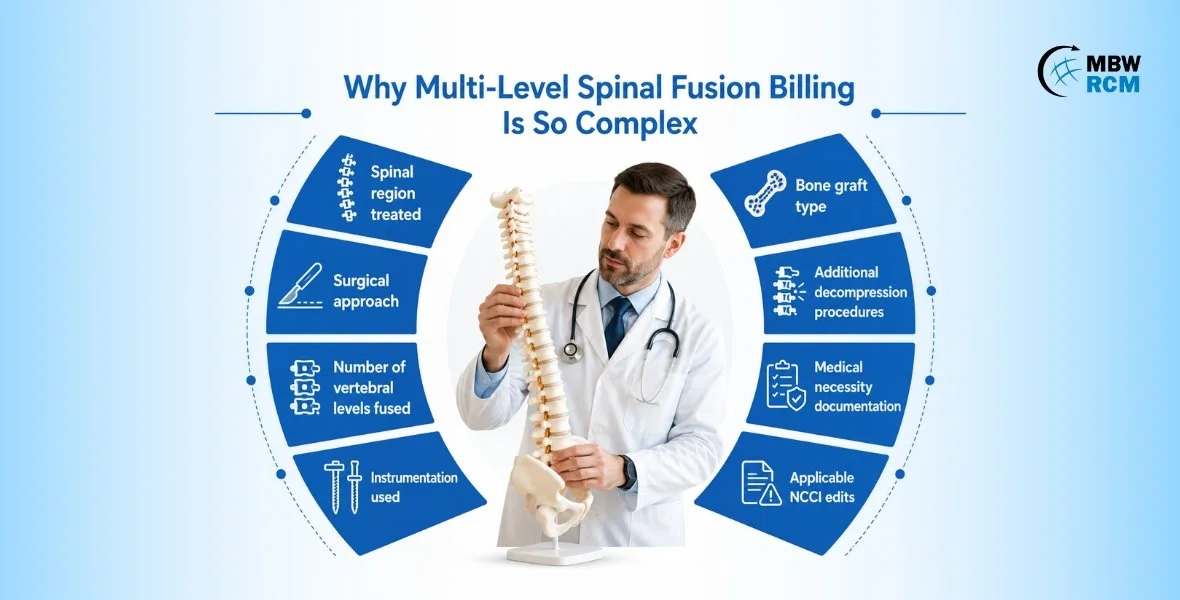
Why Multi-Level Spinal Fusion Billing Is So Complex
Few surgical specialties involve as many coding variables as spine surgery.
Every fusion procedure requires coders to evaluate multiple clinical factors before selecting the appropriate CPT® codes, including:
Spinal region treated
Surgical approach
Number of vertebral levels fused
Instrumentation used
Bone graft type
Additional decompression procedures
Medical necessity documentation
Applicable NCCI edits
Unlike routine procedures where a single CPT® code often describes the entire service, spinal fusion claims frequently combine primary procedure codes with separately reportable add-on services and implant-related reporting.
According to research published in The Spine Journal, spinal fusion utilization has increased significantly over the past two decades, contributing to higher healthcare expenditures and greater payer scrutiny of documentation and coding accuracy. As reimbursement values increase, so does the importance of precise coding and complete clinical documentation.
"Complex spine procedures require coding that reflects exactly what occurred in the operating room. Accurate documentation remains the foundation of compliant reimbursement."
— Spine Surgery Coding Consultant
Understanding the Basics of Multi-Level Spinal Fusion Billing
Before assigning procedure codes, it is important to understand how spinal fusion coding is structured.
Most spinal fusion procedures include:
A base procedure code describing the primary fusion.
Add-on codes that account for additional vertebral levels when applicable.
Separate reporting for eligible instrumentation or bone graft procedures.
Documentation supporting medical necessity for every treated level.
Because coding varies based on the surgical approach and spinal anatomy, reviewing the complete operative report is essential before assigning codes.
Rather than focusing solely on the number of vertebrae involved, coders should carefully identify the actual fusion levels documented by the surgeon. What happens after a spine surgery claim is denied? See how a denial management service helped a surgeon recover $32,000 from a denied claim.
Cervical vs. Lumbar Fusion Billing
Although both procedures involve spinal fusion, cervical and lumbar surgeries present different coding and documentation considerations.
Cervical Fusion Billing
Cervical fusion procedures are commonly performed to treat:
Cervical disc degeneration
Cervical stenosis
Radiculopathy
Cervical instability
Traumatic injury
Many cervical procedures involve an anterior approach, while others require posterior stabilization depending on the patient's condition.
Documentation should clearly identify:
Operative approach
Vertebral levels treated
Implant placement
Instrumentation
Bone graft usage
Medical necessity
Because cervical procedures often involve smaller operative fields and different anatomical considerations, coding should accurately reflect the documented surgical technique.
Lumbar Fusion Billing
Lumbar fusion procedures are frequently performed for:
Degenerative disc disease
Spondylolisthesis
Spinal instability
Severe spinal stenosis
Revision surgery
Common lumbar approaches include:
Posterior Lumbar Interbody Fusion (PLIF)
Transforaminal Lumbar Interbody Fusion (TLIF)
Anterior Lumbar Interbody Fusion (ALIF)
Posterolateral Fusion
Each technique carries unique documentation requirements that influence procedure reporting.
Operative reports should clearly describe:
Surgical approach
Fusion levels
Implant placement
Bone graft materials
Decompression performed
Instrumentation
The more detailed the operative report, the easier it becomes to assign accurate procedure codes and defend reimbursement.
Anterior vs. Posterior Fusion Approaches
The surgical approach influences both procedural documentation and coding.
Anterior Fusion
Anterior procedures access the spine through the front of the body and are commonly used for cervical and selected lumbar fusion procedures.
Documentation should specify:
Surgical exposure
Fusion levels
Interbody device placement
Bone graft material
Instrumentation
Posterior Fusion
Posterior fusion accesses the spine through the back and is frequently performed for lumbar stabilization or multilevel reconstruction.
Documentation should include:
Posterior exposure
Instrumentation placement
Fusion technique
Decompression performed
Bone graft usage
Combined Surgical Approaches
Some complex spine procedures involve both anterior and posterior approaches during the same operative session.
When this occurs, documentation should clearly distinguish:
Which procedures were performed anteriorly.
Which procedures were performed posteriorly.
Levels treated by each approach.
Instrumentation associated with each procedure.
Accurate documentation helps coders correctly assign the appropriate procedural reporting while minimizing reimbursement challenges.
Understanding Base Codes and Add-On Codes
One of the most misunderstood aspects of spinal fusion billing involves distinguishing between base procedure codes and add-on codes.
The base procedure code represents the primary spinal fusion performed during the operation.
Add-on codes may be reported, when supported by documentation and payer policy, to account for additional fusion levels beyond the primary level.
Because add-on codes cannot stand alone, they must always be reported in conjunction with an appropriate primary procedure.
Common documentation required includes:
Number of fusion levels
Operative approach
Vertebral segments involved
Implant placement
Medical necessity for each additional level
Failure to correctly identify eligible add-on services may result in incomplete reimbursement, while inappropriate reporting may trigger payer edits or audits. If you're interested in learning more about spine implant billing, take a look at this blog on Prevent Spine Implant Revenue Leakage.
Why the Number of Fusion Levels Matters
Coding complexity increases as additional spinal levels are fused.
Each additional level typically requires:
Separate physician documentation
Clear operative reporting
Medical necessity
Appropriate procedural reporting
For example, documentation should distinguish between:
Single-level fusion
Two-level fusion
Three-level fusion
Four or more fusion levels
Simply documenting that a "multilevel fusion" was performed is not sufficient. The operative report should identify each vertebral level addressed during surgery, the technique used, and the clinical rationale for extending the fusion.
According to the North American Spine Society (NASS), comprehensive operative documentation is critical for communicating the complexity of spine procedures and supporting appropriate reimbursement. Similarly, CMS's National Correct Coding Initiative (NCCI) Policy Manual emphasizes accurate reporting and proper application of coding edits when multiple spinal procedures are performed during the same operative session.
Instrumentation Reporting: When Hardware Affects Reimbursement
Instrumentation is an essential component of many spinal fusion procedures. Pedicle screws, rods, plates, hooks, interbody cages, and fixation systems are used to stabilize the spine while the fusion matures. Although instrumentation significantly increases procedural complexity, it should only be reported when supported by complete operative documentation and payer guidelines.
The operative report should clearly identify:
Type of instrumentation used
Anatomical location
Vertebral levels instrumented
Method of fixation
Clinical reason for instrumentation
Relationship between the instrumentation and the fusion procedure
Documentation should also distinguish between temporary devices, permanent implants, and interbody devices when applicable. Missing or vague documentation may prevent coders from accurately reporting the services performed. Want to learn how AI is changing spine surgery prior authorization? Read CMS WISeR: AI in Spine Surgery Prior Authorization.
"Instrumentation tells only part of the surgical story. The operative report must clearly explain why it was used, where it was placed, and how it supported the fusion to ensure accurate reimbursement."
— Revenue Integrity Specialist
Bone Graft Reporting: Accurate Documentation Matters
Bone grafts play a critical role in achieving successful spinal fusion by promoting bone growth between vertebral segments. Depending on the procedure, surgeons may use different graft materials, each with unique documentation requirements.
Common graft types include:
Autograft
Bone harvested from the patient's own body.
Allograft
Bone obtained from a donor source.
Local Bone Graft
Bone collected during the decompression or fusion procedure.
Biologic Bone Graft Substitutes
Synthetic or biologic materials used to support fusion.
The operative report should clearly document:
Type of graft used
Harvest site, when applicable
Quantity or extent of graft placement
Levels receiving the graft
Clinical indication
Clear documentation helps coders accurately determine whether additional reporting is appropriate based on payer policies and CPT® guidelines.
Decompression Bundling: Understanding NCCI Rules
One of the most challenging areas of multi-level spinal fusion billing involves determining when decompression procedures are separately reportable and when they are considered part of the fusion.
During spinal fusion surgery, surgeons may perform procedures such as:
Laminectomy
Laminotomy
Facetectomy
Foraminotomy
Neural decompression
In many situations, these procedures are considered integral to the spinal fusion and are therefore bundled under the CMS National Correct Coding Initiative (NCCI) edits. However, there are circumstances where decompression performed for a separate clinical indication or at a different anatomical level may be eligible for separate reporting when fully supported by operative documentation and payer policy.
Because NCCI edits are updated regularly, billing teams should review the CMS National Correct Coding Initiative (NCCI) Policy Manual to understand current bundling guidance and documentation expectations before submitting complex spine surgery claims. Want to improve coding accuracy for spine surgery procedures? Explore Procedure Coding Made Simple.
Common NCCI Conflicts in Multi-Level Fusion Billing
NCCI edits are designed to prevent inappropriate unbundling of services that are typically performed together. While these edits support billing consistency, they can also create confusion when multiple spine procedures are completed during the same operative session.
Common areas of conflict include:
Decompression procedures reported with spinal fusion
Instrumentation associated with the primary procedure
Bone graft reporting
Multiple fusion approaches
Additional spinal procedures performed during the same surgery
Incorrect modifier usage
Rather than attempting to bypass edits, coders should verify whether documentation supports separate reporting under applicable payer policies.
Accurate documentation remains the strongest defense when claims undergo medical review.
Common Billing Mistakes That Delay Payment
Even experienced billing teams encounter preventable errors that affect reimbursement.
Frequent mistakes include:
Selecting the Wrong Base Procedure Code
Choosing a primary procedure code that does not match the documented surgical approach or spinal region.
Missing Eligible Add-On Codes
Failing to report additional fusion levels supported by the operative report.
Incorrect Fusion Level Documentation
Operative reports that do not clearly identify each vertebral level treated.
Incomplete Instrumentation Documentation
Missing implant details that affect procedural reporting.
Bone Graft Documentation Gaps
Failure to specify graft type or harvest method.
Ignoring NCCI Bundling Rules
Reporting bundled procedures separately without documentation supporting distinct services.
Modifier Misuse
Applying modifiers without adequate clinical documentation or payer support.
These errors often result in claim denials, payment delays, or requests for additional documentation.
Documentation Checklist for Multi-Level Spinal Fusion Claims
Before submitting a claim, confirm that the medical record includes:
✔ Documentation RequirementComplete operative reportSurgical approach clearly documentedCervical or lumbar region identifiedEvery fusion level documentedInstrumentation describedBone graft type documentedMedical necessity establishedDecompression procedures identifiedImaging findings support diagnosisAppropriate diagnosis codingCPT® and add-on code validation completedNCCI edit review completed
Using a standardized documentation checklist helps improve coding consistency while reducing preventable reimbursement delays.
Best Practices for Accurate Multi-Level Spinal Fusion Billing
Protecting reimbursement begins long before the claim is submitted.
Healthcare organizations can improve billing accuracy by implementing structured revenue cycle workflows that include:
Standardized Operative Documentation
Develop templates that capture surgical approach, treated levels, instrumentation, graft usage, and decompression details.
Specialty Coding Reviews
Assign complex spinal fusion claims to coders experienced in spine surgery reimbursement.
Internal Documentation Audits
Regularly review operative reports for documentation completeness before billing.
NCCI Validation
Review applicable NCCI edits before claim submission to identify potential bundling issues.
Ongoing Physician Education
Provide surgeons with feedback regarding documentation elements that commonly affect reimbursement.
Denial Trend Monitoring
Analyze denied claims to identify recurring coding or documentation opportunities for improvement.
Practices that proactively review high-value fusion claims before submission are better positioned to reduce denials and improve reimbursement performance.
Conclusion
Multi-level spinal fusion billing requires close coordination between surgeons, coders, and revenue cycle professionals. Every element of the operative report—from the surgical approach and fusion levels to instrumentation, bone graft usage, and decompression procedures—affects reimbursement, making Spine Surgery Billing Services valuable for these complex claims.
Understanding the relationship between base procedure codes, eligible add-on codes, and NCCI bundling rules helps reduce coding errors, strengthen compliance, and improve claim accuracy. As payer scrutiny increases, complete documentation and specialty coding expertise remain essential for protecting reimbursement and minimizing avoidable denials.
FAQs: Multi-Level Spinal Fusion Billing
Improve Reimbursement for Complex Spinal Fusion Claims
Complex spinal fusion procedures deserve billing expertise that matches their clinical complexity. Our spine surgery billing specialists help practices improve coding accuracy, strengthen documentation, navigate NCCI edits, and maximize reimbursement for high-value fusion procedures.
👉 Request a Complimentary Spine Surgery Billing Assessment and discover how specialty billing support can help protect your reimbursement from documentation to final payment.