Spine Implant Revenue Leakage: From the OR Log to Final Reimbursement

Every spine implant used in the operating room represents a significant clinical investment—and a significant reimbursement opportunity. Yet for many spine surgery practices and hospitals, revenue begins to leak long before a claim reaches the payer. Missing device charges, incomplete operative documentation, unreconciled vendor invoices, contract misinterpretations, and underpaid implant claims can quietly erode profitability without attracting immediate attention.
Unlike routine surgical supplies, spine implants often carry substantial acquisition costs and unique reimbursement requirements. A single overlooked implant charge or contract variance can translate into thousands of dollars in lost revenue for one case. Across hundreds of procedures annually, those seemingly isolated issues can have a measurable financial impact on the organization's revenue cycle.
Table of Contents
Why Spine Implant Revenue Leakage Matters
Spine procedures frequently involve sophisticated implant systems that contribute significantly to the total cost of care. Pedicle screw systems, interbody cages, rods, plates, biologics, and bone graft substitutes represent substantial investments for providers, making accurate reimbursement essential to maintaining financial performance.
According to the Healthcare Financial Management Association (HFMA), healthcare organizations lose an estimated 1%–5% of their annual net patient revenue because of preventable revenue leakage related to charge capture failures, documentation issues, billing errors, and payment variance.
While revenue leakage occurs across many service lines, implant-intensive specialties such as spine surgery are particularly vulnerable because of the high value associated with each procedure.
"Revenue leakage is rarely caused by one major failure. More often, it results from multiple small process gaps that compound throughout the revenue cycle."
— Healthcare Revenue Integrity Consultant
Understanding the Revenue Journey of a Spine Implant
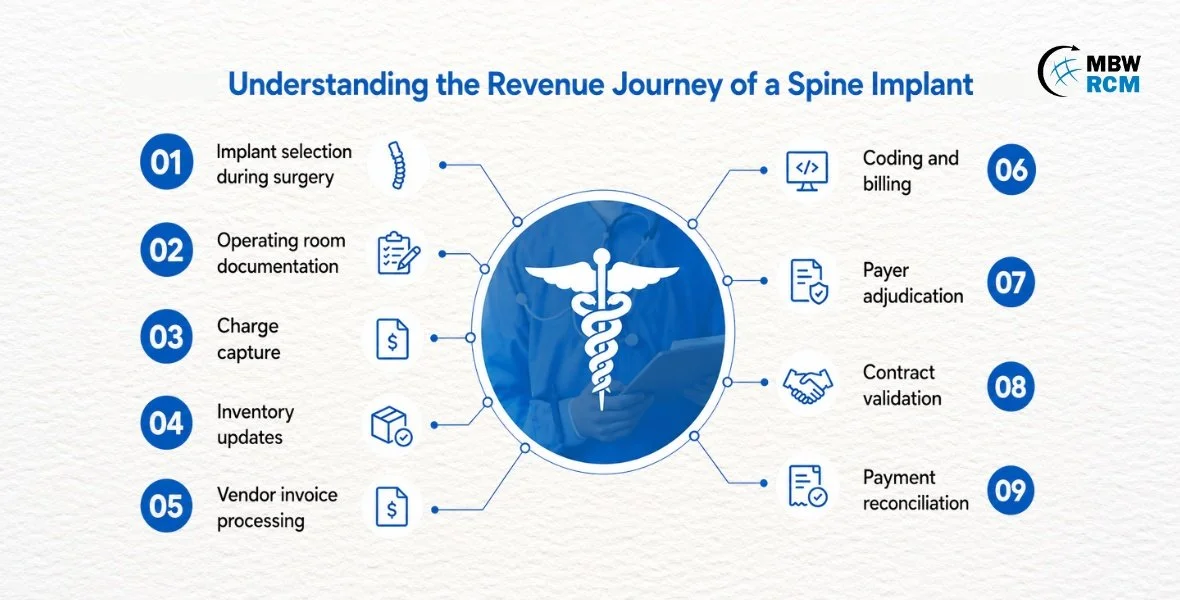
From the moment an implant is opened in the operating room until the final payer reimbursement is received, multiple departments contribute information that ultimately determines whether the organization receives appropriate payment.
That journey typically includes:
Implant selection during surgery
Operating room documentation
Charge capture
Inventory updates
Vendor invoice processing
Coding and billing
Payer adjudication
Contract validation
Payment reconciliation
A breakdown at any point in this process can create revenue leakage that may go unnoticed unless proactive monitoring is in place.
Where Revenue Leakage Begins: The Operating Room
The operating room is often where reimbursement opportunities are either protected or unintentionally lost.
During complex spine procedures, numerous implant components may be used, including screws, rods, cages, plates, connectors, biologics, and disposable instrumentation. If every implanted device is not accurately documented, subsequent billing may fail to capture the full value of the procedure.
Common Operating Room Documentation Challenges
Missing implant serial numbers
Incorrect device descriptions
Incomplete implant logs
Failure to document additional implant components
Manual documentation errors
Delayed operative note completion
Even when billing teams perform accurate coding, incomplete clinical documentation limits their ability to report all reimbursable services.
Strong collaboration between surgeons, circulating nurses, surgical technologists, and revenue cycle teams helps reduce documentation gaps before claims are submitted.
Missing Device Charges: One of the Most Common Sources of Revenue Leakage
One of the largest contributors to implant-related revenue loss is incomplete charge capture.
During a busy surgical schedule, every implant component may not be recorded accurately or transferred into the billing system. While the primary implant may be billed correctly, secondary components, biologics, or disposable devices can sometimes be omitted.
Commonly Missed Implant Charges
Bone graft substitutes
Biologic implants
Implant connectors
Locking caps
Spacer devices
Additional fixation hardware
Disposable implant-specific instrumentation
Missing even one high-cost device charge can substantially reduce reimbursement for the procedure.
Organizations that implement automated charge capture workflows and standardized implant documentation protocols are generally better positioned to reduce preventable revenue loss.
Industry Insight: Implant Costs Continue to Rise
The financial impact of implant reimbursement continues to grow as medical technology advances.
Industry analyses have shown that implant costs can account for 30%–60% of the direct cost of many orthopedic and spine procedures, making accurate reimbursement increasingly important for maintaining financial sustainability.
At the same time, payer reimbursement models continue to evolve, placing greater emphasis on documentation accuracy, medical necessity, contract compliance, and revenue integrity.
These trends make implant charge capture a strategic financial priority—not simply a billing task.
Invoice Reconciliation: Matching Clinical Care with Financial Records
Successful reimbursement depends on more than documenting implant usage. Organizations must also ensure that vendor invoices, purchasing records, inventory systems, and billed charges align accurately.
Effective Invoice Reconciliation Includes
Matching vendor invoices with the operating room implant log
Verifying inventory records against actual implant usage
Confirming chargemaster accuracy
Reconciling billed charges with vendor documentation
Identifying discrepancies before claims are submitted
Without reconciliation, discrepancies between purchasing records and billing data may remain undetected until after reimbursement—or may never be identified at all.
Many healthcare organizations now incorporate routine reconciliation processes into their revenue integrity programs to reduce preventable revenue leakage.
"Every implant should leave a complete financial trail—from the operating room log and vendor invoice to the final explanation of benefits. When one link in that chain breaks, reimbursement is placed at risk."
— Senior Healthcare Revenue Cycle Advisor
Understanding Payer Carve-Outs for High-Cost Spine Implants
Not every payer reimburses spine implants in the same way. Some commercial contracts include implant carve-outs, allowing reimbursement for eligible high-cost devices outside the standard procedural payment, while others bundle implant costs into the overall surgical reimbursement.
Before Billing Implant Claims, Verify
Whether implant carve-outs apply
Which implant categories qualify
Required supporting documentation
Invoice submission requirements
Contract reimbursement limits
Timely filing deadlines
Organizations that fail to recognize carve-out opportunities may inadvertently accept lower reimbursement than their payer contracts allow.
Healthcare organizations should also review applicable CMS reimbursement guidance and HFMA revenue integrity recommendations to strengthen implant billing accuracy and reduce reimbursement leakage.
If you're interested in learning more about spine surgery billing, take a look at this article on CMS WISeR and Spine Surgery: The Impact of AI-Assisted Prior Authorization.
Cost-Based Reimbursement: Why Every Dollar Must Be Supported
For certain payer contracts and reimbursement arrangements, payment for high-cost spine implants may depend on documented acquisition costs rather than the procedure alone. In these cases, accurate financial documentation becomes just as important as clinical documentation.
Incomplete records, missing invoices, or discrepancies between implant costs and billed charges can delay reimbursement or reduce the amount paid. Supporting documentation should clearly establish the relationship between the implanted device, the patient's procedure, and the associated costs.
Best Practices for Cost-Based Reimbursement
Retain vendor invoices for high-cost implants.
Maintain accurate implant inventory records.
Match implant costs with operative documentation.
Verify chargemaster pricing regularly.
Submit required documentation with the claim when requested.
Monitor payer-specific reimbursement policies.
Organizations that build strong documentation and reconciliation workflows are better positioned to support cost-based reimbursement and minimize avoidable payment delays.
Contract Variance: Are You Receiving the Reimbursement You Negotiated?
Even when claims are billed correctly, reimbursement may not always match the terms of the payer contract. Contract variance occurs when the amount paid differs from the expected reimbursement based on negotiated rates, implant carve-outs, or contractual provisions.
Without regular payment analysis, underpayments can go unnoticed—especially for high-cost spine implant claims where reimbursement calculations may be more complex.
Common Causes of Contract Variance
Incorrect payer reimbursement calculations
Missed implant carve-outs
Outdated fee schedules
Contract interpretation errors
Missing implant invoices
Incorrect payment methodologies
Routine contract variance analysis helps organizations identify underpayments early, recover lost revenue, and strengthen payer accountability.
The Healthcare Financial Management Association (HFMA) also recommends regular payment variance analysis and denial monitoring as essential revenue integrity practices that help healthcare organizations identify reimbursement trends, strengthen financial performance, and reduce preventable revenue leakage.
High-Cost Implant Appeals: Recovering Lost Revenue
Not every underpaid or denied implant claim should be written off. Many reimbursement opportunities can be recovered through a timely and well-supported appeal.
Successful appeals depend on presenting a complete package of clinical and financial documentation that demonstrates why reimbursement should be reconsidered.
A Strong Implant Appeal Should Include
Detailed operative report
Implant log
Vendor invoice
Medical necessity documentation
Supporting imaging, when appropriate
Applicable payer contract language
Clinical rationale for implant selection
Rather than submitting generic appeal letters, practices should tailor each appeal to the payer's denial reason while providing clear evidence supporting reimbursement.
"A successful appeal is built on evidence—not assumptions. The stronger the documentation, the stronger the opportunity to recover reimbursement."
— Healthcare Appeals and Compliance Specialist
Best Practices to Prevent Spine Implant Revenue Leakage
Revenue leakage is rarely caused by one isolated issue. More often, it results from small process gaps across multiple departments. Establishing standardized workflows can help protect reimbursement from the operating room through final payment.
Strengthen Operating Room Documentation
Ensure every implant used during surgery is accurately documented with the appropriate device description, quantity, and supporting operative notes.
Improve Charge Capture Accuracy
Implement processes that verify all implant components, biologics, and disposable devices are captured before claims are submitted.
Perform Routine Invoice Reconciliation
Regularly compare vendor invoices with implant logs, inventory records, and billed charges to identify discrepancies early.
Monitor Payer Contracts
Review implant carve-outs, reimbursement methodologies, and contract updates to ensure claims align with negotiated payment terms.
Audit High-Value Claims
Conduct periodic reviews of high-cost spine implant claims to identify documentation gaps, coding issues, or payment variances before they become recurring problems.
Track Underpayments and Appeals
Monitor denial patterns, underpayments, and appeal outcomes to improve future reimbursement performance and strengthen revenue integrity.
Spine Implant Revenue Protection Checklist
Before submitting implant-related claims, verify that each case includes:
✔ Checklist ItemComplete operative reportAccurate implant logVendor invoice on fileCorrect implant charge captureUpdated chargemaster pricingMedical necessity documentationAppropriate CPT®, HCPCS, and ICD-10-CM codingPayer-specific billing requirements verifiedImplant carve-out eligibility reviewedContract reimbursement validated before payment posting
Using a standardized checklist helps reduce preventable revenue leakage and promotes consistent reimbursement across high-value spine procedures.
Why Specialty Spine Surgery Billing Matters
Managing implant reimbursement requires more than coding expertise. It requires a coordinated revenue cycle strategy that connects clinical documentation, charge capture, inventory management, payer contracts, reimbursement analysis, and appeals.
A specialty spine surgery billing partner can help practices:
Strengthen implant documentation workflows.
Improve charge capture accuracy.
Validate payer reimbursement.
Identify contract variances.
Support high-cost implant appeals.
Reduce revenue leakage.
Improve overall financial performance.
By proactively addressing these areas, practices can protect reimbursement while allowing surgeons and clinical teams to remain focused on delivering exceptional patient care.
Conclusion
High-cost spine implants represent both a significant clinical investment and a major reimbursement opportunity. Yet revenue can be lost at multiple points in the revenue cycle—from incomplete operating room documentation and missing device charges to contract variances and underpaid claims.
Protecting implant reimbursement requires more than accurate coding. It demands collaboration across clinical, operational, and financial teams to ensure every implant is documented, billed, reconciled, and reimbursed according to payer requirements and contractual agreements.
As reimbursement models continue to evolve and financial pressures increase, healthcare organizations that prioritize revenue integrity, documentation accuracy, and proactive payment analysis will be better positioned to reduce revenue leakage and maximize the value of every spine procedure.
"The most successful revenue cycle strategies don't simply recover lost revenue—they prevent it from leaking in the first place."
— Senior Revenue Integrity Advisor
As Medicare reimbursement policies continue to evolve, providers should regularly review educational resources from the CMS Medicare Learning Network (MLN) to stay informed about payment methodologies, billing guidance, and documentation expectations that affect high-cost spine procedures.
FAQs: Spine Implant Revenue Leakage & Reimbursement
Protect Every Spine Implant Reimbursement Opportunity
Every implant used in the operating room represents earned revenue that should be accurately captured and reimbursed. Our spine surgery billing specialists help practices strengthen charge capture, reconcile implant costs, optimize payer reimbursement, manage appeals, and reduce revenue leakage across the entire revenue cycle.
👉 Request a Complimentary Spine Implant Revenue Assessment and discover opportunities to strengthen your implant billing process, recover missed reimbursement, and protect your bottom line.