CMS WISeR and Spine Surgery: How AI-Assisted Prior Authorization Changes Claim Risk

For spine surgery practices, prior authorization has long been one of the most unpredictable stages of the revenue cycle. A clinically appropriate procedure can still face delays, requests for additional documentation, or even claim denial if the supporting records fail to meet payer expectations. As Medicare introduces the Wasteful and Inappropriate Service Reduction (WISeR) Model, providers now face a new layer of scrutiny driven by artificial intelligence (AI) and advanced clinical review processes.
Table of Contents
Unlike traditional authorization programs, the WISeR Model uses AI to evaluate whether selected services meet Medicare coverage criteria before payment is issued. While this initiative aims to reduce unnecessary healthcare spending, it also raises the stakes for spine surgery practices. Incomplete documentation, missing evidence of conservative treatment, or insufficient imaging records may trigger prepayment reviews, reimbursement delays, or additional administrative work—even when the care provided is medically necessary.
Understanding how the WISeR Model affects spine surgery billing is essential for protecting revenue, maintaining compliance, and reducing avoidable claim risk.
What Is the CMS WISeR Model?
The Wasteful and Inappropriate Service Reduction (WISeR) Model is an initiative developed by the Centers for Medicare & Medicaid Services (CMS) through the Center for Medicare and Medicaid Innovation (CMMI). The model combines artificial intelligence with clinician oversight to identify Medicare services that may require additional review before payment.
Rather than replacing clinicians, AI helps analyze submitted documentation against Medicare coverage policies and established clinical guidelines. Cases identified as potentially lacking sufficient evidence are escalated for review by licensed medical professionals before a payment determination is made.
According to CMS, the goal is to reduce unnecessary utilization while improving the efficiency and consistency of the prior authorization process without compromising patient access to medically necessary care.
"Artificial intelligence should support clinical decision-making—not replace physician judgment. Complete documentation remains the strongest defense against unnecessary payment delays."
— Healthcare Revenue Cycle Compliance Perspective
Why Spine Surgery Practices Should Pay Attention
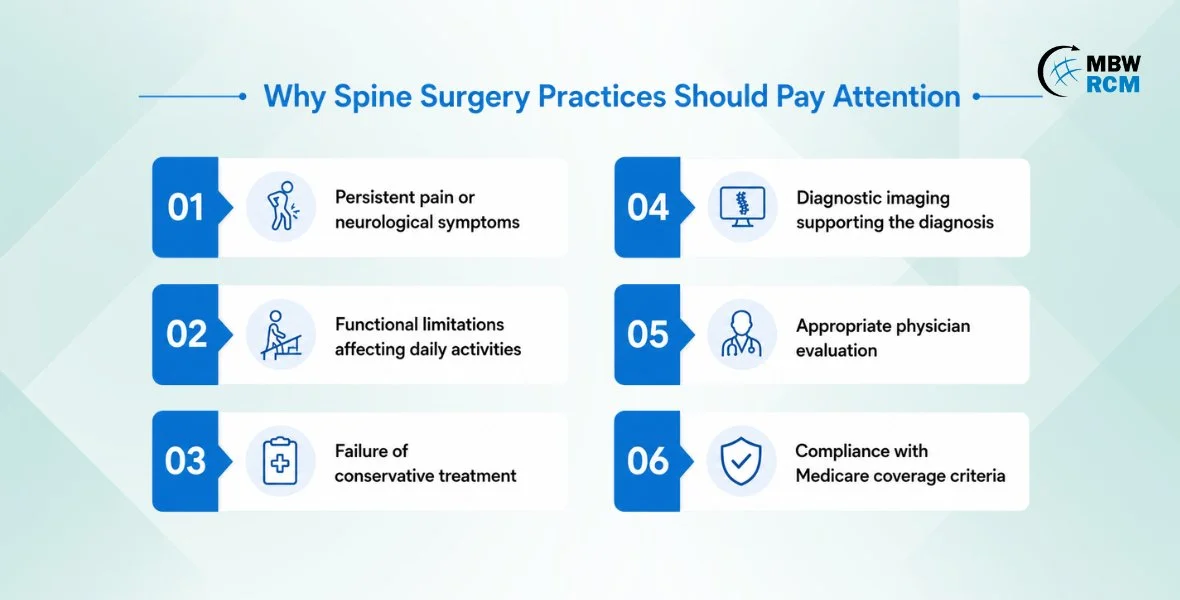
Spine surgery procedures often involve high reimbursement values, complex clinical decision-making, and strict medical necessity requirements. These characteristics make them more likely to receive detailed documentation reviews under Medicare payment integrity initiatives.
Many spine procedures require evidence demonstrating:
Persistent pain or neurological symptoms
Functional limitations affecting daily activities
Failure of conservative treatment
Diagnostic imaging supporting the diagnosis
Appropriate physician evaluation
Compliance with Medicare coverage criteria
Even minor documentation inconsistencies can increase administrative burden and delay reimbursement.
As healthcare organizations continue investing in AI-powered utilization review, practices that strengthen documentation quality today will be better positioned to navigate evolving payer requirements.
How AI-Assisted Prior Authorization Works
Traditional prior authorization relies heavily on manual document review. Under the WISeR approach, AI helps streamline the process by identifying documentation that appears complete and highlighting cases that may require further evaluation.
Although specific review workflows vary, AI may assess whether submitted records include information commonly expected under Medicare coverage policies, such as:
Clinical diagnosis
Symptoms and severity
Duration of condition
Conservative treatment history
Imaging findings
Physician documentation
Procedure indication
If documentation appears incomplete or inconsistent with applicable coverage requirements, the case may proceed to additional clinical review before payment.
Importantly, AI is designed to assist—not independently determine—coverage decisions.
Spine Procedures That May Receive Increased Documentation Scrutiny
Certain spine-related procedures already require extensive supporting documentation because of their complexity and reimbursement value. These services are more likely to benefit from strong documentation practices under evolving Medicare review initiatives.
| Spine Procedure | Primary Documentation Focus |
|---|---|
| Cervical Fusion | Neurological deficits, MRI findings, failed conservative treatment, and documented medical necessity. |
| Lumbar Fusion | Functional impairment, spinal instability, imaging correlation, and physician clinical assessment. |
| Epidural Steroid Injection | Pain duration, conservative therapy history, imaging evidence, and treatment response. |
| Spinal Decompression | Objective neurological findings, imaging support, and documented medical necessity. |
| Revision Spine Surgery | Previous surgical history, clinical rationale, complications, and supporting diagnostic evidence. |
Practices should verify payer-specific requirements and applicable Medicare coverage policies before submitting claims.
Documentation Is Becoming More Important Than Ever
Many reimbursement challenges originate long before coding begins. The physician's documentation ultimately determines whether the submitted CPT and ICD-10-CM codes accurately represent the patient's condition and the medical necessity of the procedure.
Documentation should clearly establish:
Why surgery is medically necessary
Why conservative treatment was unsuccessful
How imaging supports the diagnosis
Patient symptoms and progression
Functional limitations
Clinical decision-making process
Incomplete operative notes, vague clinical narratives, or missing supporting documentation can all contribute to additional payer scrutiny.
Industry Statistics Every Spine Practice Should Know
Several healthcare industry studies highlight why documentation quality has become a major revenue cycle priority:
Administrative costs account for approximately 15–30% of U.S. healthcare spending, with prior authorization contributing significantly to physician administrative workload.
The American Medical Association (AMA) reports that physicians complete dozens of prior authorizations each week, consuming valuable clinical staff time and delaying patient care.
Industry benchmarking consistently identifies documentation deficiencies as one of the leading contributors to claim denials and medical necessity reviews across high-value specialty services.
Medicare continues expanding initiatives focused on payment integrity, emphasizing accurate documentation and evidence-based care.
These trends reinforce the importance of building documentation processes that support both clinical quality and reimbursement success.
Medical Necessity Begins Before the Procedure
One of the most common misconceptions is that operative documentation alone determines payment.
In reality, Medicare reviewers often evaluate the entire patient journey, including:
Initial consultation
History and physical examination
Conservative treatment records
Therapy documentation
Imaging reports
Specialist consultations
Surgical decision-making
Operative report
Post-operative documentation
Every encounter contributes to demonstrating that surgery was clinically appropriate.
"The strongest spine surgery claims tell a complete clinical story—from conservative care through surgical intervention. Documentation continuity is often just as important as coding accuracy."
— Medical Coding and Revenue Integrity Expert
Evidence Requirements: Building a Defensible Clinical Record
For many spine surgery procedures, documentation must do more than describe the condition—it must demonstrate why surgery is the appropriate next step. Medicare reviewers often look for a logical progression of care supported by objective clinical evidence.
A strong clinical record typically includes:
A clearly documented diagnosis with corresponding ICD-10-CM codes.
Detailed history of symptoms, including severity, duration, and impact on daily function.
Physical examination findings that correlate with the patient's complaints.
Diagnostic imaging (such as MRI or CT scans) supporting the clinical diagnosis.
Documentation of conservative treatments attempted before surgery.
Physician rationale explaining why surgical intervention is medically necessary.
Rather than treating each document as a separate requirement, practices should ensure the medical record tells a complete and consistent clinical story from the patient's first visit through surgical planning.
Failed Conservative Care: One of the Most Critical Documentation Elements
For many spine surgery procedures, Medicare and commercial payers expect surgery to be considered only after appropriate non-surgical treatment has been attempted—unless an emergency or another exception applies. Simply stating that conservative care "failed" is rarely enough. The medical record should explain what treatments were provided, how long they were attempted, and why they did not adequately relieve the patient's condition.
A comprehensive record may include:
Physical therapy duration and patient response
Medication management history
Epidural or facet injections, when clinically appropriate
Activity modification and home exercise programs
Chiropractic care, if applicable
Pain management interventions
Follow-up evaluations documenting persistent symptoms
Clearly documenting the patient's response to each treatment helps establish why surgery became the most appropriate clinical option. If you're interested in learning more about spine implant billing, take a look at this article on Spine Implant Revenue Leakage: OR to Payment.
Imaging Documentation: Supporting Medical Necessity
Diagnostic imaging plays a central role in validating the need for spine surgery. However, imaging findings alone do not establish medical necessity. The imaging should correlate with the patient's symptoms, physical examination findings, and documented diagnosis.
A strong record typically demonstrates:
MRI, CT, or X-ray findings consistent with the diagnosis
Physician interpretation of imaging results
Correlation between imaging and neurological deficits
Evidence of progression, instability, or structural abnormalities
Documentation supporting the selected surgical approach
When imaging findings, clinical symptoms, and physician documentation align, practices are better positioned to support reimbursement during medical necessity reviews.
Prior Authorization Does Not Guarantee Payment
One of the most common misconceptions in healthcare reimbursement is that receiving prior authorization guarantees claim payment. In reality, prior authorization confirms only that the payer has approved the service based on the information available at that time.
The final payment decision may still depend on:
Complete and accurate claim submission
Correct CPT® and ICD-10-CM coding
Medical necessity supported by documentation
Compliance with Medicare or payer coverage policies
Eligibility and benefit verification
Modifier accuracy
Operative documentation
Medical record review during post-payment or prepayment audits
For spine surgery practices, authorization should be viewed as one step in the reimbursement process—not the final approval.
Understanding Prepayment Review Risk
Under payment integrity initiatives such as the CMS WISeR Model, certain claims may be selected for prepayment review before reimbursement is issued.
During a prepayment review, Medicare or its review contractor may request documentation to verify that the billed service meets applicable coverage requirements. Payment is generally withheld until the review is complete.
Common factors that may increase review risk include:
Missing documentation supporting medical necessity
Inconsistent clinical records
Insufficient evidence of failed conservative treatment
Incomplete imaging documentation
Coding that does not align with physician documentation
High-value or high-utilization procedures
Missing operative details
Although a review does not necessarily indicate inappropriate billing, responding promptly with complete documentation is essential to minimize payment delays. Looking to improve coding accuracy for spine procedures? Read this guide to strengthen your billing and reimbursement process.
"Revenue protection begins long before a claim is submitted. Consistent documentation, coding accuracy, and proactive compliance remain the strongest safeguards against payment delays."
— Healthcare Revenue Integrity Consultant
Best Practices for Reducing WISeR-Related Claim Risk
As Medicare expands technology-driven review initiatives, spine surgery practices should focus on strengthening documentation workflows rather than reacting after denials occur.
Consider these best practices:
Standardize Documentation Templates
Use specialty-specific templates that capture all required clinical information without encouraging generic documentation.
Strengthen Physician Education
Keep surgeons informed about evolving Medicare coverage requirements, documentation expectations, and payer-specific updates.
Perform Internal Documentation Audits
Review records regularly to identify missing elements before claims are submitted.
Verify Coding Accuracy
Ensure CPT®, ICD-10-CM, HCPCS, and modifiers accurately reflect the documented services.
Monitor Denial Trends
Analyze denials and documentation requests to identify recurring issues and opportunities for process improvement.
Collaborate Across Departments
Successful reimbursement depends on coordination between physicians, coders, billers, authorization teams, and compliance professionals.
| Documentation Requirement | Status |
|---|---|
| Complete Patient History | ✔ |
| Detailed Physical Examination | ✔ |
| Clearly Documented Diagnosis | ✔ |
| Functional Limitations | ✔ |
| Conservative Treatment History | ✔ |
| Response to Non-Surgical Care | ✔ |
| MRI / CT Imaging Findings | ✔ |
| Physician Interpretation of Imaging | ✔ |
| Medical Necessity Statement | ✔ |
| Complete Operative Report | ✔ |
| Accurate CPT®, ICD-10-CM & HCPCS Coding | ✔ |
| Appropriate Modifier Usage | ✔ |
How Specialty Spine Surgery Billing Services Can Help
Managing spine surgery reimbursement requires more than claim submission. It demands a detailed understanding of evolving Medicare policies, payer-specific documentation requirements, coding accuracy, and compliance expectations.
Specialty billing partners can help practices by:
Reviewing documentation before claim submission
Identifying coding opportunities and risks
Monitoring payer policy changes
Reducing preventable denials
Supporting prior authorization workflows
Improving clean claim rates
Strengthening revenue cycle performance through ongoing compliance monitoring
By aligning clinical documentation with billing best practices, practices can better navigate changing reimbursement requirements while allowing physicians to remain focused on patient care.
Conclusion
As Medicare introduces AI-assisted initiatives like the CMS WISeR Model, documentation quality is becoming even more important for spine surgery reimbursement. While artificial intelligence may help streamline reviews, it also places greater emphasis on complete, consistent, and medically supported clinical records.
Practices that strengthen documentation, coding accuracy, and partner with experienced Spine Surgery Billing Services providers will be better prepared for evolving payer expectations.
Protecting reimbursement isn't just about prior authorization—it's about ensuring every claim is supported by a complete clinical record that demonstrates medical necessity from the initial consultation through postoperative care.
FAQs: CMS WISeR and Spine Surgery Billing
Protect Your High-Value Spine Surgery Claims with Confidence
Every spine surgery claim represents significant clinical expertise and earned revenue. Our specialty billing and coding professionals help practices strengthen documentation, improve coding accuracy, reduce claim risk, and maximize reimbursement while maintaining compliance with evolving Medicare and commercial payer requirements.
👉 Request a Complimentary Spine Surgery Billing Assessment and discover opportunities to strengthen your revenue cycle before documentation gaps impact reimbursement.