Cardiovascular Surgery Global Periods: What Can Be Billed Separately?

Every cardiovascular surgery represents a significant investment of clinical expertise, time, and resources. Yet even after a successful procedure, reimbursement can be delayed—or lost entirely—if postoperative services are billed incorrectly during the global surgical period.
One of the most common misconceptions among cardiovascular surgery practices is that nothing can be billed separately during the global period. In reality, Medicare and commercial payers allow certain services to be reimbursed independently when they meet specific criteria and are supported by proper documentation.
Table of Contents
Understanding what is—and isn't—included in the global package can help your practice reduce denials, improve reimbursement accuracy, and stay compliant with payer requirements.
In this guide, we'll walk through the cardiovascular surgery global period, explain which postoperative services may be billed separately, review the modifiers that support these claims, and discuss current payer trends shaping reimbursement in 2026.
Why Global Period Billing Matters More Than Ever
Cardiovascular surgery is one of the highest-value specialties in healthcare, which also makes it one of the most closely reviewed by payers. As insurers continue investing in automated claims editing and advanced reimbursement analytics, modifier accuracy and postoperative documentation have become more important than ever.
According to the Centers for Medicare & Medicaid Services (CMS), the global surgical package bundles routine preoperative, intraoperative, and postoperative care into a single payment for the surgical procedure. Services performed outside of this package may qualify for separate reimbursement when they meet Medicare's billing requirements. Practices can review the official CMS Global Surgery Booklet for a detailed explanation of what is included in the global surgical package.
Industry data also highlights the financial impact of billing accuracy. The Medical Group Management Association (MGMA) reports that physician practices can lose 1%–5% of their annual net patient revenue due to preventable revenue cycle inefficiencies, including coding and billing errors. For cardiovascular surgery practices handling high-value procedures, even a small percentage of lost reimbursement can translate into substantial revenue leakage.
"Successful postoperative billing isn't about finding exceptions—it's about understanding when the clinical story supports separate reimbursement."
Understanding the Cardiovascular Surgery Global Period
The global surgical period is a predefined timeframe during which certain services related to a surgical procedure are considered part of the original payment.
Depending on the procedure, CPT® codes generally fall into one of three categories:
Understanding Cardiovascular Surgery Global Periods
| Global Period | What It Includes |
|---|---|
| 0-Day Global | Includes the procedure day only. Routine follow-up services provided after the procedure day may be separately billable when medically necessary. |
| 10-Day Global | Includes the procedure day and 10 days of routine postoperative care related to the procedure. |
| 90-Day Global | Includes one day of preoperative care, the surgery day, and 90 days of routine postoperative care. |
Most major cardiovascular procedures—including coronary artery bypass grafting (CABG), valve replacement, carotid endarterectomy, thoracic aneurysm repair, and other open-heart surgeries—carry a 90-day global period.
Routine follow-up visits, standard postoperative care, dressing changes, uncomplicated recovery management, and normal pain management are already included in the surgical reimbursement.
However, that doesn't mean every service provided during those 90 days is bundled.
What Can Be Billed Separately During the Global Period?
Several postoperative services may still qualify for separate reimbursement when supported by medical necessity and appropriate documentation.
Related vs. Unrelated Postoperative Care (Modifier 24)
Patients recovering from cardiovascular surgery often return for follow-up appointments. Most of these visits are included in the global package.
However, what happens when the patient develops an entirely unrelated medical condition?
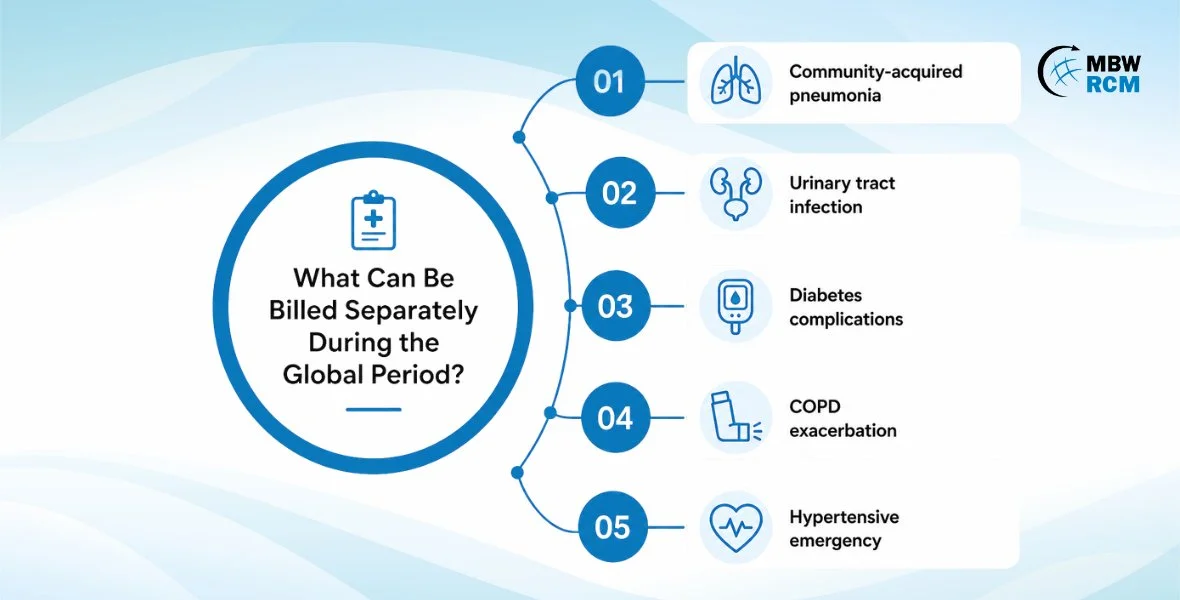
For example:
Community-acquired pneumonia
Urinary tract infection
Diabetes complications
COPD exacerbation
Hypertensive emergency
These visits are unrelated to the cardiovascular procedure itself. When documentation clearly supports that distinction, physicians may report the evaluation and management (E/M) service using Modifier 24.
The key is ensuring the medical record demonstrates that the visit addresses a condition separate from the original surgery. Documentation is the foundation of accurate cardiovascular reimbursement. Learn how missing operative details can trigger CABG claim denials and impact reimbursement.
Significant, Separately Identifiable E/M Services (Modifier 25)
Some patients require both a procedure and a comprehensive evaluation on the same day.
Modifier 25 is appropriate when the E/M service goes well beyond the usual work associated with performing the procedure.
Examples include:
Evaluating new chest pain before performing a minor procedure
Assessing additional cardiovascular symptoms requiring separate medical decision-making
Managing unrelated clinical concerns during the same encounter
Simply documenting the procedure isn't enough. The physician's evaluation must be significant, separately identifiable, and medically necessary.
Decision for Major Surgery (Modifier 57)
Not every cardiovascular procedure is scheduled weeks in advance.
Patients may present with conditions requiring immediate surgical intervention, such as:
Acute aortic dissection
Symptomatic carotid artery stenosis
Critical limb ischemia
Severe valvular disease requiring urgent surgery
If the physician performs a comprehensive evaluation that directly results in the decision to proceed with major surgery, that E/M service may be billed separately using Modifier 57.
Modifier 57 applies to the decision-making process—not the routine preoperative assessment that's already included in the global package.
Staged or More Extensive Procedures (Modifier 58)
Cardiovascular treatment often occurs in carefully planned stages.
For example, a patient may undergo:
Planned staged vascular reconstruction
Additional bypass surgery following initial stabilization
A more extensive procedure anticipated during the original treatment plan
These situations may qualify for Modifier 58.
Modifier 58 is generally appropriate when the second procedure is:
Planned prospectively
More extensive than the original procedure
A normal progression of treatment
Unlike several other modifiers, Modifier 58 typically starts a new global period.
Return to the Operating Room (Modifier 78)
Complications can occur even after technically successful surgery.
Patients sometimes require an unexpected return to the operating room because of:
Postoperative bleeding
Cardiac tamponade
Graft revision
Surgical wound exploration
Hematoma evacuation
When a related complication requires another procedure during the postoperative period, Modifier 78 may apply.
Unlike Modifier 58, Modifier 78 does not begin a new global period. The original global period continues. If you're interested in learning more about cardiovascular billing, take a look at this article on TAVR Billing & Coding: Protect High-Value Claims.
Unrelated Surgery During the Global Period (Modifier 79)
Occasionally, patients require an entirely unrelated surgical procedure while still recovering from cardiovascular surgery.
Imagine a patient who undergoes CABG but later requires emergency vascular surgery after sustaining traumatic arterial injuries in an accident.
Because the second procedure is unrelated to the original cardiovascular surgery, Modifier 79 may be appropriate.
Unlike Modifier 78, Modifier 79 generally establishes a new global period for the second surgery.
Quick Modifier Reference for Global Period Billing
| Modifier | When It Is Used | Starts a New Global Period? |
|---|---|---|
| 24 | Unrelated evaluation and management service provided during the postoperative period. | No |
| 25 | Significant, separately identifiable evaluation and management service performed on the same day as another procedure. | No |
| 57 | Evaluation and management service that results in the decision to perform major surgery. | No |
| 58 | Planned, staged, related, or more extensive procedure performed during the postoperative period. | Yes |
| 78 | Unplanned return to the operating or procedure room for a related complication. | No |
| 79 | Unrelated procedure performed by the same physician during the postoperative period. | Yes |
Can Diagnostic Tests Be Billed Separately?
Yes—but only under the right circumstances.
Many diagnostic services performed during the postoperative period may qualify for separate reimbursement if they are medically necessary and not already included in the global package.
Examples include:
Echocardiography
CT angiography
Duplex vascular ultrasound
Stress testing
Diagnostic cardiac imaging
Peripheral vascular imaging
For instance, if a patient develops new symptoms such as unexplained chest pain or suspected graft complications after surgery, additional diagnostic testing may be medically necessary and separately billable.
Routine postoperative monitoring, however, generally remains bundled into the surgical payment.
"The strongest modifier in billing isn't 24, 58, or 79—it's complete clinical documentation that clearly explains why a service deserves separate reimbursement."
Payer-Specific Bundling Rules Can Change Everything
One of the biggest mistakes practices make is assuming every payer follows Medicare's billing rules exactly.
While Medicare provides the foundation for global surgery guidelines, commercial insurers often implement additional reimbursement edits through:
National Correct Coding Initiative (NCCI) edits
Proprietary claims-editing software
Internal medical policies
Prior authorization requirements
Frequency limitations
Modifier-specific documentation reviews
It's not uncommon for one payer to reimburse a postoperative diagnostic service while another requests additional records—or denies the claim altogether.
That's why successful cardiovascular surgery billing requires more than understanding CPT® coding. It also requires familiarity with each payer's reimbursement policies.
While commercial insurers may have their own reimbursement policies, Medicare's billing rules remain the foundation for understanding global surgery reporting. The Medicare Claims Processing Manual (Chapter 12) provides detailed guidance on modifier usage, global surgery policies, and physician billing requirements, making it a valuable reference for providers and billing teams: https://www.cms.gov/regulations-and-guidance/guidance/manuals/internet-only-manuals-ioms
Common Billing Mistakes During the Global Period
Even experienced billing teams can encounter avoidable errors.
Some of the most common include:
Billing routine postoperative visits separately
Using Modifier 24 for surgery-related follow-up care
Reporting Modifier 25 without distinct documentation
Confusing Modifier 78 with Modifier 79
Billing diagnostic services without demonstrating medical necessity
Failing to verify payer-specific global surgery policies
Missing operative documentation that supports modifier usage
Most denials aren't caused by incorrect CPT® codes—they're caused by insufficient documentation or inappropriate modifier selection.
Current Trends in Cardiovascular Surgery Global Period Billing
Billing requirements continue to evolve as payers strengthen their reimbursement review processes.
Several trends are shaping cardiovascular surgery billing in 2026.
AI-Driven Claims Editing Is Becoming Standard
Commercial insurers are increasingly using artificial intelligence and predictive analytics to identify modifier misuse, duplicate billing, and potential bundling violations before claims are paid.
Documentation Reviews Are More Detailed
High-value cardiovascular procedures continue to receive increased scrutiny, especially when multiple modifiers are reported during the same postoperative period.
Medical Necessity Is Receiving Greater Attention
Rather than reviewing codes alone, payers increasingly evaluate whether physician documentation clearly supports why postoperative services should be reimbursed separately.
Specialty Billing Expertise Is Becoming More Valuable
As reimbursement rules become more complex, many cardiovascular surgery practices are partnering with specialty billing companies that understand procedure-specific coding, payer policies, and modifier requirements.
Best Practices for Accurate Global Period Billing
Improving reimbursement doesn't always require major operational changes. Often, consistency is what makes the biggest difference.
Consider these best practices:
Verify the global period before submitting every surgical claim.
Review whether postoperative services are routine or separately billable.
Ensure documentation clearly supports modifier usage.
Stay current with Medicare and commercial payer policy updates.
Audit high-value cardiovascular surgery claims regularly.
Educate physicians on documentation that supports medical necessity.
Monitor denial trends to identify recurring billing issues before they affect revenue.
Small workflow improvements today can significantly reduce denials and strengthen long-term financial performance.
Final Thoughts
The cardiovascular surgery global period isn't meant to prevent practices from receiving appropriate reimbursement—it exists to define which services are included in the original surgical payment and which may qualify for separate billing.
Understanding these rules, selecting the correct modifiers, and maintaining complete clinical documentation can help practices avoid unnecessary denials while protecting revenue from complex cardiovascular procedures.
As payer requirements continue to evolve, success depends not only on coding knowledge but also on proactive documentation, specialty expertise, and a revenue cycle strategy built around compliance and accuracy.
FAQs: Cardiovascular Surgery Global Periods
Protect Every Reimbursable Cardiovascular Surgery Claim
Global period rules, modifier selection, and payer-specific bundling edits can quickly become overwhelming—especially for high-value cardiovascular procedures where even a single denied claim can significantly impact revenue.
At MBW RCM, our cardiovascular surgery billing specialists help practices navigate complex global surgery rules, strengthen documentation, reduce denials, and maximize reimbursement without compromising compliance.
Request a Free Cardiovascular Surgery Billing Assessment and discover how your practice can improve billing accuracy, streamline reimbursement, and protect revenue at every stage of the surgical episode.