Failed Conservative Treatment Documentation: The Missing Element Behind Spine Claim Denials
For many spine surgery practices, claim denials are often attributed to coding errors, prior authorization challenges, or payer policies. While these factors certainly influence reimbursement, one of the most overlooked causes of denied or delayed claims begins much earlier in the patient's treatment journey—incomplete documentation of failed conservative treatment.
Before approving many elective spine procedures, Medicare and commercial payers expect clear evidence that appropriate non-surgical treatment was attempted and that surgery became medically necessary only after those treatments failed to provide meaningful improvement. Simply stating that conservative care was unsuccessful is rarely sufficient. Payers want a detailed clinical narrative supported by objective findings, treatment history, physician assessments, and diagnostic imaging.
Table of Contents
When documentation does not clearly demonstrate the progression from conservative management to surgical intervention, practices may face prior authorization delays, medical necessity denials, additional documentation requests, or prolonged reimbursement cycles.
This article explores what payers expect to see before approving spine procedures, the documentation elements that frequently determine reimbursement, and practical strategies to strengthen medical necessity while reducing preventable spine claim denials.
Why Failed Conservative Treatment Documentation Matters
Medical necessity is the foundation of reimbursement for elective spine procedures. Before approving surgery, payers typically evaluate whether reasonable non-operative treatments were attempted, appropriately documented, and unsuccessful in relieving the patient's condition.
Rather than reviewing only the operative report, payer reviewers often examine the patient's complete clinical journey, including:
Initial consultation
Physician evaluations
Physical therapy records
Medication history
Injection history
Diagnostic imaging
Functional assessments
Follow-up visits
Surgical decision-making
Each encounter contributes to establishing why surgery became the most appropriate treatment option.
Incomplete documentation may create uncertainty about whether surgery was clinically necessary, even when the procedure itself was performed appropriately.
According to the American Medical Association (AMA), prior authorization requirements continue to create significant administrative burdens for physician practices, with incomplete supporting documentation remaining a common reason for delays and additional review requests.
"The strongest spine surgery claims begin long before the patient enters the operating room. Every conservative treatment documented strengthens the medical necessity story."
— Spine Documentation Consultant
What Payers Expect Before Approving Spine Procedures
Although specific requirements vary by payer and procedure, most Medicare and commercial insurers look for consistent clinical evidence demonstrating that conservative treatment was attempted before surgery.
A well-documented medical record should answer several key questions:
What symptoms prompted treatment?
How long have the symptoms persisted?
Which non-surgical treatments were attempted?
How did the patient respond?
Did symptoms improve, remain unchanged, or worsen?
How do imaging findings support the diagnosis?
Why is surgery now medically necessary?
Rather than relying on isolated clinical notes, reviewers expect the documentation to tell a complete and consistent story from the patient's first visit through the decision to operate.
Providers should also review applicable Local Coverage Determinations (LCDs) in the CMS Medicare Coverage Database (MCD), as these policies often outline documentation expectations and medical necessity criteria for spine-related procedures.
Physical Therapy Documentation: More Than a Referral
Physical therapy is one of the most commonly required conservative treatments before elective spine surgery. However, simply documenting that physical therapy was prescribed rarely satisfies payer expectations.
Instead, the medical record should demonstrate:
When therapy began
Duration of treatment
Number of completed sessions
Patient participation and compliance
Objective clinical progress
Persistent symptoms despite therapy
Therapist recommendations
Physician review of therapy outcomes
Detailed progress notes help establish that conservative treatment was both appropriate and unsuccessful before surgery was considered.
Documentation Should Answer Questions Such As:
Did the patient complete the recommended therapy?
Was there measurable improvement?
Did symptoms worsen during treatment?
Were functional limitations still present after therapy?
When these details are missing, reviewers may question whether sufficient conservative care was attempted. If you're interested in learning more about spine billing, take a look at this blog on Spine Implant Revenue Leakage: OR Log to Reimbursement.
Medication Management: Demonstrating Appropriate Non-Surgical Care
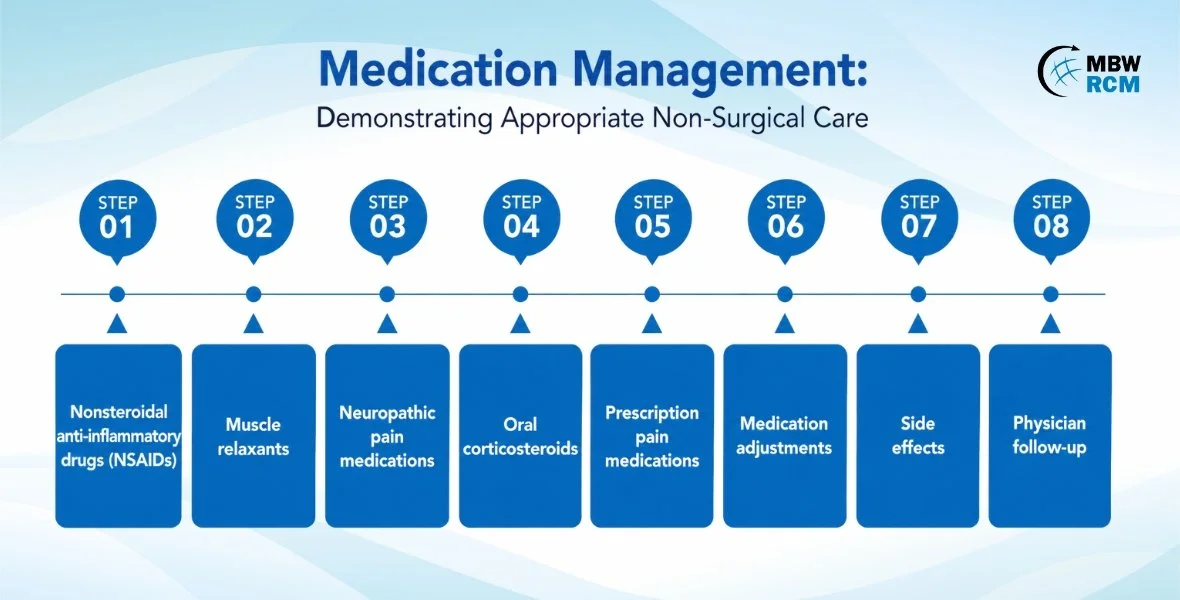
Medication history is another important component of failed conservative treatment documentation.
Payers often expect evidence that reasonable pharmacological management was attempted before surgery, particularly when clinically appropriate.
Documentation may include:
Nonsteroidal anti-inflammatory drugs (NSAIDs)
Muscle relaxants
Neuropathic pain medications
Oral corticosteroids
Prescription pain medications
Medication adjustments
Side effects
Physician follow-up
Rather than listing medications alone, providers should document how the patient responded to treatment.
For example:
Did medications reduce pain?
Were symptoms only temporarily controlled?
Did side effects limit continued use?
Was medication therapy no longer effective?
These clinical details strengthen the rationale for progressing toward surgical intervention. Want to learn more about coding complex spine procedures? Read Multi-Level Spinal Fusion Billing: Base Codes & NCCI for additional billing and coding insights.
Injection History: Evidence That Conservative Care Was Exhausted
Many patients undergo interventional pain management before surgery is considered. Epidural steroid injections, facet joint injections, selective nerve root blocks, or other therapeutic procedures may provide temporary relief while helping physicians evaluate the patient's condition.
However, payers generally expect more than documentation that an injection was performed.
The medical record should clearly describe:
Type of injection
Date performed
Anatomical level treated
Patient response
Duration of symptom relief
Need for repeat procedures
Physician assessment following treatment
If injections provided only temporary improvement or failed to produce meaningful functional recovery, the documentation should clearly explain why surgery became the next appropriate treatment option.
"Conservative treatment is not measured by the number of therapies attempted—it is measured by how well the clinical record explains why those therapies no longer met the patient's needs."
— Healthcare Revenue Integrity Specialist
Duration of Symptoms: Establishing Medical Necessity Over Time
The length and progression of symptoms play a significant role in determining medical necessity.
Acute pain that improves with conservative management often does not justify surgical intervention. In contrast, persistent or worsening symptoms despite appropriate treatment may support the decision to proceed with surgery.
Documentation should clearly establish:
When symptoms first began
Frequency and severity of pain
Changes over time
Progression despite treatment
New neurological findings
Impact on quality of life
Rather than documenting pain as a single event, providers should demonstrate the patient's clinical progression across multiple visits.
Consistent documentation of symptom duration helps reviewers understand that surgery was not an immediate decision, but the result of a structured course of conservative management.
Functional Impairment: One of the Strongest Indicators of Medical Necessity
Pain alone does not always justify spine surgery. Payers frequently evaluate how the patient's condition affects daily function, mobility, and overall quality of life.
The medical record should describe objective functional limitations such as:
Difficulty walking or standing
Limited sitting tolerance
Sleep disturbances caused by pain
Inability to perform work duties
Difficulty lifting, bending, or climbing stairs
Reduced participation in daily activities
Loss of independence
Whenever possible, providers should include measurable findings rather than general statements such as "patient has severe pain."
For example, documenting that a patient can walk only a short distance before experiencing severe radicular pain provides stronger evidence of functional impairment than simply describing pain severity.
Evidence-based clinical guidance from the North American Spine Society (NASS) also emphasizes correlating patient symptoms, physical examination findings, and functional limitations when evaluating candidates for spine surgery.
Imaging Correlation: MRI Findings Alone Do Not Establish Medical Necessity
Diagnostic imaging is one of the most important pieces of evidence supporting spine surgery, but imaging alone rarely justifies surgical intervention. MRI, CT, and X-ray findings must correlate with the patient's symptoms, physical examination, and documented functional limitations.
Payers frequently compare imaging reports with the clinical documentation to determine whether the anatomical findings explain the patient's condition. A significant imaging abnormality without corresponding symptoms may not support medical necessity, while severe symptoms without imaging correlation may trigger requests for additional documentation.
The medical record should clearly demonstrate:
MRI, CT, or X-ray findings
Physician interpretation of imaging
Correlation between imaging and neurological findings
Relationship between imaging and reported symptoms
Evidence supporting the proposed surgical procedure
Rather than attaching an imaging report alone, providers should explain how the imaging findings support the decision to proceed with surgery after conservative treatment was unsuccessful.
According to the CMS Medicare Coverage Database (MCD), Local Coverage Determinations (LCDs) often require documentation that diagnostic imaging and clinical findings support the medical necessity of spine procedures. Reviewing the applicable LCD before claim submission helps ensure documentation aligns with payer expectations. Can MRI findings alone justify spine surgery? Explore this peer-reviewed article to understand why clinical correlation is essential.
Can MRI findings alone justify spine surgery? Explore this peer-reviewed article on clinical correlation of MRI findings.
Common Documentation Mistakes That Lead to Spine Claim Denials
Many spine claim denials occur because critical documentation elements are incomplete rather than because surgery was inappropriate.
Some of the most common documentation gaps include:
Documenting "Failed Physical Therapy" Without Supporting Details
A brief statement that therapy failed does not explain how long treatment continued, whether the patient complied, or why surgery became necessary.
Missing Medication History
Documentation should describe the medications prescribed, patient response, dosage adjustments, and whether conservative medication management provided meaningful improvement.
Incomplete Injection Documentation
Injection records should include the procedure performed, anatomical location, patient response, duration of relief, and physician assessment.
No Timeline of Symptoms
Reviewers expect a clear progression of symptoms from the initial presentation through surgical evaluation.
Functional Limitations Are Poorly Documented
General statements about pain are less persuasive than objective descriptions of how the condition limits walking, standing, working, sleeping, or daily activities.
Imaging Does Not Match Clinical Findings
The physician should explain how diagnostic imaging supports the patient's symptoms and surgical plan rather than relying solely on imaging reports.
Inconsistent Clinical Documentation
Differences between physician notes, therapy records, imaging reports, and operative documentation can create uncertainty during medical necessity reviews.
Best Practices for Stronger Failed Conservative Treatment Documentation
Well-organized documentation not only supports reimbursement but also improves communication between physicians, coders, authorization specialists, and payers.
Use Standardized Documentation Templates
Templates help ensure every required documentation element is captured consistently throughout the patient's treatment.
Document Every Conservative Treatment
Record each non-surgical intervention, including physical therapy, medications, injections, activity modification, and physician follow-up.
Establish a Clear Clinical Timeline
Show how symptoms progressed over time despite appropriate conservative management before surgery was recommended.
Measure Functional Outcomes
Whenever possible, document objective findings that demonstrate how the patient's condition affects mobility, work, and daily activities.
Correlate Imaging With Clinical Findings
Explain how diagnostic imaging supports the documented symptoms, physical examination, and surgical decision.
Review Documentation Before Authorization or Claim Submission
Conduct internal documentation reviews to identify missing clinical information before requests are submitted to the payer.
Practices that implement structured documentation workflows are better positioned to reduce medical necessity denials while improving reimbursement efficiency.
Failed Conservative Treatment Documentation Checklist
Before requesting prior authorization or submitting a spine surgery claim, verify that the medical record includes:
✔ Documentation RequirementComplete symptom historyDuration of symptoms documentedPhysical therapy recordsMedication management historyInjection history and responseFunctional limitations clearly describedPhysician follow-up evaluationsMRI or CT findingsImaging correlated with symptomsMedical necessity documentedSurgical rationale clearly explainedConsistent documentation across all clinical records
Using a standardized checklist helps practices identify documentation gaps before they result in payer delays or denials.
Why Specialty Spine Surgery Billing Matters
Strong reimbursement begins with strong documentation. Even when surgery is clinically appropriate, incomplete records can delay prior authorization, trigger medical necessity reviews, or lead to denied claims.
A specialty spine surgery billing partner helps practices strengthen documentation workflows while ensuring coding accurately reflects the patient's clinical journey.
Specialty billing teams can assist by:
Reviewing documentation before claim submission.
Identifying medical necessity gaps.
Supporting prior authorization requests.
Validating coding accuracy.
Monitoring payer policy updates.
Reducing preventable denials.
Improving reimbursement for complex spine procedures.
By aligning documentation, coding, and payer requirements, practices can improve revenue cycle performance while allowing physicians to remain focused on patient care.
Conclusion
Failed conservative treatment documentation is more than a payer requirement—it is the clinical foundation that supports medical necessity for elective spine surgery. Every physical therapy session, medication adjustment, injection, physician evaluation, and imaging study helps demonstrate why surgery became the appropriate course of treatment.
When documentation clearly reflects the patient's progression from conservative care to surgical intervention, practices are better positioned to secure prior authorization, reduce medical necessity denials, and protect reimbursement.
As payer expectations continue to evolve, investing in stronger documentation processes and experienced Spine Surgery Billing Services can help practices improve compliance, strengthen revenue cycle performance, and reduce unnecessary claim delays.
FAQs: Failed Conservative Treatment Documentation for Spine Surgery
Strengthen Your Spine Documentation Before Claims Are Submitted
Complete documentation protects more than compliance—it protects reimbursement. Our spine surgery billing specialists help practices identify documentation gaps, improve medical necessity support, strengthen coding accuracy, and reduce preventable denials before claims reach the payer.
👉 Request a Complimentary Spine Documentation Assessment and discover how stronger documentation can improve authorization success, reduce denials, and maximize reimbursement.