When Decompression and Fusion Can Be Reported Together: Understanding NCCI Bundling Rules

If there's one topic that consistently creates confusion in spine surgery billing, it's whether decompression and spinal fusion can be reported together. Many assume that because both procedures were performed during the same operation, they should always be billed separately. Others avoid reporting decompression altogether, worried about triggering National Correct Coding Initiative (NCCI) edits.
The truth is somewhere in between.
In many cases, decompression is considered part of the spinal fusion procedure and cannot be reported separately. However, there are situations where decompression addresses a different pathology or a different spinal level, making separate reporting appropriate when supported by complete documentation and payer guidelines.
Table of Contents
Knowing the difference isn't just important for reimbursement—it also helps reduce coding errors, prevent avoidable denials, and maintain compliance.
In this guide, we'll break down when decompression and fusion may be reported together, what documentation payers expect, and how practices can avoid common billing mistakes.
Why This Topic Creates So Much Confusion
Spine surgery is rarely straightforward. A single operation may involve fusion, decompression, instrumentation, bone grafting, and multiple spinal levels.
Because several procedures happen during one surgery, coders often ask questions like:
Is the decompression already included in the fusion?
Does operating on another spinal level change anything?
When should Modifier 59 be considered?
What documentation do payers expect?
Will this trigger an NCCI edit?
The answer depends less on how many procedures were performed and more on why they were performed and how well they're documented.
A well-written operative report often makes the difference between a clean claim and a costly denial.
"In spine surgery coding, documentation should explain the surgeon's intent—not just the procedures performed. That's what allows coders to accurately distinguish bundled services from separately reportable ones."
— Spine Surgery Coding Consultant
Understanding NCCI Bundling
Before discussing decompression and fusion together, it's helpful to understand why NCCI edits exist in the first place.
The National Correct Coding Initiative (NCCI) was developed by CMS to promote accurate coding and reduce inappropriate unbundling of services that are normally performed together.
Certain procedures are considered an expected part of another procedure because they are necessary to complete the surgery safely and effectively.
Think of it this way.
If a surgeon must perform a limited decompression simply to access the spine and complete the planned fusion, that decompression is generally considered part of the primary procedure—not an additional reimbursable service.
The CMS National Correct Coding Initiative (NCCI) Policy Manual explains these bundling principles and helps providers understand when services are considered integral to another procedure.
The goal isn't to reduce reimbursement—it's to ensure that claims accurately represent the work that was actually performed. Want to learn how multi-level spinal fusion procedures are coded? Read Multi-Level Spinal Fusion Billing: Add-On Codes & NCCI.
Why Decompression Is Often Bundled Into Fusion
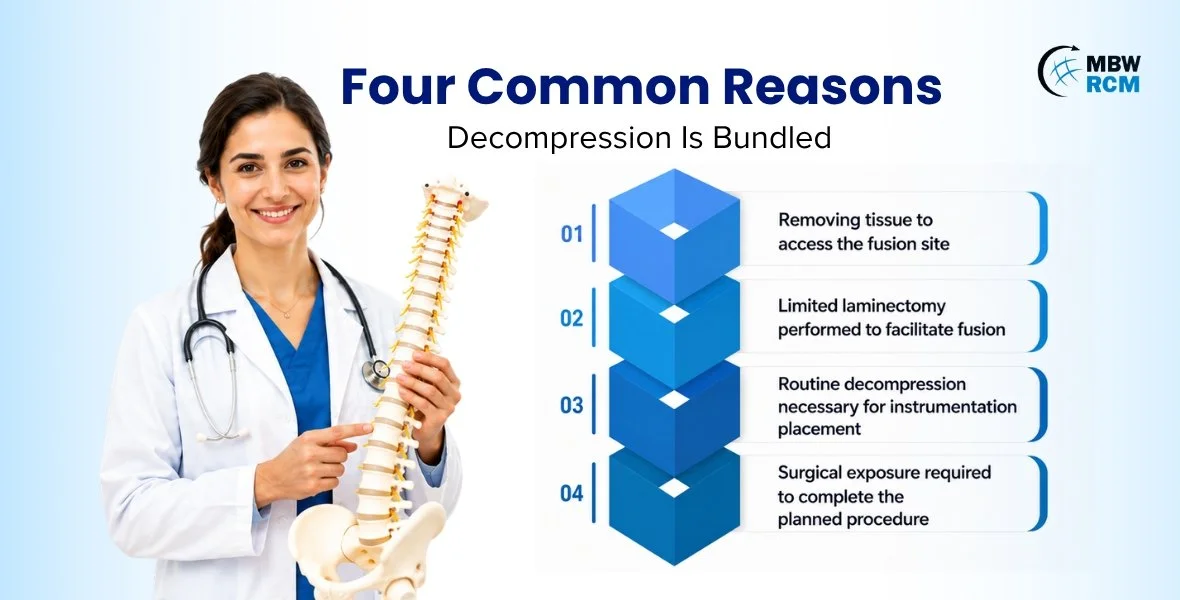
Many spinal fusion procedures require some degree of decompression to expose the surgical site, remove tissue, or prepare the spine before stabilization.
In these situations, decompression is viewed as part of completing the fusion procedure rather than as a separate operation.
Examples may include:
Removing tissue to access the fusion site
Limited laminectomy performed to facilitate fusion
Routine decompression necessary for instrumentation placement
Surgical exposure required to complete the planned procedure
Because these steps are considered integral to the fusion, they are commonly bundled under NCCI edits.
This doesn't mean decompression can never be reported separately—it simply means the documentation must demonstrate that it was performed for an additional clinical reason beyond completing the fusion.
When Decompression and Fusion May Be Reported Together
This is where documentation becomes incredibly important.
There are circumstances where decompression and fusion represent distinct surgical services rather than one integrated procedure.
For example, separate reporting may be appropriate when documentation clearly supports:
A different spinal level
A separate pathological condition
Independent medical necessity
A distinct surgical objective
Compliance with payer and NCCI guidance
The key isn't that two procedures occurred.
The key is that the medical record clearly explains why both procedures were necessary.
If the operative note simply lists "fusion and decompression performed," reviewers may assume the decompression was part of the fusion.
If it explains that decompression addressed symptomatic stenosis at a different anatomical level while fusion treated instability elsewhere, the clinical picture becomes much clearer.
Separate Levels: Why Location Matters
One of the biggest factors reviewers evaluate is where each procedure was performed.
Imagine a patient undergoing lumbar fusion at one level while decompression is performed at another level because of documented spinal stenosis.
Those procedures may represent different clinical problems requiring different surgical work.
However, the operative report must make this obvious.
Instead of simply documenting multiple procedures, surgeons should identify:
Every vertebral level treated
Which level received fusion
Which level received decompression
The diagnosis associated with each level
The clinical rationale for each procedure
The more specific the documentation, the easier it becomes for coders to determine whether separate reporting should be considered.
Simply stating "multilevel decompression" or "lumbar fusion performed" leaves too much open to interpretation. Still have questions about lumbar spinal fusion coding? This guide breaks down the billing rules every spine billing team should know.
Distinct Pathology Must Be Clearly Documented
Separate anatomical levels alone may not always tell the complete story.
Reviewers also want to understand why each procedure was performed.
Different spinal conditions often require different surgical objectives.
For example, documentation may describe:
Spinal stenosis
Herniated disc
Radiculopathy
Degenerative instability
Spondylolisthesis
Foraminal narrowing
When decompression addresses one documented condition while fusion treats another, the physician's documentation should clearly explain that relationship.
Rather than expecting coders or reviewers to make assumptions, the operative note should connect:
Diagnosis
Imaging findings
Symptoms
Surgical findings
Procedures performed
This creates a complete clinical story that supports medical necessity.
According to the CMS Medicare Coverage Database (MCD), many Local Coverage Determinations (LCDs) require documentation that clearly demonstrates the relationship between the patient's diagnosis, clinical findings, imaging, and the procedure performed. Strong documentation helps support medical necessity during payer review.
Your Operative Note Is Your Strongest Defense
No amount of coding expertise can compensate for incomplete operative documentation.
The operative report should clearly describe:
Surgical Approach
How the spine was accessed.
Vertebral Levels
Exactly which levels underwent fusion and which underwent decompression.
Clinical Findings
What pathology was identified during surgery.
Surgical Objective
Why each procedure was necessary.
Medical Necessity
How the documented pathology supported each surgical decision.
When these details are present, coding becomes significantly more straightforward.
When they're missing, practices often face additional documentation requests, NCCI edit challenges, delayed reimbursement, or denied claims. Could missing conservative treatment documentation be putting your spine claims at risk? Find out in Failed Conservative Treatment & Spine Claim Denials.
Operative Note Language: Small Details Make a Big Difference
When it comes to spine surgery billing, the operative report is more than a surgical record—it's the document that tells the payer exactly what happened in the operating room and why.
A well-written operative note should do more than list procedures. It should explain the surgeon's clinical reasoning and clearly distinguish between services that were necessary to complete the fusion and services that addressed a separate condition.
The documentation should clearly identify:
The spinal levels treated
The diagnosis associated with each level
The reason decompression was performed
The reason fusion was performed
The surgical approach
Operative findings
The relationship between imaging, symptoms, and pathology
For example, instead of documenting:
"Lumbar decompression and fusion performed."
A stronger operative note would explain:
Which vertebral levels received decompression
Which levels underwent fusion
Why each procedure was necessary
The pathology treated at each level
How the procedures addressed separate clinical problems
The more clearly the operative report explains the surgeon's decision-making, the easier it becomes for coders to support accurate claim reporting.
"A complete operative note doesn't just describe the procedure—it explains the clinical purpose behind every surgical step. That's what supports compliant reimbursement."
— Healthcare Revenue Integrity Specialist
Modifier 59 and X Modifiers: Documentation Comes First
Modifier 59 and the X{EPSU} modifiers are often discussed whenever multiple spine procedures are performed during the same operative session. However, one of the biggest misconceptions is that a modifier alone allows separate reimbursement.
It doesn't.
A modifier should only be considered when the documentation clearly supports that the services were distinct and separately reportable under applicable payer policies.
Before appending any modifier, billing teams should confirm:
The operative note supports separate reporting.
The procedures meet payer and NCCI requirements.
Medical necessity is documented for each service.
Clinical findings justify the distinction between procedures.
Modifiers should clarify an already well-documented clinical scenario—not compensate for incomplete documentation.
Practices should also recognize that commercial payers may apply modifier policies differently from Medicare, making payer-specific verification an important part of the billing workflow.
Payer Variations: Not Every Policy Is the Same
One of the biggest challenges in spine surgery billing is assuming every payer follows the same reimbursement rules.
While Medicare uses NCCI edits as the foundation for many coding decisions, commercial insurers may have additional medical policies, documentation requirements, or claim editing systems.
Differences may include:
Prior authorization requirements
Documentation expectations
Modifier acceptance
Medical necessity criteria
Procedure-specific reimbursement policies
Claims editing software
Before submitting complex spine surgery claims, practices should review both the payer's medical policy and the applicable coding guidance.
Many Medicare Administrative Contractors (MACs) publish Local Coverage Determinations (LCDs) that outline procedure-specific documentation expectations. Reviewing these policies alongside the CMS Medicare Coverage Database (MCD) helps practices ensure their documentation supports medical necessity before claims are submitted.
Common Billing Mistakes That Lead to Denials
Many denied spine surgery claims share the same underlying issue—not the coding itself, but the documentation supporting it.
Some of the most common mistakes include:
Assuming Every Decompression Is Separately Reportable
Not every decompression performed during fusion qualifies for separate reporting. Billing without reviewing the documentation and payer guidance can result in denials.
Missing Operative Details
Incomplete documentation of vertebral levels, pathology, or surgical intent makes accurate coding difficult.
Using Modifiers Without Clinical Support
Appending Modifier 59 or an X modifier without documentation that supports a distinct service may trigger payer scrutiny or denial.
Poor Correlation Between Diagnosis and Procedure
The documented diagnosis, imaging findings, and surgical procedures should align throughout the medical record.
Failing to Review NCCI Edits
Ignoring current NCCI edits before claim submission increases the risk of payment delays and compliance concerns.
Treating Every Payer the Same
Commercial insurers often have different billing rules than Medicare. Applying one payer's policy to another can create avoidable reimbursement issues.
Documentation Checklist for Decompression and Fusion Claims
Before submitting a claim, verify that the operative record includes:
✔ Documentation RequirementComplete operative reportSurgical approach documentedFusion levels identifiedDecompression levels identifiedDistinct pathology describedMedical necessity documentedImaging correlated with symptomsClinical rationale for each procedureNCCI edits reviewedModifier support documented (when applicable)Payer-specific requirements verified
A standardized review process helps identify documentation gaps before they become claim denials.
Best Practices for Accurate Decompression and Fusion Billing
Reducing denials begins with strong collaboration between surgeons, coders, and billing professionals.
Educate Surgeons on Documentation Expectations
Help surgeons understand which documentation elements directly affect coding and reimbursement.
Review Operative Reports Before Coding
Complex spine procedures should receive a detailed documentation review before codes are assigned.
Validate NCCI Edits
Check current NCCI edits before submitting claims involving multiple spinal procedures.
Verify Payer Policies
Confirm documentation and billing requirements for each payer rather than relying on a single workflow.
Conduct Internal Coding Audits
Periodic audits help identify recurring documentation issues and coding trends before they affect reimbursement.
Encourage Communication Between Clinical and Billing Teams
Coders should feel comfortable seeking clarification when operative documentation is incomplete or unclear.
Practices that combine thorough documentation with proactive coding reviews are better equipped to reduce denials, strengthen compliance, and improve reimbursement accuracy.
Conclusion
Determining when decompression and fusion can be reported together requires more than understanding coding guidelines—it requires understanding the clinical purpose behind each procedure.
While many decompression procedures are considered integral to spinal fusion, others may qualify for separate reporting when they address a distinct pathology or spinal level and are fully supported by the operative documentation.
The strongest claims begin with detailed operative notes that clearly explain what was done, where it was performed, and why each procedure was medically necessary. Combined with Spine Surgery Billing Services, accurate documentation and coding help practices reduce denials, improve compliance, and protect reimbursement for complex spine procedures.
FAQs: Decompression and Fusion Billing
Improve Coding Accuracy for Complex Spine Surgery Claims
Complex spine procedures deserve coding expertise that matches their clinical complexity. Our spine surgery billing specialists help practices review operative documentation, navigate NCCI edits, validate coding accuracy, and reduce preventable denials for decompression and fusion procedures.
👉 Request a Complimentary Spine Surgery Coding Review and discover how specialty billing support can help strengthen compliance and maximize reimbursement.