How to Choose a Radiation Oncology Billing Company

If you've ever spoken with three different medical billing companies, you've probably heard the same promises.
"We reduce denials."
"We improve collections."
"We maximize reimbursements."
On paper, they all sound alike.
The problem is that radiation oncology isn't like most medical specialties. Billing isn't built around a single office visit or procedure. Instead, every patient moves through a treatment journey that may span several weeks, with dozens of billable services generated along the way. From CT simulation and treatment planning to dosimetry, physics review, treatment delivery, and weekly management, every step has its own coding, documentation, and reimbursement requirements.
That complexity is exactly why choosing a billing company deserves more attention than comparing percentages or monthly fees.
The right partner doesn't simply submit claims—they understand how radiation oncology practices work, how payers review treatment episodes, and where revenue quietly slips away.
If you're evaluating a radiation oncology billing company, here are the factors that actually matter.
Table of Contents
Why Your Choice Matters More Than You Think
Imagine delivering exceptional patient care, investing in advanced treatment technology, and employing experienced radiation oncologists—only to discover months later that thousands of dollars were left uncollected because documentation didn't support a treatment planning code or an authorization expired halfway through treatment.
Unfortunately, situations like these happen more often than most practices realize.
Unlike many specialties, radiation oncology billing is continuous rather than episodic. One patient's treatment can generate multiple claims over several weeks, each depending on accurate documentation from the previous stage.
A missing physician signature, an incorrect modifier, or delayed authorization doesn't just affect one claim. It can disrupt reimbursement for an entire course of treatment.
That's why practices increasingly look for radiation oncology medical billing services that specialize in oncology rather than relying on general medical billing companies.
As the American Society for Radiation Oncology (ASTRO) has highlighted, reimbursement models continue to evolve, placing greater emphasis on documentation accuracy, compliance, and quality reporting. That means billing has become far more than an administrative function—it's now a critical part of protecting practice revenue.
"Strong revenue cycle management begins long before the claim is submitted."
Radiation Oncology Billing Isn't Like Traditional Medical Billing
One of the biggest misconceptions among providers is that every billing company can learn a specialty after onboarding.
While that's true for some physician practices, radiation oncology has its own challenges.
Think about everything involved before treatment even begins.
Insurance verification.
Prior authorization.
CT simulation.
Treatment planning.
Medical physics.
Dosimetry calculations.
Image guidance.
Treatment delivery.
Weekly management.
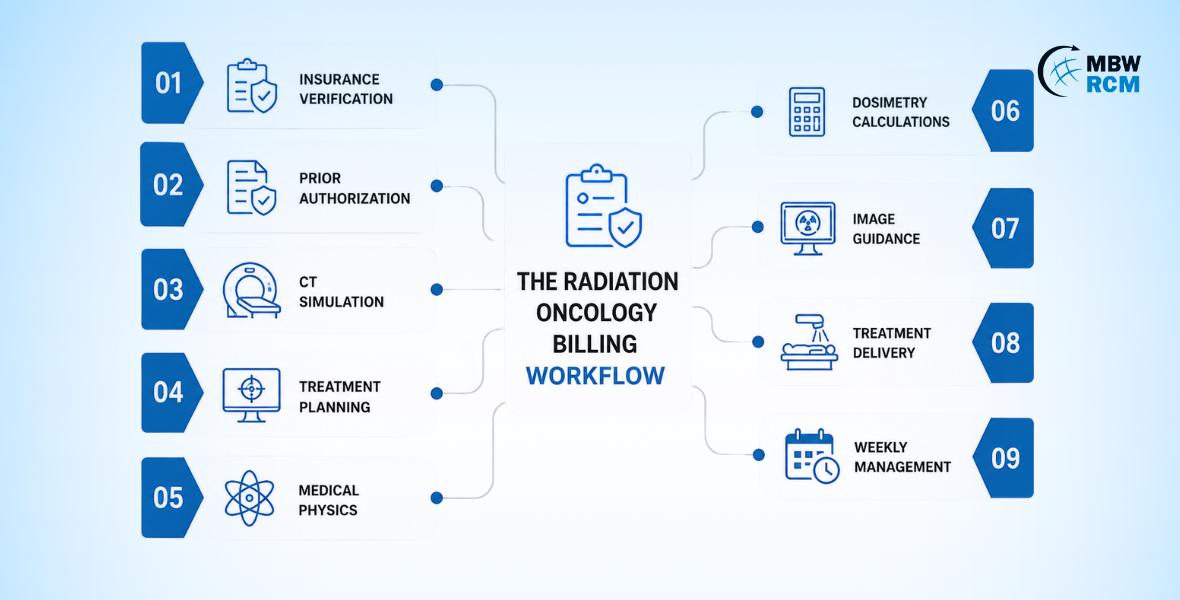
Each of those services must be documented correctly, coded accurately, and billed according to payer-specific rules. Missing even one component can delay reimbursement or trigger an avoidable denial.
This is why practices often prefer billing companies with dedicated experience in radiation therapy billing, radiation oncology coding, and oncology revenue cycle management, rather than firms that divide their attention across dozens of unrelated specialties.
What Should You Look for in a Radiation Oncology Billing Company?
There isn't a perfect checklist.
But after working with physician groups across different specialties, certain qualities consistently separate average billing companies from exceptional ones.
Choose Experience Over Marketing
Every company's website claims they're experts.
Instead of relying on marketing language, ask a few practical questions.
How many radiation oncology clients do you currently support?
What percentage of your business comes from oncology?
How familiar is your team with IMRT, IGRT, stereotactic treatments, and complex treatment planning?
Can you explain your workflow for handling treatment episodes?
The answers tell you far more than any sales brochure.
A company that's genuinely experienced won't struggle to explain how a treatment course flows from simulation through final delivery. They'll speak confidently about documentation requirements, payer expectations, and common denial patterns because they've dealt with them before.
Experience doesn't eliminate every billing issue—but it dramatically reduces the learning curve.
Look Beyond Claim Submission
Submitting claims is only one part of revenue cycle management.
The real work happens before and after.
An effective billing partner should review documentation, verify insurance eligibility, monitor authorizations, identify coding discrepancies, and track claims until payment is received.
If a company measures success simply by the number of claims submitted, that's not enough.
You want a partner who measures:
First-pass claim acceptance
Days in Accounts Receivable
Denial trends
Underpayments
Collection rates
Aging reports
Those metrics reveal whether your revenue cycle is actually improving.
Coding Expertise Should Never Be an Afterthought
Radiation oncology coding isn't something staff can "figure out" over time.
Every year brings updates to CPT guidelines, payer policies, National Correct Coding Initiative (NCCI) edits, and Local Coverage Determinations (LCDs).
An experienced coding team should already understand:
Professional and technical component billing
Modifier usage
Medical necessity requirements
Documentation audits
Radiation oncology reimbursement policies
Medicare billing requirements
More importantly, they should identify documentation gaps before claims are submitted—not after denials arrive.
One missed documentation element may not seem significant today, but repeated across hundreds of treatment courses, it can quietly affect revenue throughout the year. To learn more about radiation oncology coding, explore this blog on the 2026 Radiation Oncology Coding Guide.
Ask How They Handle Denials
Almost every billing company says they provide denial management.
Very few explain what that actually means.
Here's a better question.
"What happens the moment one of our claims is denied?"
Listen carefully.
Do they investigate the root cause?
Do they categorize denials by payer?
Do they identify recurring documentation issues?
Do they provide monthly trend reports?
Or do they simply correct the claim and resubmit it?
There's a huge difference.
The best billing companies treat denials as opportunities to improve the entire billing process—not just individual claims.
"The most valuable denial is the one that never happens because the underlying problem was fixed."
Prior Authorization Shouldn't Be Separate From Billing
In radiation oncology, prior authorization isn't an isolated administrative task.
It's connected to almost every stage of treatment.
A billing company that doesn't coordinate authorizations with documentation and coding creates unnecessary risk.
Strong medical billing services integrate authorization tracking directly into the revenue cycle so treatments, documentation, and billing remain aligned throughout the patient's course of care.
That coordination often prevents delays long before claims ever reach the payer. Coordinated prior authorization workflows don't just prevent delays—they also protect revenue. Explore this case study on how a radiation oncology practice reduced prior authorization-related revenue risk.
Transparency Matters More Than Fancy Dashboards
Most billing companies will tell you they provide reports.
The real question is: Will those reports help you make better decisions?
Receiving a spreadsheet at the end of the month isn't the same as having visibility into your revenue cycle.
A good radiation oncology billing company should help you understand what's happening behind the numbers.
For example:
Why did denials increase this month?
Which payer is taking the longest to reimburse?
Are IMRT claims taking longer than conventional radiation therapy claims?
Which physicians have the highest documentation-related denials?
How much revenue is sitting in Accounts Receivable beyond 90 days?
Those insights allow practice administrators and physicians to fix problems before they become expensive.
If every monthly meeting revolves around "Here's how many claims we submitted," you're probably not getting the level of reporting your practice deserves.
Technology Should Support People—Not Replace Them
Automation has made medical billing faster, but radiation oncology still requires human expertise.
A billing company should certainly use modern billing software, electronic claim scrubbing, workflow automation, and payer integration. However, technology alone won't recognize when documentation doesn't fully support a treatment planning service or when a payer has introduced a new reimbursement policy.
That's where experienced billing specialists make the difference.
The best billing partners combine technology with knowledgeable professionals who review high-value claims, monitor payer behavior, and identify issues before they affect reimbursement.
Think of software as the engine. The billing team is still responsible for driving the car. That expertise becomes especially important when managing professional and technical component billing in radiation oncology. Explore this guide to learn more.
Compliance Should Never Be an Afterthought
Healthcare regulations continue to evolve, and radiation oncology billing is no exception.
Your billing company should have well-defined processes for maintaining compliance with:
HIPAA requirements
Medicare billing guidelines
Commercial payer policies
Documentation standards
Coding updates
Internal quality audits
Ask whether they conduct regular compliance reviews and coding audits. It's far better to identify a documentation issue internally than during a payer audit.
For practices treating a high volume of Medicare patients, staying current with policy updates isn't optional—it's essential.
You can review Medicare billing guidance directly through the Centers for Medicare & Medicaid Services (CMS)
Questions to Ask Before Signing a Contract
Before choosing a radiation oncology billing company, don't focus only on pricing.
Instead, have a conversation that reveals how they actually operate.
Some useful questions include:
How much experience do you have with radiation oncology practices?
Years in business don't always translate into specialty expertise. Ask specifically about radiation oncology clients.
Who will manage our account?
Will you have a dedicated account manager, or will multiple people handle your practice?
Consistency often leads to faster issue resolution.
How do you measure success?
Listen for answers like:
First-pass claim acceptance rate
Days in A/R
Net collection rate
Denrollment prevention
Denial reduction
Payment turnaround
These metrics indicate they're focused on long-term performance rather than simply processing claims.
What does your onboarding process look like?
Switching billing companies shouldn't create disruption.
A structured onboarding plan, clear timelines, and regular communication usually indicate a well-organized team.
Red Flags You Shouldn't Ignore
Sometimes it's easier to identify the wrong billing company than the right one.
Be cautious if a company:
Promises unrealistic collection increases
No ethical billing company can guarantee a specific reimbursement increase without first reviewing your current revenue cycle.
Doesn't specialize in radiation oncology
General billing knowledge has its place, but radiation oncology has unique workflows that require specialized expertise.
Can't explain denial trends
If they only resubmit denied claims without identifying why those denials occurred, the same issues will continue to repeat.
Avoids discussing reporting
Transparency shouldn't be optional.
If you're trusting someone with your revenue cycle, you should always know how your practice is performing.
Why More Practices Are Outsourcing Radiation Oncology Billing
Hiring and retaining experienced billing professionals has become increasingly difficult.
At the same time, payer requirements continue to grow more complex.
For many practices, outsourcing isn't about reducing staff—it's about gaining access to specialists who already understand radiation oncology reimbursement.
An experienced billing partner can often help practices:
Improve first-pass claim acceptance
Reduce denial rates
Shorten Accounts Receivable days
Capture missed technical and professional charges
Strengthen documentation quality
Improve overall reimbursement consistency
Perhaps more importantly, physicians and administrators spend less time worrying about billing issues and more time focusing on patient care.
As the American Medical Association (AMA) frequently emphasizes, administrative burden remains one of the biggest challenges facing physician practices today. Reducing that burden allows providers to focus on what they do best—treating patients.
Learn more about coding and documentation resources from the American Medical Association (AMA)
Final Thoughts
Choosing a radiation oncology billing company isn't simply a purchasing decision—it's a long-term partnership that directly influences your practice's financial health.
The lowest price isn't always the best value.
A company that understands radiation oncology billing services, identifies missed reimbursement opportunities, reduces denials, and provides meaningful reporting will usually deliver a far greater return than one that only submits claims.
Before making a decision, ask thoughtful questions. Request sample reports. Understand how they approach denial prevention, coding accuracy, and payer-specific billing challenges. Speak with existing clients if possible.
The right partner won't just tell you they're experienced—they'll be able to demonstrate it through their processes, communication, and results.
If your current billing process is creating more questions than answers, it may be time to evaluate whether your billing partner is helping your practice grow—or simply keeping up.
FAQs: How to Choose a Radiation Oncology Billing Company
Need Help With Radiation Oncology Billing?
Radiation oncology billing demands specialty knowledge, accurate coding, proactive denial management, and continuous payer follow-up. If your practice is experiencing delayed reimbursements, recurring denials, or inconsistent collections, MBW RCM can help you identify opportunities to strengthen your revenue cycle.
Contact MBW RCM today to learn how our radiation oncology billing experts help practices improve claim accuracy, reduce denials, and achieve more predictable reimbursement.