
Case Study: The Prior Authorization Mistake That Put $387,500 in Revenue at Risk

A multi-location radiation oncology practice in Texas was experiencing reimbursement delays despite maintaining steady patient volumes and delivering complex radiation therapy services. Prior authorizations were routinely obtained, claims were submitted on time, and billing operations appeared to be performing efficiently.
However, our revenue cycle assessment uncovered significant reimbursement risks across high-value services, including IMRT, SBRT, IGRT, CT simulation, and treatment planning. Authorization mismatches, expired approvals, treatment plan changes, and payer-specific workflow gaps were placing reimbursement at risk and increasing administrative workload.
After implementing our Radiation Oncology Prior Authorization Services, the practice strengthened its authorization workflow, reduced authorization-related denials, improved first-pass claim acceptance, and protected approximately $387,500 in reimbursement opportunities within six months.
Client Overview
Location: Texas, USA
Specialty: Radiation Oncology
Providers: 6 Radiation Oncologists
Treatment Centers: 3
Monthly Claims Volume: ~1,980
Monthly Prior Authorization Requests: ~340
Claims Reviewed: 12,450 (6-Month Assessment)
Reimbursement Opportunity Identified: $387,500
Key Radiation Oncology Services Reviewed
IMRT (Intensity-Modulated Radiation Therapy)
SBRT (Stereotactic Body Radiation Therapy)
IGRT (Image-Guided Radiation Therapy)
CT Simulation
Treatment Planning
Medical Physics Services
Weekly Treatment Management
Customer Situation
When the practice approached us, leadership believed reimbursement delays were primarily caused by increasingly complex payer authorization requirements for advanced radiation therapy.
However, our review of authorization workflows, payer policies, denial reports, treatment documentation, and accounts receivable revealed several operational gaps affecting reimbursement performance.
Our assessment found:
Prior authorizations did not consistently match the physician's final treatment plan.
Approved fraction counts differed from the completed course of treatment.
Treatment plan modifications were not always updated with the payer.
Authorization validity periods expired during extended treatment courses.
Medicare Advantage and commercial payer requirements were not consistently monitored.
Communication gaps between clinical, scheduling, and billing teams delayed authorization updates.
Although authorizations were obtained before treatment, reimbursement opportunities continued to be placed at risk before claims reached the payer.
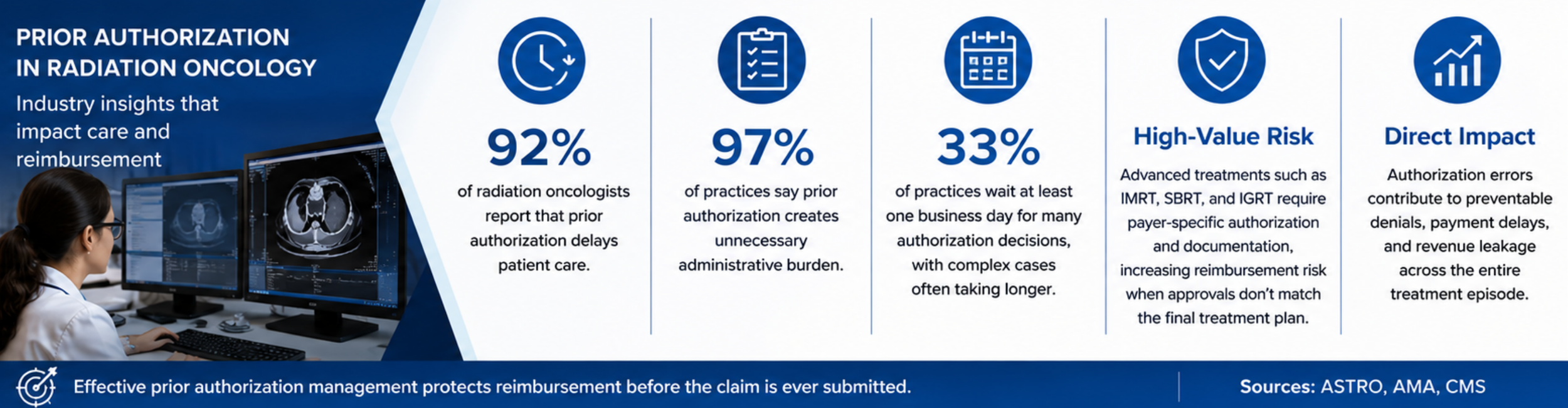
Authorization Findings from Our Assessment
Our comprehensive assessment identified several authorization-related issues impacting reimbursement.
Treatment modality approvals did not always align with the prescribed therapy.
Additional documentation required for IMRT, SBRT, and IGRT was not consistently submitted.
Authorizations expired before completion of multi-week treatment plans.
Treatment plan revisions were not reconciled with existing approvals.
Medical necessity documentation varied across payer requirements.
High-value authorization denials were not consistently prioritized for appeal.
Manual tracking processes delayed authorization management and claim submission.
These issues affected both Medicare Advantage and commercial payer claims, contributing directly to delayed reimbursement and unnecessary administrative effort.
Key Prior Authorization Challenges
We identified several gaps within the practice's prior authorization management process.
➤ Authorization requirements for advanced radiation therapy services varied significantly between payers and required continuous monitoring throughout the patient's treatment journey.
➤ Changes in treatment modality, fraction count, or treatment duration were not consistently reflected in updated authorizations before billing.
➤ Authorization performance was not monitored by payer or treatment type, limiting visibility into recurring denial patterns and reimbursement risks.
➤ No centralized authorization workflow existed to proactively identify authorization issues before claims were submitted.
As a result:
Authorization-related denials continued to increase.
High-value radiation therapy claims remained in accounts receivable longer than expected.
Staff spent considerable time managing preventable appeals.
Reimbursement turnaround slowed across major payers.
Revenue performance remained below expectations despite stable treatment volumes.
During our six-month assessment:
22% of reviewed authorization requests required intervention.
Approximately $387,500 in reimbursement opportunities were identified as being at risk.
Authorization-related A/R exceeded the practice's internal performance targets.
Our Solution
We implemented a comprehensive prior authorization strategy tailored to radiation oncology reimbursement.
Treatment-Level Authorization Validation
Every authorization was validated against the physician's final treatment plan, including diagnosis, treatment modality, treatment site, and approved fraction count before services were delivered.
Payer-Specific Authorization Management
Our specialists developed payer-specific workflows for Medicare Advantage and commercial insurers, ensuring compliance with documentation requirements and authorization guidelines for advanced radiation therapy services.
Treatment Course Monitoring
Authorizations were continuously monitored throughout each patient's treatment course to identify expired approvals, treatment modifications, and additional authorization requirements before claims were submitted.
Clinical Documentation Review
Medical necessity documentation was reviewed before authorization submission to support IMRT, SBRT, IGRT, simulation, and treatment planning services according to payer-specific policies.
Authorization Performance Reporting
Monthly dashboards tracked authorization turnaround times, denial trends, payer performance, and reimbursement risks, providing leadership with greater visibility into authorization performance.
Results
Following implementation of our Radiation Oncology Prior Authorization Services, the practice achieved measurable improvements across key revenue cycle metrics.
Key Outcomes
Reduced authorization-related denials by 39%
Protected approximately $387,500 in reimbursement opportunities
Improved first-pass claim acceptance from 91% to 98%
Reduced authorization-related A/R by 35%
Reduced authorization turnaround time by 31%
Improved payer compliance and authorization accuracy
Increased operational visibility through real-time performance reporting
The practice strengthened reimbursement performance while allowing physicians and staff to focus on delivering timely patient care.
Performance Transformation: Before vs. After
| Metric | Before | After |
|---|---|---|
| First-Pass Claim Acceptance | 91% | 98% |
| Authorization Denial Rate | 16% | 10% |
| Authorization-Related A/R | Baseline | -35% |
| Authorization Turnaround Time | Baseline | -31% |
| Reimbursement Opportunity | Not Measured | $387,500 Protected |
By strengthening prior authorization workflows, payer verification, and documentation, the practice reduced authorization-related denials and protected $387,500 in reimbursement opportunities.
If your radiation oncology practice is facing authorization delays, payer denials, or reimbursement risks, our Radiation Oncology Prior Authorization Services can help protect your revenue.
Request Your Complimentary Billing Assessment
Every prior authorization plays a critical role in protecting reimbursement. Even small workflow gaps can lead to avoidable denials, delayed payments, and revenue loss. Complete the form to receive a complimentary billing assessment and uncover opportunities to strengthen your radiation oncology revenue cycle.
