

Ocular trauma ICD-10 coding can be challenging because eye injuries often involve multiple structures, laterality requirements, and treatment phase tracking. Small documentation gaps—such as missing foreign body details or incorrect encounter phase selection—can lead to coding errors or claim rejections.
Understanding common error points and applying the right coding steps helps ensure proper injury classification and consistent code selection. This blog outlines key coding structure, frequent mistakes, and practical Do’s and Don’ts for ocular trauma ICD-10 coding.
Understanding Ocular Trauma Coding Structure in ICD-10
Ocular trauma coding starts with identifying the correct ICD-10 category before selecting the specific injury code. Eye injuries can vary from minor surface injuries to severe globe damage, so choosing the correct category helps reflect the injury type, severity, and treatment stage. Most traumatic eye injuries are coded under:
S05 – Injury of Eye and Orbit
Within this category, codes are divided based on:
Type of injury (contusion, laceration, rupture, foreign body)
Laterality (right, left, unspecified)
Encounter phase (initial, subsequent, sequela)
Eye trauma coding complexity increases when injuries involve:
Orbit fractures
Eyelid injuries
Retinal complications
Optic nerve involvement
Post-traumatic complications
Common Causes of Ocular Trauma Coding Errors
Errors in Ocular Trauma ICD-10 coding usually occur when key clinical details are unclear, incomplete, or interpreted incorrectly during code selection. Because eye trauma codes rely heavily on injury depth, laterality, and treatment phase, even small documentation gaps can lead to coding errors.
Common causes include:
Provider documentation using non-specific terms like “eye injury”
Missing laterality in ED notes
Surgical notes documenting severity not reflected in coding
Confusion between open globe and closed globe injuries
Missing foreign body depth documentation
Not linking long-term complications to original trauma
Want to know the key billing challenges in Ophthalmology and how they affect coding performance? Check out our Ophthalmology billing challenges guide.
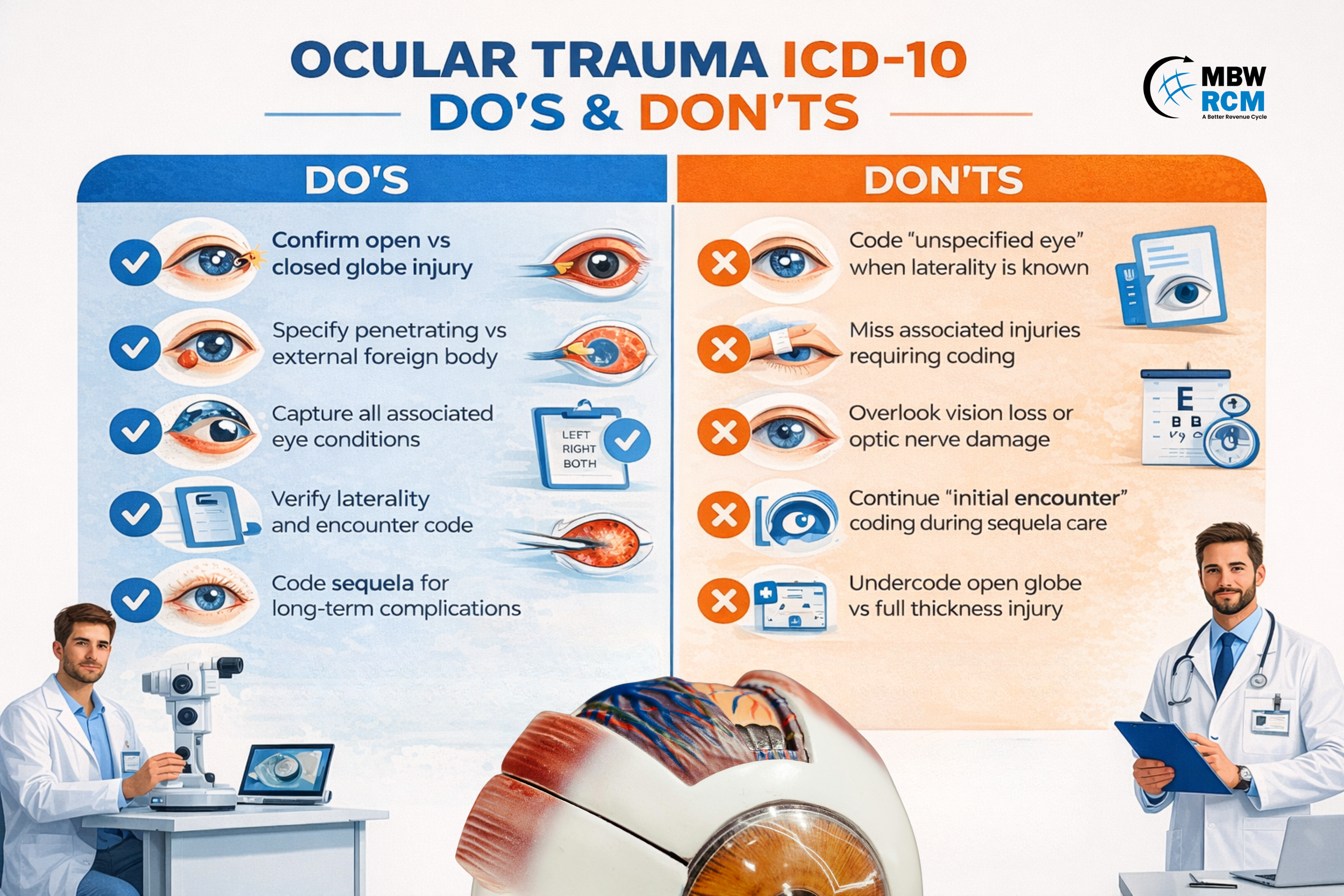
DO’s in Ocular Trauma ICD-10 Coding
Applying correct coding practices in Ocular Trauma ICD-10 requires careful review of injury documentation, anatomical involvement, and treatment stage. The following Do’s highlight key actions that support proper injury classification and correct code selection in eye trauma cases.
1. Do Confirm Globe Status Before Selecting Codes
Always verify if the injury is:
Open globe (rupture, full-thickness laceration, penetrating injury)
Closed globe (contusion, superficial laceration, corneal abrasion)
Open globe injuries fall into higher severity code ranges and often align with surgical intervention. Coding closed globe when documentation supports open globe results in undercoding and claim risk.
Documentation Clues for Open Globe:
Tissue prolapse
Full thickness corneal or scleral tear
Intraocular foreign body
Emergency globe repair surgery
2. Do Match Foreign Body Documentation to Code Depth
Foreign body coding in Ocular Trauma ICD-10 depends on the exact anatomical location of the object within ocular structures.
ICD-10 differentiates surface foreign bodies, partial thickness embedded foreign bodies, and intraocular foreign bodies, which directly impacts code selection and injury classification. Ocular trauma coding requires identifying if foreign body is:
Query Providers If Missing:
Was FB removed surgically?
Was FB inside anterior chamber or vitreous?
3. Do Code Associated Ocular Complications When Documented
Eye trauma frequently causes secondary damage. Never assume primary injury code covers everything. Secondary complications may involve anterior segment, posterior segment, or optic nerve structures depending on injury mechanism and force of impact, and should be captured when clearly documented.
Common additional diagnoses:
Traumatic hyphema
Traumatic cataract
Retinal detachment
Vitreous hemorrhage
Traumatic optic neuropathy
Missing these reduces coding accuracy and severity representation.
4. Do Apply the Correct 7th Character Based on Treatment Phase
Ocular trauma ICD-10 injury codes under S05 category require a 7th character to indicate the phase of care. Missing or incorrect assignment is one of the most common rejection reasons in eye trauma claims.
This value is determined based on treatment phase classification, including active management, routine healing care, or management of late ocular trauma complications.
Correct 7th Character Usage for Eye Trauma
Ocular Trauma Example — Correct 7th Character
Day 1:
Patient presents with globe rupture → Emergency surgery
👉 Use Initial Encounter (A)
2 Weeks Later:
Patient returns for healing follow-up
👉 Use Subsequent Encounter (D)
6 Months Later:
Patient develops traumatic cataract due to injury
👉 Use Sequela (S) + Current complication diagnosis
5. Do Cross-Check Imaging Reports for Hidden Trauma
Imaging helps identify deeper structural injuries that may not be visible during initial clinical examination, especially in high-impact or penetrating eye trauma cases.
CT orbit or ocular ultrasound often reveals:
Occult orbital fractures
Retained foreign bodies
Posterior segment injuries
These findings may not appear in initial exam documentation but must be coded if confirmed.
6. Do Confirm If Injury Is Mechanical vs Chemical vs Radiation
Correctly identifying whether the injury is Mechanical, Chemical, or Radiation-related is necessary because each exposure type causes different patterns of ocular tissue damage and falls under different coding classifications. Not all eye trauma is mechanical.
Examples requiring different coding logic:
Chemical splash injuries
Thermal burns
Radiation exposure injuries
Always verify injury mechanism. This helps ensure the injury is assigned to the correct ICD-10 category and supports proper selection of related diagnosis and external cause codes when documented.
DON’Ts in Ocular Trauma ICD-10 Coding
Avoiding common coding mistakes is just as important as applying correct coding steps in Ocular Trauma ICD-10. The following Don’ts highlight frequent documentation and code selection errors that can lead to incorrect injury classification and claim issues in eye trauma cases.
1. Don’t Code “Unspecified Eye” When Laterality Is Documented
If operative note says:
“Left globe rupture repair”
But ED note says:
“Eye injury”
Always code based on highest documentation specificity.
Laterality may appear in operative reports, imaging reports (CT orbit, MRI orbit), ophthalmology consult notes, or procedure documentation. If laterality is documented anywhere in the encounter, it should be captured in final coding.
Frequent use of unspecified eye codes can lead to payer edits, medical record review requests, and audit scrutiny because eye trauma typically requires precise laterality reporting.
2. Don’t Assume Corneal Laceration = Open Globe Injury
Corneal injuries can be:
Lamellar (partial thickness) → Closed globe
Full thickness → Open globe
If thickness not documented → Query provider.
Documentation may use terms like corneal cut, tear, or wound, which do not automatically confirm full thickness injury. Confirmation often comes from findings such as positive Seidel test, aqueous leakage, anterior chamber collapse, or globe repair procedure.
Procedure type can help determine severity. Minor repair may indicate superficial injury, while globe repair usually indicates open globe trauma.
3. Don’t Miss Combined Injury Scenarios
Example frequent coding error: Missing additional injury coding when multiple ocular or orbital injuries are documented in the same encounter.
Documented:
Globe rupture
Orbital floor fracture
Eyelid laceration
Incorrect coding: Only globe rupture coded.
Correct approach: Each injury coded separately if documented and treated.
Eye trauma often occurs with surrounding orbital or facial injuries. Imaging and specialty consult notes may reveal orbital fractures, lacrimal injuries, orbital hematoma, or muscle entrapment that should be reviewed when documented.
4. Don’t Ignore Post-Traumatic Vision Loss Coding Opportunities
If trauma results in:
Permanent vision loss
Visual field defects
Optic nerve damage
These may require additional diagnosis coding beyond injury code.
Vision loss or structural damage may be identified during follow-up visits rather than initial presentation. Follow-up testing may identify trauma-related complications such as macular hole, retinal scarring, or choroidal rupture when documented.
Not sure if your Billing and Coding approach for Retina, Cataract and Glaucoma is optimized? Check out our Ophthalmology billing guide to learn more.
5. Don’t Continue Acute Injury Codes During Long-Term Follow-Up
If patient returns 6 months later for: Post-traumatic glaucoma
Correct approach:
Sequela injury code
Current condition code
Not initial or subsequent encounter injury coding.
Long-term trauma complications can include traumatic glaucoma, traumatic cataract, delayed retinal detachment, or chronic inflammation related to prior trauma. Using acute injury codes during long-term management can create inaccurate injury timelines. For additional ocular trauma coding guidance, refer to the AAO ocular trauma coding guidance:
6. Don’t Ignore Surgical Procedure Clues
If patient undergoes:
Vitrectomy
Globe repair
Foreign body removal from vitreous
These strongly suggest penetrating or severe injury classification.
Certain ophthalmic procedures correlate with deeper injury severity. Vitrectomy often indicates posterior segment involvement. Intraocular foreign body removal confirms penetrating trauma. Globe repair usually indicates full thickness injury. Emergency surgery soon after injury often indicates vision-threatening trauma.
Quality Control Checklist for Ocular Trauma Coding
A structured review helps ensure all required ocular trauma coding elements are addressed and reduces the risk of missing key injury details during final code selection. Before finalizing coding, confirm:
✓ Injury type confirmed (open vs closed)
✓ Laterality assigned
✓ 7th character applied correctly
✓ Associated injuries captured
✓ Foreign body depth confirmed
✓ Documentation supports severity
✓ Sequela evaluated if applicable
Conclusion:
Ocular trauma ICD-10 coding requires close attention to injury type, laterality, treatment phase, and associated complications to support correct code selection and reduce coding errors.
If you are looking to improve coding accuracy and reduce denials, expert Ophthalmology billing services can help manage complex eye trauma cases more efficiently. Contact MBW RCM to learn how our team can support your billing and coding needs.
Request for Information
Facing ocular trauma coding challenges like globe injury classification errors, laterality issues, foreign body documentation gaps, or eye trauma claim denials? An ophthalmology coding expert can review your workflows and identify areas for improvement.
Fill out the form below to connect with an MBW RCM specialist about resolving common ocular trauma coding challenges and improving your billing and coding performance.