
Top 5 Ophthalmology Medical Billing Challenges in Healthcare
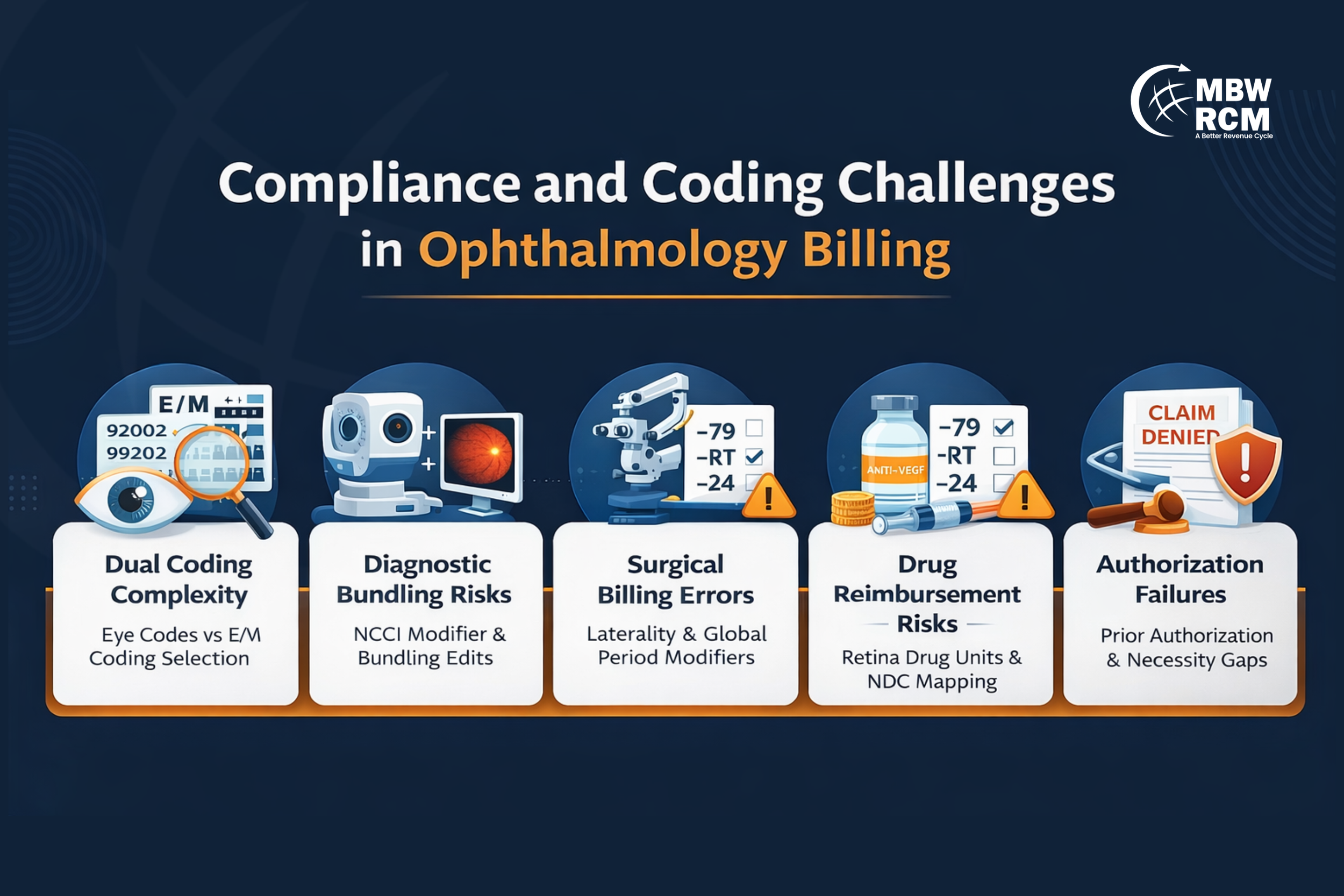
Ophthalmology practices operate in a highly specialized reimbursement environment within outpatient care. From surgical procedures and diagnostics to specialty drug billing, small workflow gaps can lead to major revenue loss. With stricter payer rules and evolving coding guidelines, Ophthalmology Medical Billing requires strong documentation accuracy and payer-specific validation.

This blog highlights the top five challenges affecting Ophthalmology Billing performance and how leading practices are improving reimbursement and reducing denials.
Table of Contents
1. Dual Coding Complexity: Eye Codes vs. E/M Codes
Ophthalmology providers must choose between Eye visit codes (92002–92014) and E/M codes (99202–99215). CMS Billing for Retina, Cataract and Glaucoma data shows that incorrect E/M leveling accounts for nearly 18% of ophthalmology audit findings, especially after MDM-based E/M updates.
Incorrect code selection directly impacts Ophthalmology Medical Billing accuracy and reimbursement predictability. In this scenario, reimbursement may vary such as:
Comprehensive Eye Code reimbursement: ~$90–$160
Level 4 E/M reimbursement: ~$130–$210 (payer dependent)
For Instance:
A diabetic retinopathy patient receives a dilated exam, OCT review, and systemic disease management discussion.
Key billing risks:
Incorrect MDM scoring documentation
Payer Eye code frequency edits (often 1 per 12 months)
Misalignment with Ophthalmology CPT Coding guidelines
How top practices address it:
Deploy code selection decision trees inside EHR workflows
Integrate clinical prompts tied to diagnosis mapping
Align documentation templates with Eye Care Revenue Cycle metrics
Key Differences Between Eye Visit Codes and E/M Billing
2. Diagnostic Testing Bundling and Modifier Misuse
Ophthalmology clinics perform diagnostics in 70–85% of patient encounters. NCCI edits frequently bundle imaging with exam services, impacting Ophthalmology Medical Billing compliance and reimbursement.
For Instance:
Glaucoma monitoring visit includes OCT + visual field + optic nerve photo.
Key billing risks:
Incorrect modifier -59 usage increasing audit probability by ~22%
Failure in Ophthalmology Claims Processing due to NCCI bundling edits
Incorrect test frequency vs payer medical policy
How top practices address it:
Automated diagnosis-to-test validation
Pre-claim scrubbers aligned with Eye Care Insurance Claims rules
Integrated testing workflows supporting Ophthalmology Insurance Billing accuracy
3. Laterality and Surgical Global Period Errors
Global surgical period errors account for nearly 12% of surgical claim denials in ophthalmology. Laterality accuracy is critical for surgical reimbursement integrity and downstream Ophthalmology Medical Billing workflows.
For Instance:
Cataract surgery right eye → follow-up left eye evaluation → incorrectly billed inside global.
Key billing risks:
Incorrect modifier usage (-24, -79, RT, LT)
Mistakes in Cataract Surgery Billing episode tracking
Documentation gaps affecting Billing for Retina, Cataract and Glaucoma
How top practices address it:
Automated surgical timeline tracking
Case-level QA review before claim submission
Surgical workflow integration supporting Ophthalmology Billing Company standards
4. Drug and Injection Reimbursement Variability (Retina Procedures)
Retina drug inventory may represent 35–50% of practice operating cost. Errors in units, NDC mapping, or wastage reporting directly impact margins and downstream Ophthalmology Medical Billing performance.
For Instance:
Anti-VEGF injection billed with incorrect units or missing JW modifier.
Key billing risks:
Lost reimbursement from wastage reporting errors
Inventory mismatch impacting Retina Billing Coding
Delayed AR cycles impacting Ophthalmology Denial Management workflows
Looking for the Guide to Optometry Billing and Coding? Explore this resource to understand coding structure, payer rules, and documentation requirements:
How top practices address it:
Drug inventory-to-billing integration
Barcode drug capture at chairside
Monthly reconciliation dashboards supporting Ophthalmology Billing Companies
Retina Drug Billing Risk and Revenue Protection Controls
5. Prior Authorization and Medical Necessity Documentation Gaps
Prior authorization denial rates for advanced imaging and specialty drugs range from 8–15% without automated verification workflows. These directly affect Ophthalmology Medical Billing turnaround times.
For Instance:
OCT performed without updated payer approval → claim denied.
Key billing risks:
Failure in Ophthalmology Prior Authorization documentation criteria
Missed coverage exclusions linked to Non-Covered Charges in Ophthalmology
Authorization mismatch during Eye Care Insurance Claims adjudication
How top practices address it:
Real-time eligibility and authorization verification
Documentation templates aligned to payer clinical criteria
Centralized workflows managed through specialized Ophthalmology Billing Company operations
How to Effectively Reduce Ophthalmology Billing Errors
Reducing errors in Ophthalmology Billing requires strong alignment between clinical documentation, payer coding edits, and automated charge validation.
High-performing practices improve clean claim rates by aligning EHR templates with Ophthalmology Medical Coding standards — especially for diagnostics, surgical global tracking, and drug unit reporting. Focused audits on high-risk services like retina injections and cataract procedures help detect revenue leakage early.
Strategic Implementation Focus Areas:
Specialty-specific coder training
Automated claim scrubbing before submission
Monthly denial root cause monitoring
Standardized documentation for Ophthalmology Medical Billing compliance
Key Strategies to Prevent Ophthalmology Claim Denial
Most ophthalmology denials occur due to authorization errors, modifier misuse, and frequency limit violations. Strengthening front-end verification and payer rule validation improves first-pass claim acceptance and reduces rework costs in Ophthalmology Claims Processing workflows.
Denial Prevention Best Practices:
Verify eligibility, referrals, and plan-specific imaging coverage 48 hours before visit
Use payer rule engines to validate modifiers, NCCI edits, and frequency limits pre-submission
Categorize denials by root cause (coding, authorization, medical necessity, eligibility)
Track denial trends using dashboards integrated into Ophthalmology Claims Processing workflows
How can automation help reduce ophthalmology claim denials?
Automation improves Ophthalmology Medical Billing efficiency by reducing manual errors and standardizing payer rule validation across coding, authorization, and documentation workflows.
Advanced systems detect missing modifiers, incorrect drug units, and medical necessity gaps before submission.
Automated modifier validation, smart documentation prompts, predictive denial alerts, and end-to-end automation help improve first-pass acceptance and speed up the Ophthalmology Billing cycle.
Strengthen RCM with Reliable Ophthalmology Medical Billing
Effective revenue performance in eye care depends on precise documentation, payer-aligned workflows, and strong denial prevention. As claim requirements become more detailed, practices using specialized Ophthalmology Billing and Coding Solutions are better equipped to reduce denials, improve reimbursement timelines, and maintain compliance.
If you want to strengthen billing performance, optimize claims, and reduce revenue leakage, the right expertise matters. Contact MBW RCM to learn how our Ophthalmology Billing and Coding Solutions can support your practice’s financial performance and operational efficiency.
FAQs: Ophthalmology Billing Compliance
Request for Information
Facing Ophthalmology Medical Billing challenges like coding errors, documentation gaps, or claim denials in your practice? Connect with an ophthalmology billing expert to review your workflows and identify improvement opportunities.
Fill out the form below to speak with an MBW RCM specialist about resolving common ophthalmology billing challenges.
