Top Anesthesia Billing Trends in Medical Coding for 2026

Anesthesia billing has always required more than selecting the correct CPT® code. In 2026, coding teams must account for anesthesia time, base units, provider roles, modifiers, medical direction, documentation, payer rules, and procedure-specific requirements before a claim reaches the payer.
For hospitals, anesthesia groups, ambulatory surgery centers (ASCs), and physician practices, these requirements make anesthesia one of the more specialized areas of medical coding and billing.
At the same time, coding workflows are changing. Greater use of automation, increased payer scrutiny, tighter documentation requirements, and more sophisticated claim edits are influencing how anesthesia services are coded and reimbursed.
Here are the top anesthesia billing trends in medical coding for 2026 and what healthcare organizations should be watching.
Table of Contents
1. Greater Scrutiny of Anesthesia Modifiers
Anesthesia modifiers remain one of the most important areas of claim accuracy.
Modifiers such as AA, QK, QX, QY, QZ, and AD communicate who performed the anesthesia service and whether medical direction or supervision was involved.
Common examples include:
AA – Anesthesia services personally performed by the anesthesiologist
QK – Medical direction of two, three, or four concurrent anesthesia procedures
QX – CRNA service with medical direction by a physician
QY – Medical direction of one CRNA by an anesthesiologist
QZ – CRNA service without medical direction by a physician
AD – Medical supervision by a physician of more than four concurrent anesthesia procedures
Selecting a modifier based only on provider type can create problems. The modifier should reflect the actual anesthesia arrangement supported by the documentation.
Coding teams therefore need to reconcile physician records, CRNA documentation, concurrent cases, anesthesia times, and medical direction requirements before submitting the claim.
2026 trend: Modifier validation is increasingly becoming a pre-bill control rather than an issue discovered after a denial.
2. Anesthesia Time Documentation Is Receiving More Attention
Unlike many physician services, anesthesia reimbursement depends heavily on time.
Anesthesia time generally begins when the anesthesia practitioner starts preparing the patient for induction in the operating room or equivalent area and ends when the practitioner is no longer providing personal attendance and the patient may safely be placed under postoperative supervision.
Even small inconsistencies can affect the number of billable time units.
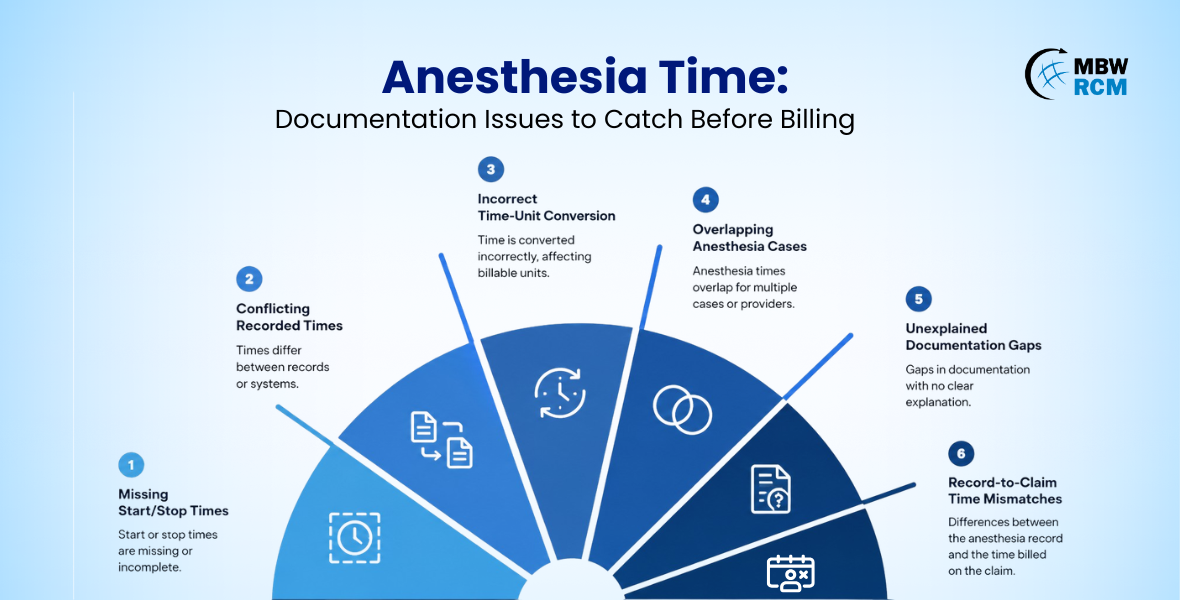
Coding and billing teams should watch for:
Missing start or stop times
Conflicting times between records
Incorrect time-unit conversion
Overlapping cases
Unexplained gaps in anesthesia documentation
Differences between the anesthesia record and submitted claim
The increasing availability of electronic anesthesia records makes automated time validation possible, but automation does not eliminate the need for coding review.
2026 trend: Organizations are placing stronger controls around anesthesia time before claims are released.
3. Medical Direction Documentation Is Becoming a Coding Priority
Medical direction remains a major compliance and reimbursement consideration when anesthesiologists work with CRNAs.
The claim must accurately represent what occurred clinically.
Coding teams need sufficient documentation to determine whether the requirements for medical direction have been satisfied and whether the physician and CRNA claims are consistent.
That may require reviewing documentation related to the anesthesiologist's participation, concurrent procedures, provider involvement, and applicable payer requirements.
A mismatch can lead to:
Incorrect modifier combinations
Payment reductions
Claim denials
Additional documentation requests
Compliance concerns
For coding departments, medical direction validation is increasingly becoming part of the standard anesthesia coding workflow rather than a downstream billing check.
4. AI-Assisted Coding Is Expanding, but Human Review Still Matters
Artificial intelligence and automation are becoming more common across medical coding.
Anesthesia is no exception.
Technology can assist coding teams by identifying:
Missing modifiers
Incomplete anesthesia times
Provider inconsistencies
Documentation gaps
Potential coding conflicts
Claim-edit failures
Historical denial patterns
However, anesthesia cases frequently require clinical and billing context that cannot be determined from a single data field.
For example, an automated system may identify the provider type but still require validation of the medical direction arrangement before the appropriate modifier can be assigned.
The shift in 2026 is toward AI-assisted coding rather than fully autonomous anesthesia coding.
Technology can identify exceptions quickly, while experienced anesthesia coders determine how those exceptions should be resolved.
5. Pre-Bill Coding Edits Are Replacing Post-Denial Corrections
Correcting an anesthesia claim after denial is considerably less efficient than identifying the problem before submission.
For that reason, more organizations are introducing anesthesia-specific edits into their pre-bill workflow.
These edits may identify:
Missing anesthesia modifiers
Invalid modifier combinations
Missing time information
Provider mismatches
CPT® and diagnosis inconsistencies
Medical direction conflicts
Duplicate services
Missing authorization information
This represents an important shift in revenue cycle management.
Instead of asking "Why was this anesthesia claim denied?", organizations are increasingly asking "What could prevent this claim from being paid before we submit it?"
That approach can reduce avoidable rework while supporting stronger first-pass claim acceptance. For more on anesthesia coding and physical status reporting, read our Anesthesia Physical Status Modifiers P1–P6 Guide.
6. Payer-Specific Coding Rules Are Becoming Harder to Manage
Anesthesia billing cannot always rely on one standardized workflow for every payer.
Medicare, Medicaid programs, commercial insurers, and managed care plans can have different requirements involving:
Time units
Modifier usage
Medical direction
Provider eligibility
Prior authorization
Documentation
Claim submission
Reimbursement methodology
Applying the same coding logic across every payer can therefore create preventable billing problems.
Anesthesia coding teams increasingly need payer-specific edit libraries and billing rules that can be updated as requirements change.
For organizations managing multiple facilities or payer contracts, maintaining these rules centrally can improve consistency across anesthesia claims.
7. Documentation Quality Is Becoming More Closely Connected to Revenue
Anesthesia documentation is no longer simply a clinical recordkeeping issue.
It directly influences whether coding teams can submit an accurate claim.
Missing or inconsistent information involving anesthesia time, provider participation, medical direction, procedure details, or patient status can delay coding and ultimately reimbursement.
This is leading hospitals and anesthesia groups to place more emphasis on documentation improvement before the account reaches billing.
A stronger workflow connects:
Clinical documentation → Coding validation → Charge capture → Claim submission → Reimbursement
When documentation problems are identified earlier, coding teams spend less time chasing information after the encounter.
8. MAC and Procedure-Specific Coding Requires Greater Attention
Monitored Anesthesia Care (MAC) continues to require careful coding and documentation.
Coding teams must distinguish between different anesthesia services and ensure that the documentation supports the service reported.
Depending on the payer and clinical circumstances, additional requirements may apply.
This makes procedure-specific knowledge increasingly valuable for anesthesia coding teams.
Rather than treating every anesthesia encounter through the same coding workflow, organizations are developing coding rules around procedure type, setting, patient circumstances, and payer requirements. Want to better understand anesthesia coding for monitored care? Explore this resource on MAC anesthesia billing and coding.
9. Anesthesia Coding Analytics Are Moving Beyond Denial Rates
Denial rate remains important, but it does not tell the entire story.
Healthcare organizations are increasingly using coding and billing data to identify problems before they significantly affect revenue.
Useful anesthesia metrics can include:
Breaking these metrics down by facility, provider, payer, procedure, and denial reason can make them considerably more actionable.
10. Specialized Anesthesia Coding Expertise Is Becoming More Valuable
Perhaps the biggest trend is specialization itself.
Anesthesia coding combines several variables that must work together correctly:
Procedure + Base Units + Time Units + Modifiers + Provider Role + Documentation + Payer Rules
A mistake in any one of these areas can affect reimbursement.
This complexity is encouraging hospitals and anesthesia organizations to evaluate whether their existing billing teams have sufficient anesthesia-specific expertise.
Specialized coding teams can also identify recurring problems upstream, including documentation gaps, modifier inconsistencies, charge capture delays, and payer-specific claim failures. Looking to strengthen your anesthesia revenue cycle? Explore practical approaches for improving anesthesia billing performance and addressing coding, documentation, and reimbursement challenges.
What These Anesthesia Billing Trends Mean for Healthcare Organizations
The direction of anesthesia coding in 2026 is clear: more validation is happening before the claim reaches the payer.
Organizations relying primarily on downstream denial management may find themselves repeatedly correcting problems that could have been prevented earlier.
A stronger anesthesia revenue cycle connects clinical documentation, coding, provider-role validation, payer requirements, claim edits, and reimbursement analytics.
That means the goal is no longer simply to code an anesthesia case correctly.
The goal is to create a process in which every anesthesia claim is validated for coding, documentation, time, modifiers, and payer requirements before submission.
Prepare Your Anesthesia Billing for What Comes Next
Anesthesia reimbursement can be affected by a single modifier, an incomplete time entry, inconsistent medical direction documentation, or a payer-specific billing requirement.
MBW RCM provides specialized Anesthesia Billing Services designed to support accurate coding, modifier validation, charge capture, denial management, A/R follow-up, and reimbursement workflows.
If anesthesia coding issues, recurring denials, or delayed reimbursements are affecting your revenue cycle, identifying where those problems begin can be the first step toward improving performance.
Request an anesthesia billing assessment with MBW RCM and identify where coding and billing gaps may be delaying your reimbursement.
FAQs on Anesthesia Billing Trends in Medical Coding
Stay Ahead of Changing Anesthesia Coding Requirements
As anesthesia coding becomes more complex, modifier accuracy, time documentation, medical direction, and payer-specific rules can directly influence whether claims move smoothly toward reimbursement.
Are your anesthesia coding workflows keeping pace with these changes?
Request an Anesthesia Billing & Coding Review →