Anesthesia Modifiers: AA, QK, QX, QY, QZ & AD Explained

Anesthesia billing is different from many other areas of medical billing because reimbursement depends on more than selecting the correct CPT® code. Who performed the anesthesia, whether an anesthesiologist personally performed or medically directed the service, how many anesthesia cases were running concurrently, who administered the anesthesia, and how the service was documented can all influence how the claim should be coded and paid.
That is where anesthesia modifiers become important.
Modifiers AA, QK, QX, QY, QZ, and AD communicate the relationship between the anesthesiologist, Certified Registered Nurse Anesthetist (CRNA), anesthesiologist assistant, and the anesthesia service being billed.
For hospitals, health systems, anesthesia groups, and physician practices, incorrect modifier assignment can create more than a coding problem. It can affect reimbursement, generate payer edits, increase claim rework, and create compliance concerns when the modifier does not match the actual clinical arrangement.
This guide explains the major anesthesia billing modifiers, when they are used, their Medicare payment implications, common coding mistakes, and what organizations should review before an anesthesia claim is submitted.
Table of Contents
Why Anesthesia Modifiers Matter in Medical Billing
Unlike many physician services, Medicare anesthesia payment generally considers base units, anesthesia time units, and a locality-specific anesthesia conversion factor.
CMS states that anesthesia payment is generally calculated using:
(Base Units + Time Units) × Anesthesia Conversion Factor
For Medicare, one anesthesia time unit equals 15 minutes of anesthesia time. CMS also requires the actual elapsed anesthesia time to be reported in minutes on the claim.
For calendar year 2026, CMS reports that anesthesia base units remain unchanged from 2025.
But calculating the units is only part of the process.
The modifier tells the payer how the anesthesia service was performed and the provider relationship involved in the case.
As CMS explains:
“Physicians report the appropriate modifier to denote whether the service meets the requirements for payment at the personally performed rate, medically directed rate, or medically supervised rate.”
This makes modifier selection a reimbursement issue as much as a coding issue.
Quick Reference: AA, QK, QX, QY, QZ and AD Anesthesia Modifiers
| Modifier | What It Means | Typically Reported By | Common Scenario |
|---|---|---|---|
| AA | Anesthesia personally performed by an anesthesiologist. | Anesthesiologist | Physician personally performs the anesthesia service. |
| QK | Medical direction of 2, 3, or 4 concurrent anesthesia procedures. | Anesthesiologist | Physician medically directs multiple qualified anesthesia providers. |
| QX | CRNA service with medical direction by a physician. | CRNA | CRNA performs the anesthesia service under qualifying medical direction. |
| QY | Medical direction of one qualified nonphysician anesthetist. | Anesthesiologist | Physician medically directs a single CRNA or other qualified nonphysician anesthetist. |
| QZ | CRNA service without medical direction by a physician. | CRNA | CRNA performs anesthesia without physician medical direction. |
| AD | Medical supervision by a physician of more than 4 concurrent anesthesia procedures. | Anesthesiologist | Physician supervises more than four concurrent anesthesia cases. |
The difference between these modifiers may appear small on a claim, but the reimbursement implications can be significant.
AA Modifier: Anesthesia Personally Performed by the Anesthesiologist
Modifier AA indicates that anesthesia services were personally performed by the anesthesiologist.
CMS defines AA as:
“Anesthesia Services performed personally by the anesthesiologist.”
A typical AA scenario occurs when an anesthesiologist manages the anesthesia case personally rather than medically directing a CRNA or another qualified anesthesia professional.
Under Medicare rules, personally performed anesthesia can qualify for payment at the personally performed rate when applicable requirements are met.
Example
A hospital anesthesiologist personally provides the complete anesthesia service for a surgical patient without medically directing another qualified anesthesia provider.
The anesthesia CPT code would generally be reported with modifier AA, assuming the documentation supports the arrangement.
Coding Risk to Watch
A common mistake is assigning AA simply because an anesthesiologist was involved in the case.
Being involved does not automatically mean the anesthesia service was personally performed.
Medical coders should determine whether the documentation supports personally performed anesthesia, medical direction, or medical supervision before selecting the modifier. Want to learn more about anesthesia billing? Read our blog, “Top 15 Procedure Codes for Anesthesia: Billing Guide.”
QK Modifier: Medical Direction of 2–4 Concurrent Anesthesia Procedures
Modifier QK indicates that an anesthesiologist medically directed two, three, or four concurrent anesthesia procedures involving qualified individuals.
This modifier is especially important for hospitals and anesthesia groups operating a care-team model where an anesthesiologist oversees multiple anesthesia cases.
Under Medicare, medical direction involves more than simply being available.
CMS identifies specific activities that must be performed to satisfy medical direction requirements, including:
Performing the pre-anesthetic examination and evaluation
Prescribing the anesthesia plan
Personally participating in the most demanding procedures of the anesthesia plan, including induction and emergence when applicable
Ensuring other procedures are performed by qualified anesthesia personnel
Monitoring anesthesia administration at frequent intervals
Remaining physically present and available for immediate diagnosis and treatment of emergencies
Providing indicated post-anesthesia care
CMS requires the applicable medical direction requirements and documentation to be satisfied for the physician service to qualify for payment at the medically directed rate.
Medicare Payment Impact
For qualifying medical direction, Medicare determines the physician's payment at 50% of the allowance for the service if it had been performed by the physician alone.
That payment methodology makes accurate distinction between AA and QK particularly important.
Example
An anesthesiologist medically directs three concurrent anesthesia cases, each being performed by qualified anesthesia professionals, and fulfills the Medicare medical direction requirements.
The physician would generally report the applicable anesthesia code with QK. For more on anesthesia billing, read “Anesthesia Coding & Modifiers: Understanding Payment Series Codes.”
QX Modifier: CRNA Service With Medical Direction
Modifier QX identifies anesthesia services performed by a CRNA with medical direction by a physician.
QX is therefore commonly the qualified anesthesia professional's side of a medically directed anesthesia arrangement.
For example, when an anesthesiologist medically directs one CRNA, the claims may generally reflect:
Anesthesiologist → QY
CRNA → QX
When an anesthesiologist medically directs two to four qualifying concurrent cases, the physician side may use QK while the medically directed CRNA reports QX when applicable.
Why QX Creates Coding Problems
QX should not be selected simply because an anesthesiologist was physically present somewhere in the hospital.
The documentation must support the medical direction arrangement.
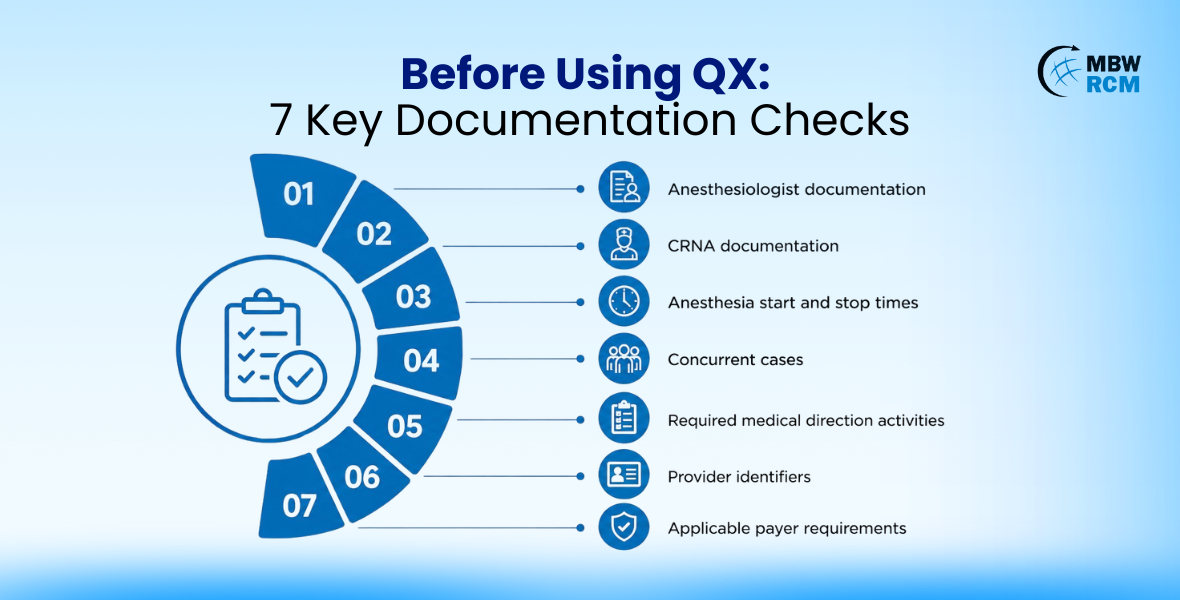
Coders should be able to reconcile:
Anesthesiologist documentation
CRNA documentation
Anesthesia start and stop times
Concurrent cases
Required medical direction activities
Provider identifiers
Applicable payer requirements
A mismatch between the physician's modifier and the CRNA's modifier can result in inconsistent claims. Need a better understanding of anesthesia coding challenges? Explore our HCC Coding and Billing for Anesthesia case study to see how specialized coding support can improve billing accuracy and reimbursement.
QY Modifier: Medical Direction of One Qualified Nonphysician Anesthetist
Modifier QY represents medical direction of one qualified nonphysician anesthetist by an anesthesiologist.
This differs from QK primarily because of the number of concurrent cases.
Think of the basic distinction as:
1 medically directed case → QY
2–4 medically directed concurrent cases → QK
Example
An anesthesiologist medically directs one CRNA during a surgical procedure and satisfies the applicable medical direction requirements.
The anesthesiologist reports QY, while the medically directed CRNA generally reports QX.
CMS has specifically described this pairing for a single medically directed service.
Common QY Coding Error
One risk is automatically assigning QY whenever an anesthesiologist and CRNA appear on the same case.
The medical record must demonstrate that the requirements for medical direction were actually satisfied.
Hospitals should therefore make sure their anesthesia coding workflow does not determine modifiers solely from provider names or schedules.
QZ Modifier: CRNA Service Without Medical Direction
Modifier QZ indicates a CRNA service without medical direction by a physician.
This modifier is particularly important because CRNA practice and supervision requirements can vary depending on federal requirements, state law, facility type, and payer policy.
CMS notes that states may opt out of the federal CRNA physician supervision requirement, and its current anesthesiology information center reports that 19 states have chosen to opt out.
That does not mean QZ can automatically be applied based solely on the state.
Hospitals and anesthesia groups still need to consider:
State scope-of-practice requirements
Facility policies
Medicare requirements
Commercial payer policies
Actual clinical arrangement
Medical record documentation
QX vs. QZ
This distinction is critical:
QX = CRNA service with medical direction
QZ = CRNA service without medical direction
Incorrectly switching between these modifiers can cause the claim to communicate a provider relationship different from what actually occurred.
AD Modifier: Medical Supervision of More Than Four Concurrent Procedures
Modifier AD represents medical supervision by a physician of more than four concurrent anesthesia procedures.
This is substantially different from QK.
QK applies when the anesthesiologist medically directs two, three, or four qualifying concurrent anesthesia cases.
Once the arrangement exceeds four concurrent procedures, the circumstances can fall under medical supervision rather than medical direction.
Under Medicare's medically supervised payment methodology, the MAC may allow three base units per procedure, with an additional time unit potentially recognized when the physician documents presence at induction.
That creates an important operational issue for larger hospital anesthesia departments.
Concurrency is not merely a staffing metric. It can directly affect how anesthesia services are coded and reimbursed.
Medical Direction vs. Medical Supervision: Why the Difference Matters
The terms medical direction and medical supervision should not be treated as interchangeable.
For Medicare anesthesia billing, the distinction can affect both the modifier and the payment methodology.
An anesthesiologist managing up to four concurrent qualifying anesthesia cases may meet the requirements for medical direction when all required activities are performed.
But if the physician is involved in more than four concurrent anesthesia procedures, or performs other services that prevent the requirements for medical direction from being satisfied, the case may fall under medical supervision rules.
For hospital revenue cycle teams, that means scheduling data, anesthesia documentation, concurrency records, and coding workflows need to align.
The Documentation Behind the Modifier Matters
An anesthesia modifier should be the result of documented clinical circumstances, not a default value added by the billing system.
Before submitting a medically directed anesthesia claim, coding teams should verify that documentation supports the required activities.
For example, Medicare expects documentation supporting elements such as the pre-anesthetic evaluation, participation in demanding portions of the anesthesia plan, appropriate monitoring, availability, and post-anesthesia care.
Hospitals should also validate anesthesia time carefully.
CMS defines anesthesia time as a continuous period beginning when the anesthesia professional starts preparing the patient for anesthesia in the operating room or equivalent area and ending when the patient is safely placed under postoperative care.
A correct modifier cannot compensate for incorrect anesthesia time.
Common Anesthesia Modifier Errors Hospitals Should Watch For
Several problems repeatedly create risk in anesthesia coding workflows.
Using AA when another anesthesia professional participated.
Coders should verify whether the anesthesiologist personally performed the service or medically directed another provider.
Confusing QK and QY.
QY generally represents medical direction of one qualified nonphysician anesthetist, while QK represents two to four concurrent medically directed procedures.
Reporting QX without supported medical direction.
The physician's involvement and documentation must support the underlying medical direction arrangement.
Using QZ without validating payer and regulatory requirements.
CRNA practice arrangements can vary by state, facility, and payer.
Missing concurrency changes.
If an anesthesiologist moves from four concurrent cases to more than four, the billing implications may change.
Failing to reconcile physician and CRNA claims.
The modifiers submitted for each side of the anesthesia care team should tell a consistent story.
Treating QS as a replacement for a payment modifier.
CMS states that QS is informational. Actual anesthesia time and an appropriate anesthesia payment modifier must still be reported.
Anesthesia Coding Is More Than Selecting the Right Modifier
Hospitals processing high anesthesia volumes have multiple variables to manage simultaneously:
Procedure → Anesthesia CPT Code → Base Units → Time → Provider → Concurrency → Modifier → Payer Rules → Claim
An error anywhere in that sequence can affect reimbursement.
CMS also maintains NCCI edits for Medicare services and updates NCCI resources regularly. The 2026 NCCI Policy Manual includes a dedicated chapter covering anesthesia services and CPT codes 00000–01999.
That is why effective anesthesia coding requires more than memorizing AA, QK, QX, QY, QZ, and AD.
The coding team needs to understand how the clinical record, anesthesia care model, payer requirements, time reporting, CPT coding, modifiers, and claim submission fit together.
What Hospitals Should Review Before Submitting Anesthesia Claims
A strong pre-bill anesthesia coding review should answer several questions:
Who actually performed the anesthesia service?
Was an anesthesiologist personally performing, medically directing, or medically supervising?
Was a CRNA or anesthesiologist assistant involved?
How many cases were concurrent?
Were the medical direction requirements documented?
Are anesthesia start and stop times supported by the record?
Does the CPT code correspond with the procedure performed?
Does the modifier match the documented provider arrangement?
Do physician and CRNA claims align?
Have Medicare, MAC, state, and commercial payer requirements been checked?
These checks can identify problems before the claim reaches the payer instead of after a denial or payment discrepancy occurs.
Why Specialized Anesthesia Medical Coding Matters
Anesthesia claims combine clinical documentation, provider participation, time-based billing, concurrency rules, payer-specific requirements, and specialized modifiers.
For hospitals and physician groups managing thousands of anesthesia encounters, even a small percentage of coding inconsistencies can translate into substantial rework.
The challenge becomes greater when coding teams must distinguish between:
Personally performed anesthesia
Medical direction
Medical supervision
CRNA services
Monitored anesthesia care
Physical status modifiers
Qualifying circumstances
Anesthesia time
Base units
Payer-specific edits
A specialized anesthesia medical coding and billing team can provide another layer of review between clinical documentation and final claim submission.
Strengthen Anesthesia Coding Before Claims Reach the Payer
Anesthesia modifiers may occupy only two characters on a claim, but those characters can communicate who performed the service, how the anesthesia care team operated, and which payment methodology may apply.
For hospitals, health systems, anesthesia groups, and physician practices, the goal should not simply be to correct modifier-related denials after they occur.
The stronger approach is to identify coding and documentation gaps before submission.
MBW RCM provides anesthesia medical coding and billing services designed to support complex anesthesia workflows, including CPT coding, modifier validation, anesthesia time review, documentation checks, claim submission, denial management, and revenue cycle follow-up.
If your hospital or anesthesia group is seeing recurring modifier discrepancies, anesthesia coding backlogs, documentation-related edits, or preventable claim rework, it may be time to review the process behind the claim.
Request an anesthesia coding and billing assessment from MBW RCM to identify where coding, modifier, documentation, and claim submission gaps may be affecting reimbursement.
FAQs on Anesthesia Modifiers
Get Anesthesia Coding Right Before the Claim Goes Out
Anesthesia modifier errors can start with a small documentation or coding mismatch but end with delayed payments, avoidable denials, and additional rework. For hospitals and anesthesia groups managing high claim volumes, getting AA, QK, QX, QY, QZ, and AD right at the coding stage can make a meaningful difference to revenue cycle performance.
A specialized anesthesia coding process can help ensure provider roles, medical direction, concurrency, anesthesia time, and modifiers are accurately reflected before claims reach the payer. MBW RCM brings specialty-focused anesthesia medical coding and billing expertise to help healthcare organizations strengthen claim accuracy and keep reimbursement moving.
Not sure if anesthesia coding gaps are affecting your claims?
Request an Anesthesia Coding Review →