Anesthesia Physical Status Modifiers P1–P6 Explained

Anesthesia coding involves much more than selecting an anesthesia CPT® code and calculating time units. The patient's physical condition before anesthesia is another important part of accurately communicating the circumstances of the service.
That is where anesthesia physical status modifiers P1, P2, P3, P4, P5, and P6 come into play.
These modifiers classify a patient's physical status, ranging from a healthy patient under P1 to a declared brain-dead patient undergoing organ procurement under P6. Although the definitions may look straightforward, applying them to real-world anesthesia cases can become complicated when patients have multiple comorbidities, poorly controlled conditions, significant functional limitations, or life-threatening disease.
For hospitals, anesthesia groups, anesthesiologists, CRNAs, and medical coding teams, physical status modifier accuracy also depends on documentation. A diagnosis alone may not provide enough information to distinguish between P2, P3, and P4.
This article breaks down P1–P6 anesthesia modifiers, their differences, clinical examples, documentation considerations, emergency status, payer considerations, and common coding mistakes.
Table of Contents
What Are Anesthesia Physical Status Modifiers?
Anesthesia physical status modifiers describe the patient's overall health condition before anesthesia.
The P1–P6 range is part of the CPT® anesthesia physical status modifier set. AAPC's Codify reference identifies P1 through P6 as anesthesia physical status modifiers within the CPT code set maintained by the American Medical Association.
The classifications progress as follows:
P1 – Normal healthy patient
P2 – Patient with mild systemic disease
P3 – Patient with severe systemic disease
P4 – Patient with severe systemic disease that is a constant threat to life
P5 – Moribund patient who is not expected to survive without the operation
P6 – Declared brain-dead patient whose organs are being removed for donor purposes
Although increasingly severe illness is represented as the classifications progress, P1–P6 should not be interpreted simply as a surgical risk score.
Clinical literature notes that the ASA Physical Status Classification System describes the patient's underlying physiological condition, while other factors such as the invasiveness of the procedure and patient frailty also contribute to overall perioperative risk.
Quick Reference: P1–P6 Anesthesia Physical Status Modifiers
These examples provide educational context. Actual modifier selection should reflect the documented patient condition and applicable coding and payer requirements.
P1 Modifier: Normal Healthy Patient
P1 represents a normal, healthy patient.
The patient does not have significant systemic disease that would warrant a higher physical status classification.
A useful example would be a fit, healthy individual undergoing an elective surgical procedure with no significant underlying disease identified during the pre-anesthesia assessment.
NCBI's current StatPearls review gives a healthy, nonobese, nonsmoking patient with good exercise tolerance and no underlying disease as an example of ASA I physical status.
Example of P1
Consider a healthy adult scheduled for an elective procedure. The patient's pre-anesthesia assessment shows no meaningful systemic disease or functional limitation.
When the documented assessment supports the classification, P1 may be appropriate.
P1 Coding Consideration
One mistake is assuming that age determines physical status.
It does not.
The clinical review notes that age itself is not part of the ASA physical status classification, even though patients at different ages may respond differently to anesthesia.
A young patient is therefore not automatically P1, and an older adult should not automatically be assigned a higher classification solely because of age.
P2 Modifier: Patient With Mild Systemic Disease
P2 describes a patient with mild systemic disease.
The patient is no longer considered completely healthy, but the condition has not reached the severity associated with P3.
Examples can include certain patients with:
Well-controlled hypertension
Well-controlled diabetes
Mild pulmonary disease
Current smoking
Obesity
Other mild systemic conditions
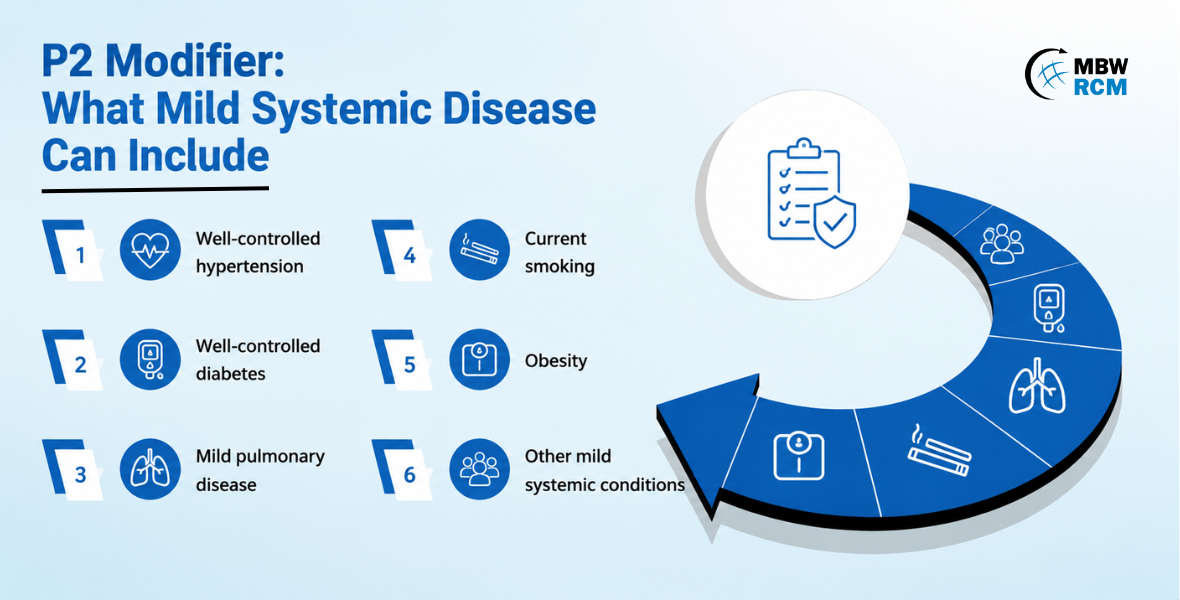
NCBI's clinical reference includes controlled disease without functional limitation among its ASA II examples. It also identifies obesity with a BMI between 30 and 40 among possible examples.
Example of P2
A patient scheduled for an elective procedure has hypertension controlled with medication and no meaningful functional limitations.
The documented clinical assessment may support P2 rather than P1.
P1 vs. P2
The basic difference can be understood as:
P1: Patient is healthy without significant systemic disease.
P2: Mild systemic disease is present.
But medical coding teams should be careful about automatically converting a diagnosis into a modifier.
A diagnosis of hypertension, for example, does not by itself explain whether the condition is controlled, poorly controlled, producing functional limitations, or contributing to a more serious clinical picture.
P3 Modifier: Patient With Severe Systemic Disease
P3 indicates severe systemic disease.
This represents an important step up from P2.
The patient's condition is more clinically significant and may involve substantial disease burden or functional limitation.
Examples may include patients with:
Poorly controlled diabetes
Significant cardiovascular disease
Severe pulmonary disease
Morbid obesity
End-stage renal disease
Significant functional limitations
Research-based clinical examples are particularly helpful here.
The StatPearls ASA classification reference lists BMI of 40 or greater, end-stage renal disease undergoing regular dialysis, poorly controlled moderate-to-severe disease, and certain significant cardiovascular histories among examples associated with ASA III.
Example of P3
A patient undergoing surgery has end-stage renal disease and receives regularly scheduled dialysis.
The documented systemic disease may support P3.
P2 vs. P3: Where Coding Gets More Difficult
Consider two patients who both have diabetes.
Patient A: Diabetes is well controlled and causes no substantial functional limitations.
Patient B: Diabetes is poorly controlled and associated with significant systemic effects.
Although the diagnosis is the same, the patient's physical status may not be.
This is why anesthesia coding should not be reduced to:
Diagnosis → Modifier
Instead, the coding workflow needs to consider the documented severity and overall patient condition.
P4 Modifier: Severe Systemic Disease That Is a Constant Threat to Life
P4 represents a patient with severe systemic disease that is a constant threat to life.
This wording is important because it distinguishes P4 from P3.
Both classifications involve severe disease.
With P4, however, the patient's systemic condition creates an ongoing threat to life.
Examples in clinical literature include certain patients with severe end-organ dysfunction, shock states, ongoing coagulopathy, or recent coronary or cerebral ischemic events when the overall clinical situation meets the classification.
Example of P4
Consider a surgical patient with severe cardiac dysfunction and substantial clinical limitations whose condition presents a continuing threat to life.
When supported by the anesthesia assessment, P4 may be appropriate.
P3 vs. P4
A practical way to understand the difference is:
P3 = Severe systemic disease
P4 = Severe systemic disease + constant threat to life
The complexity of the surgery itself should not be used to increase the patient's physical status classification.
The modifier describes the patient's physical condition, not simply the difficulty or invasiveness of the planned procedure.
P5 Modifier: Moribund Patient Not Expected to Survive Without Surgery
P5 represents a moribund patient who is not expected to survive without the operation.
This classification applies to extremely serious clinical circumstances.
Clinical examples described in the literature include situations such as a ruptured aneurysm, severe multisystem trauma, or extensive intracranial hemorrhage with mass effect when the patient's overall condition meets the P5 definition.
Example of P5
A critically ill patient presents with a catastrophic surgical emergency and is unlikely to survive unless immediate operative intervention occurs.
The anesthesia provider's documented assessment may support P5.
P4 vs. P5
The distinction is important:
P4: The patient's severe systemic disease represents a constant threat to life.
P5: The patient is not expected to survive without the operation.
An emergency procedure alone does not automatically make a patient P5.
The patient's actual documented physical condition must support the classification.
P6 Modifier: Declared Brain-Dead Patient for Organ Donation
P6 applies to a declared brain-dead patient whose organs are being removed for donor purposes.
Unlike the preceding classifications, P6 represents a very specific circumstance.
Example of P6
A patient has been formally declared brain dead and is brought to the operating room for organ procurement for transplantation.
The applicable anesthesia service may use P6 when the circumstances and reporting requirements support it.
P5 vs. P6
P6 should not simply be viewed as a more severe version of P5.
They describe fundamentally different situations.
P5: Critically ill patient not expected to survive without surgery.
P6: Declared brain-dead patient undergoing organ procurement.
This distinction is important for anesthesia documentation and coding. For additional guidance on physical status classifications and their application, refer to AAPC CPT® Appendix Q.
P2 vs. P3 vs. P4: Look Beyond the Diagnosis
One of the most useful lessons for anesthesia coding teams is that the same general disease category can potentially appear across different physical status levels depending on its severity and impact.
Take obesity as an example.
The clinical reference from NCBI includes obesity with BMI 30–40 among ASA II examples, while BMI ≥40 appears among ASA III examples.
This does not mean a medical coder should independently calculate BMI and assign the patient's anesthesia physical status based on that number alone.
Rather, it demonstrates how severity matters when the patient's overall physical status is determined.
The same principle applies to:
Diabetes
Hypertension
Cardiovascular disease
Pulmonary disease
Kidney disease
Obesity
Other systemic conditions
Instead of asking only:
“What diagnosis does this patient have?”
Anesthesia coding workflows should also determine:
“What physical status did the anesthesia provider document, and does the clinical record support it?”
What Does the “E” Mean in ASA Physical Status?
You may encounter classifications such as:
P2E
P3E
P4E
P5E
The E designation identifies an emergency procedure.
It does not represent a seventh physical status level.
NCBI's review explains that adding “E” denotes an emergency surgical procedure, with an emergency involving circumstances where delaying treatment significantly increases the threat to life or a body part.
Therefore:
P3 = Patient's physical condition
P3E = P3 physical condition + emergency procedure
This distinction is valuable because the patient's health status and the urgency of surgery describe two different aspects of the encounter.
How P1–P6 Differ From AA, QK, QX, QY, QZ and AD
Physical status modifiers are only one part of anesthesia coding.
They should not be confused with anesthesia payment/provider modifiers such as:
AA
QK
QX
QY
QZ
AD
The easiest distinction is:
P1–P6 describe the patient's physical status.
AA/QK/QX/QY/QZ/AD describe how the anesthesia service was personally performed, medically directed, or medically supervised.
For example:
AA + P2
AA may indicate that the anesthesiologist personally performed the anesthesia service.
P2 communicates that the patient has mild systemic disease.
QX + P3
QX may identify a CRNA service under qualifying medical direction.
P3 communicates severe systemic disease.
Both modifier families can therefore communicate different information about the same anesthesia encounter.
Hospitals should ensure their anesthesia billing workflow does not treat them as interchangeable. Need more clarity on anesthesia payment and provider modifiers? Explore ourAnesthesia Modifiers Explained article to understand how AA, QK, QX, QY, QZ, and AD are used in anesthesia billing.
Do P1–P6 Modifiers Affect Anesthesia Reimbursement?
This requires payer-specific attention.
Hospitals and anesthesia practices should not assume that every payer handles physical status modifiers identically.
Depending on the payer and contract, physical status classifications may be informational or may be incorporated into the payer's anesthesia reimbursement methodology.
That means coding and billing teams should maintain payer-specific information regarding:
Whether P1–P6 modifiers should be reported
Whether physical status units are recognized
Whether additional units affect reimbursement
Which classifications qualify
Documentation requirements
Claim formatting requirements
A technically accurate P3 classification does not automatically mean every payer will reimburse the claim using the same additional-unit methodology.
This is an important distinction between coding accuracy and payment policy. Want to see how billing and coding can impact reimbursement? Check out our Anesthesia Reimbursement Case Study to see how focused improvements strengthened reimbursement outcomes.
Physical Status Modifiers and Monitored Anesthesia Care
P1–P6 can also appear in the context of monitored anesthesia care (MAC).
CMS Medicare Administrative Contractor guidance uses physical status classifications when describing the clinical condition of patients receiving MAC and separately identifies G8 and G9 for particular circumstances.
This highlights an important distinction:
P1–P6 → Patient physical status
G8/G9 → Particular MAC circumstances
AA/QK/QX/QY/QZ/AD → Anesthesia provider/payment arrangement
Each modifier communicates something different about the anesthesia service.
For hospital coding teams, understanding these modifier families as separate pieces of the claim can help prevent inappropriate substitution.
Documentation Should Drive Physical Status Modifier Selection
The difference between P2, P3, and P4 cannot always be determined from a problem list.
Physical status classification depends on the patient's overall systemic condition and functional impact.
Anesthesia documentation may need to reflect information such as:
Current systemic diseases
Disease severity
Whether conditions are controlled or uncontrolled
Functional limitations
Cardiovascular status
Pulmonary status
Renal disease
Diabetes and associated complications
Significant recent clinical events
Overall preoperative condition
Emergency status, when applicable
The anesthesia provider's assessment should support the physical status reported.
A coding workflow that automatically maps an ICD-10-CM diagnosis to P1–P6 without considering documented severity can create inconsistencies.
Common P1–P6 Anesthesia Coding Errors
1. Assigning Physical Status Based Only on Age
Age alone does not determine P1–P6.
A healthy older patient should not automatically be classified as P3, just as a younger patient with severe systemic disease should not automatically be considered P1 or P2.
2. Automatically Mapping Diagnoses to Modifiers
A diagnosis does not always establish disease severity.
Two patients with the same diagnosis can have very different physical status classifications.
3. Confusing P2 and P3
The difference centers on the severity of systemic disease.
P2 represents mild systemic disease, while P3 represents severe systemic disease.
4. Confusing P3 and P4
P4 requires more than severe systemic disease—the disease represents a constant threat to life.
5. Treating Every Emergency Patient as P5
Emergency status and physical status are different concepts.
A patient can undergo emergency surgery without meeting the P5 definition.
6. Confusing P5 and P6
P5 describes a moribund patient not expected to survive without surgery.
P6 specifically applies to a declared brain-dead patient undergoing organ procurement.
7. Assuming Every Payer Pays Physical Status Units
Payer reimbursement methodologies vary.
Organizations should verify individual payer contracts and policies instead of applying one reimbursement methodology across every anesthesia claim. Looking to avoid common anesthesia coding and billing errors? Explore our Anesthesia Medical Billing Guide for practical insights on improving coding accuracy and strengthening the billing process.
A Practical P1–P6 Pre-Bill Checklist
Before submitting an anesthesia claim, coding and billing teams should review:
1. What physical status did the anesthesia provider document?
2. Does the medical record support the reported classification?
3. Is systemic disease mild or severe?
4. Are meaningful functional limitations documented?
5. If P4 is reported, does the condition represent a constant threat to life?
6. If P5 is reported, is the patient not expected to survive without the operation?
7. If P6 is reported, is this a declared brain-dead organ donor?
8. Is an emergency designation applicable and documented?
9. Are the appropriate anesthesia provider/payment modifiers also present?
10. Does the payer recognize or reimburse physical status modifiers under its specific policy?
This type of pre-bill review can identify inconsistencies before the claim reaches the payer.
Why Physical Status Coding Matters for Hospitals and Anesthesia Groups
P1–P6 may represent only a small portion of an anesthesia claim, but they exist within a much larger coding workflow.
A complete anesthesia claim may require accurate handling of:
Anesthesia CPT Code → Base Units → Anesthesia Time → Provider Role → Physical Status → Payment Modifier → MAC/Other Modifiers → Diagnosis → Payer Rules → Claim
An error at any point can create unnecessary rework.
This becomes particularly challenging for hospitals and large anesthesia groups managing high case volumes, multiple facilities, different anesthesia care models, and numerous payer requirements.
It is also why specialized anesthesia medical coding requires more than knowing modifier definitions. Coding teams need to understand how documentation, clinical circumstances, anesthesia time, provider arrangements, modifier rules, and payer requirements work together.
Strengthen Anesthesia Coding Before Claims Reach the Payer
The difference between P1, P2, P3, P4, P5, and P6 can look straightforward on a reference sheet. Real anesthesia encounters are rarely that simple.
Multiple comorbidities, changing disease severity, emergency procedures, incomplete documentation, and payer-specific reimbursement rules can make modifier selection considerably more complex.
For hospitals, health systems, anesthesiologists, and anesthesia groups, catching those inconsistencies before claim submission can be more effective than repeatedly addressing modifier-related edits and payment discrepancies after the claim reaches the payer.
MBW RCM provides specializedanesthesia medical coding and billing support across CPT coding, anesthesia time, physical status modifiers, provider modifiers, documentation review, claim submission, and revenue cycle follow-up.
FAQs on Anesthesia Physical Status Modifiers P1–P6
Strengthen Your Anesthesia Coding Before Claims Go Out
If recurring anesthesia coding discrepancies, documentation gaps, or payer-specific modifier requirements are creating additional work for your internal team, a focused review can help identify where those issues are entering the revenue cycle.
How confident are you that your anesthesia modifiers are supported before the claim goes out?
Request an Anesthesia Coding Review →