Medical Billing and Coding Services for Large Practices

Medical Billing and Coding Services for Large Practices are essential for managing high claim volumes, multi-specialty coding, and complex payer requirements. In large practices, even small gaps in coding or claim processing can lead to denials and delayed reimbursements.
As operations scale, billing requires accurate ICD-10, CPT, and HCPCS coding, efficient claim submission, and structured workflows to maintain consistent revenue flow.
This guide explores how these services help streamline billing processes and improve overall revenue cycle performance in large practices.
Table of Contents
Revenue Cycle Complexity in Large Practices
Large practices operate within a highly complex Revenue Cycle Management (RCM) ecosystem, where multiple workflows run simultaneously across departments.
Key complexity factors include:
High claim throughput, typically processed within 24–72 hours
Multi-specialty services requiring diverse coding expertise
Payer-specific rules affecting reimbursement timelines
Variability in provider documentation impacting coding consistency
Industry data shows that unmanaged systems in large practices experience 8–15% denial rates, with reimbursement delays extending up to 30–60 days. These inefficiencies highlight the need for structured processes supported by Medical Billing and Coding Services.
Core Components of Medical Billing Services in High-Volume Practices
In high-volume practices, medical billing is structured around a few critical components that ensure claims are generated, processed, and reimbursed efficiently at scale.
Front-End Data Validation:
Accurate patient demographics, insurance eligibility, and prior authorizations are essential to prevent early-stage claim rejections. In large practices, this step alone can reduce front-end denials by 20–25%.Charge Capture and Coding Execution:
Clinical encounters are converted into billable data using ICD-10, CPT, and HCPCS codes. Consistent coding practices help minimize Medical Coding Errors and ensure appropriate reimbursement.Claim Generation and Submission:
Clean claim creation, validation, and electronic submission through clearinghouses are key to maintaining a 90–95% first-pass acceptance rate.Payment Posting and Receivables Tracking:
Payments received via ERA/EOB are reconciled, while pending claims are tracked systematically. Timely follow-ups (within 7–14 days) help control outstanding balances.Denial Handling and Resolution:
Denied claims are categorized, corrected, and resubmitted within 15–30 days, ensuring revenue recovery and reducing repeat errors.
Importance of Coding Accuracy in Large Practices
Coding accuracy is critical for revenue integrity, claim adjudication, and compliance in large practices. At scale, discrepancies can affect 10–20% of claims, resulting in denials, underpayments, or audit risks.
Accurate coding requires proper ICD-10 and CPT/HCPCS alignment, correct modifier usage, and complete clinical documentation to support medical necessity.
Effective coding controls help improve coding accuracy and revenue, reduce Medical Coding Errors, and ensure consistent reimbursement performance.
Benefits of Outsourcing Medical Billing & Coding in Large-Scale Practices
In large practices, outsourcing billing and coding is driven by the need to manage high claim volumes, multi-provider variability, and complex payer requirements. The benefits are directly reflected in operational control and revenue cycle performance.
Consistency Across Multiple Providers and Specialties:
Standardized coding protocols ensure uniform ICD-10, CPT, and HCPCS application across departments, reducing variability caused by different documentation styles.
Higher First-Pass Claim Acceptance in High-Volume Environments:
Pre-bill validation and payer-specific edits help maintain 90–95% clean claim rates, which is critical when processing thousands of claims monthly.
Controlled Denial Patterns at Scale:
Structured denial tracking and root cause analysis reduce recurring issues such as medical necessity and modifier errors, lowering denial rates by 15–25%.
Improved AR Performance and Cash Flow Stability:
Dedicated follow-ups on large claim volumes help keep Days in AR below 35–40 days, ensuring predictable revenue cycles.
Scalable Operations Without Internal Expansion:
Outsourcing supports 5,000–20,000+ claims per month without increasing internal staffing, allowing large practices to handle growth and volume fluctuations efficiently.
These outcomes reflect the Benefits of Outsourcing Medical Coding, enabling large practices to maintain consistency, reduce operational variability, and improve financial performance at scale.
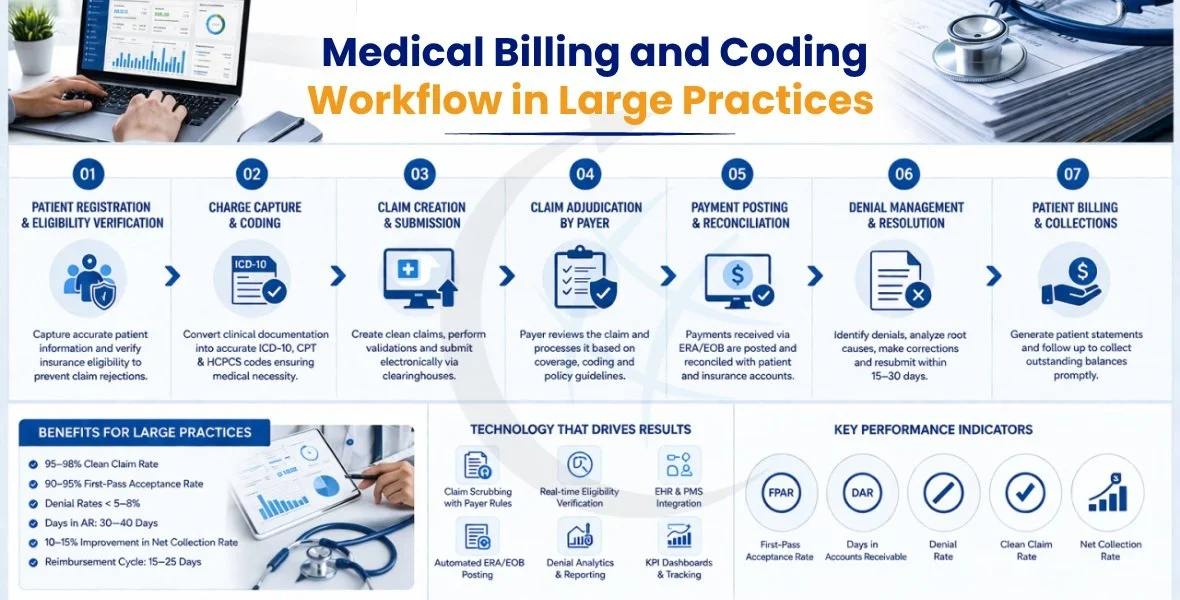
What Results Should You Expect?
In large practices handling 5,000–20,000+ claims per month, optimized workflows typically deliver:
95–98% clean claim rate → fewer rejections and minimal rework
90–95% first-pass acceptance rate → faster claim approvals
Days in AR reduced to 30–40 days → quicker cash flow cycles
Denial rates reduced to below 5–8% → lower revenue leakage
10–15% improvement in net collection rate → higher realized revenue
Reimbursement cycles within 15–25 days → predictable payment timelines
These outcomes reflect how Medical Billing and Coding Services improve efficiency and financial performance in large-scale practices.
Key Results Achieved with Credit Balance Optimization
Technology and Automation in Billing Services
Technology and automation support multi-specialty billing operations by enabling standardized processing, real-time validation, and performance tracking across high-volume workflows.
Automated claim scrubbing with NCCI and payer-specific edits
AI-driven validation of ICD-10, CPT, and HCPCS code combinations
Real-time eligibility and prior authorization verification systems
Integrated EHR–PMS data exchange for charge capture accuracy
Automated ERA/EOB posting and reconciliation workflows
Denial analytics with payer, specialty, and code-level tracking
AR workflow automation with 7–10 day follow-up triggers
KPI dashboards tracking FPAR, DAR, denial rate, and net collection rate
Regulatory Compliance Requirements in Large Practice Billing
Large practices must adhere to strict compliance standards, including:
HIPAA regulations for patient data protection
Standardized coding systems (ICD-10, CPT, HCPCS)
Payer-specific billing and documentation requirements
Failure to meet compliance standards can result in penalties, denials, and audit exposure. Structured compliance protocols within Medical Billing and Coding Services ensure adherence to regulatory frameworks. If you are interested to read more about healthcare Billing & Coding, please have a look at this blog on ‘‘Medical Coding and Billing: A Practical Guide to Getting Started’’.
Choosing the Right Medical Billing and Coding Partner
For large practices, selecting the right partner requires alignment with revenue cycle workflows, multi-specialty coding requirements, and payer-specific billing rules.
Key considerations include:
Multi-specialty coding capability: Consistent application of ICD-10, CPT, and HCPCS codes across service lines
Payer guideline expertise: Ability to manage payer edits, medical necessity checks, and reimbursement policies
System integration: Seamless connectivity with EHR and Practice Management Systems (PMS) for accurate charge capture and claim generation
Coding compliance and audit controls: Structured processes for coding validation, documentation review, and audit readiness
KPI and SLA tracking: Monitoring metrics such as First-Pass Acceptance Rate (FPAR), Days in AR (DAR), and denial rate
Large practices Choose Medical Coding and Billing partners based on their ability to ensure coding accuracy, claim integrity, and consistent reimbursement performance.
How MBW RCM Supports Large Practices
MBW RCM supports large practices by aligning billing operations with high claim volumes, multi-specialty workflows, and payer-specific requirements.
High-Volume Claims Management: Processing 5,000–20,000+ claims/month with 24–48 hour submission TAT
Multi-Specialty Coding Execution: ICD-10, CPT, and HCPCS coding aligned with documentation and medical necessity
Denial Management: CARC/RARC-based corrections with resubmission within 15–30 days
AR Follow-Up at Scale: Prioritized follow-ups to maintain Days in AR below 35–40 days
MBW RCM delivers consistent reimbursement outcomes through structured Medical Billing and Coding Services.
Optimize Revenue Cycle Performance for Large Practices
Managing high claim volumes can create delays, denials, and operational gaps across large practices. Our Medical Billing and Coding Services help streamline workflows, reduce backlogs, and improve overall RCM performance.
👉 Talk to Our RCM ExpertsConclusion:
In large practices, billing and coding are integral to financial performance and operational efficiency. Managing high claim volumes, ensuring coding precision, and maintaining compliance require structured workflows and continuous monitoring.
By implementing optimized processes and leveraging advanced systems, healthcare organizations can reduce denials, accelerate reimbursements, and achieve consistent revenue outcomes.
Need a reliable billing solution for your large practice? Explore reliable Medical Coding Services tailored for large practices—contact us today to streamline your billing operations and improve reimbursement outcomes.
FAQs on Medical Billing & Coding for Large Practices
Schedule a No-Cost RCM Consultation
Large practices managing high claim volumes often face workflow gaps that impact billing and coding efficiency. A detailed review of your Medical Billing and Coding Services helps uncover issues in coding quality, claim flow, and denial patterns across the revenue cycle.
Connect with our specialists to see how our Medical Coding Services can support smoother operations, reduce delays, and improve performance at scale.