How Medical Coding Errors Lead to Revenue Leakage in Large Clinics

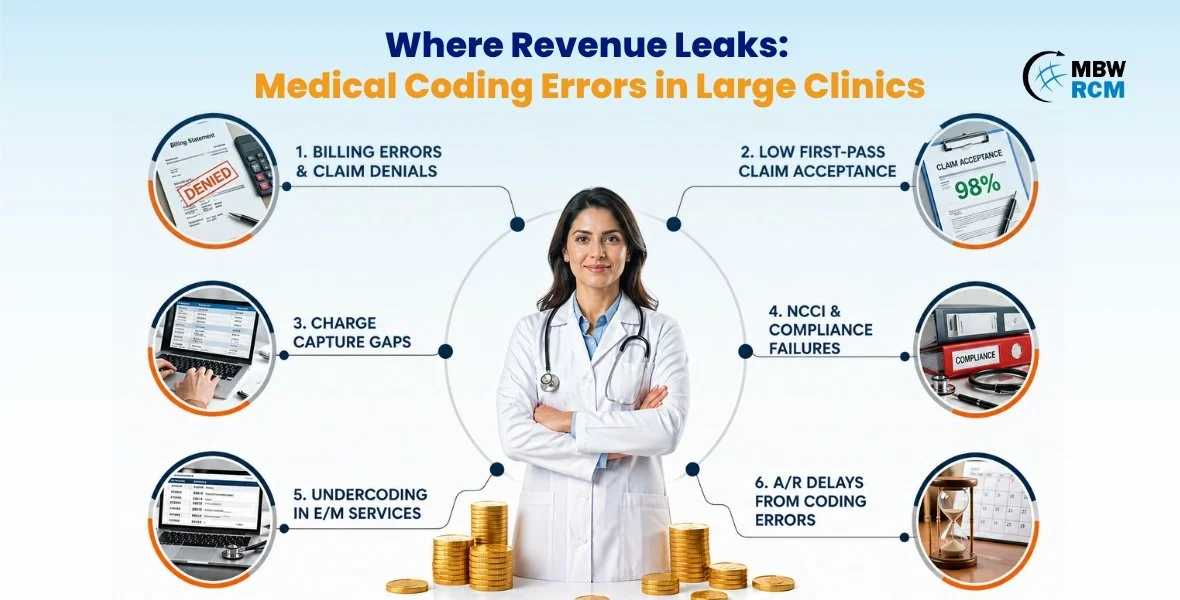
Medical Coding Errors lead to revenue leakage in large clinics by causing claim denials, underpayments, and delayed reimbursements across high-volume claims. When issues like CPT–ICD mismatches or missing modifiers repeat across multiple claims, they create consistent revenue loss that directly impacts collections.
In large clinics, coding depends on accurate documentation, validation checks, and payer rules across departments. Even small errors can reduce first-pass acceptance, increase A/R days, and trigger rework cycles. This guide will help you understand how these errors occur, their impact on revenue leakage, and ways to prevent revenue loss effectively.
Table of Contents
1. CPT–ICD Mismatch in High-Volume Claims Driving Denials
In high-volume claim workflows, Medical Coding Errors often arise from CPT–ICD mismatches, where diagnosis codes do not support billed procedures. Payers use automated medical necessity checks, and even small inconsistencies can trigger denials such as CO-11 or CO-16. In batch submissions, these mismatches repeat across similar encounters, increasing denial rates.
When denial patterns persist, claims move into rework cycles, extending turnaround times beyond 30–45 days. This reduces first-pass acceptance and creates backlog in denial workflows, contributing to ongoing revenue leakage across billing cycles.
2. E/M Level Undercoding Across Encounters Reducing Yield
E/M undercoding occurs when clinical complexity is not fully translated into code selection, especially in multi-provider documentation workflows where variability in physician notes affects coding decisions. When time, medical decision-making (MDM), or risk elements are not clearly documented, coders tend to assign lower-level E/M codes to avoid audit exposure.
Higher acuity visits coded at lower E/M levels
Revenue drop of 15–20% per encounter
Repeated across high daily patient volumes
No denial trigger, making losses less visible
Direct impact on net collection metrics
Compounds into significant monthly yield gaps
Over time, this creates a systematic reduction in average revenue per visit. In high-throughput settings, even a small percentage of undercoded encounters can result in substantial monthly revenue leakage, especially when not tracked through variance analysis or coding audits.
3. Modifier -25/-59 Omission in Multi-Line Claims Causing Loss
Modifier omission affects how payers interpret multiple services within a single claim.
Missing Modifier -25 in E/M with Procedure Cases
When modifier -25 is not appended to an E/M service performed on the same day as a procedure, payer systems treat the visit as included in the procedure. This leads to denial or removal of the E/M component, even when it qualifies for separate billing.
Modifier -59 Omission in Distinct Procedural Services
Failure to use modifier -59 in multi-procedure claims causes NCCI bundling edits to group services together. Procedures that should be reimbursed separately are instead reduced to a single payable component.
Impact on Reimbursement and Claim Adjudication
Partial reimbursement instead of full claim value
Average loss of 10–15% per multi-line claim
Increased payer-side adjustments during adjudication
This is a frequent category of Medical Coding Errors affecting reimbursement accuracy in multi-line claim processing.
4. Charge Capture Leakage in Multi-Provider Visit Flows
Charge capture leakage occurs when services are not converted into billable codes due to gaps between clinical documentation and billing systems. In multi-provider workflows, services across EHR, lab, and radiology modules often fail to map correctly, leading to missed charges.
Procedures may be documented but not coded, diagnostics may not link to billing, and time-based services may be inconsistently recorded. Typically, 3–7% of charges are missed, resulting in unrecoverable revenue when no claim is generated. These gaps arise from poor system integration and delayed documentation, leading to direct revenue leakage.
Build strong coding workflows. Keep them consistent. Focus on documentation, validation, and claim reviews. You get the drift—keep it structured. If you're exploring support options, consider medical coding outsourcing for physician practices to strengthen your coding process.
5. NCCI Edit Failures in Multi-Procedure Billing Workflows
NCCI edits enforce valid CPT code combinations using Column 1–Column 2 relationships and bundling logic defined by CMS. Failures occur when coding does not align with updated edit tables or when required modifier overrides (e.g., -59, -X{EPSU}) are not applied. In high-volume claim processing, absence of real-time NCCI validation allows invalid code pairs to pass into submission, triggering automated payer denials.
NCCI-related denials contribute to 8–12% of total coding denials, with rework cycles extending 20–30 days
First-pass claim acceptance drops below 85% when edit validation is not integrated at pre-bill stage
These structured Medical Coding Errors directly reduce claim acceptance rates and increase compliance risk across billing workflows.
6. Low First-Pass Resolution from Coding Validation Gaps
First-pass resolution (FPR) relies on clean claims validated against payer rules, NCCI edits, and medical necessity criteria. When pre-bill validation or claim scrubbing is missing, coding gaps pass into adjudication, increasing denial rates in high-volume submissions.
First-pass rate drops below 85%, with denial rates increasing by 10–15%
Increased manual corrections and multiple claim touchpoints before payment
Reimbursements delayed beyond 30–45 days
Cost-to-collect rises by 5–8% due to rework and inefficiencies
These validation gaps reduce claim processing speed and directly impact revenue realization. If you are interested to read more about medical coding, please have a look at this blog on ‘‘Understanding Medical Coding: A Simple Guide.’’
7. Medical Necessity Failures Against LCD/NCD Edits
Medical necessity validation follows LCD and NCD policies that define coverage based on diagnosis–procedure alignment. When ICD-10 codes don’t meet payer criteria, claims are automatically denied. In high-volume operations, repeated denials across diagnostic and imaging claims become a major source of revenue leakage.
Diagnosis–Procedure Misalignment Against LCD/NCD Criteria
Payer systems validate claims using predefined mappings. When ICD-10 codes lack specificity or do not match covered indications, claims fail medical necessity checks—commonly in imaging and lab services.
Automated Denials During Claim Adjudication
Claims are rejected with codes like CO-50 or CO-96 before payment processing, requiring correction and resubmission.
Revenue Impact from Medical Necessity Denials
Claim denial with recovery rates below 60%
High frequency in diagnostics and radiology
Direct blockage of reimbursement eligibility
This is a critical layer of Medical Coding Errors affecting claim approval. Choosing the right coding partner directly impacts claim outcomes and revenue performance. For a better comparison, explore top medical coding services companies in the US to identify options that align with your needs.
8. A/R Aging Growth from Coding-Driven Denial Rework Cycles
Coding-driven denials extend A/R timelines as claims move through repeated correction cycles. When claims exceed 60–90 days in A/R, recovery probability declines sharply, impacting liquidity. Billing teams spend more time on rework instead of new submissions, increasing operational cost per claim.
This cycle creates a compounding effect where delayed collections disrupt future billing cycles. Persistent rework patterns reduce overall revenue realization efficiency and increase dependency on manual intervention, further amplifying leakage.
Key Metrics Affected by Medical Coding Errors
Preventing Revenue Leakage from Medical Coding Errors
Preventing Medical Coding Errors in high-volume billing requires rule-driven controls at the pre-adjudication stage. Leakage occurs when claims bypass payer-specific validation, especially across multi-specialty services. Implementing system-level checks aligned with CMS edits and payer policies helps intercept errors before submission.
Pre-bill validation using NCCI Column 1–Column 2 edits and modifier logic (-25, -59)
Claim scrubbing integrated with LCD/NCD rules and payer-specific edit libraries
Automated CPT–ICD crosswalk validation to support procedures
Denial tagging using CARC/RARC codes to track recurring issues
EHR-to-billing mapping validation to prevent charge capture gaps
Use of Best Medical Coding Services for coding standardization
These controls reduce denials, limit rework cycles, and improve reimbursement reliability.
How Large Clinics Can Identify Medical Coding Errors Early
Large clinics identify Medical Coding Errors early by embedding pre-bill validation and centralized monitoring across high-volume, multi-department claim workflows.
Centralized denial analytics (CARC/RARC) to track recurring errors across departments
Department-level coding audits to identify E/M and specialty-specific variations
Revenue variance tracking across service lines (expected vs actual)
AI validation tools to flag NCCI and LCD/NCD mismatches at scale
Real-time claim scrubbing integrated across billing systems
Ability to boost clinic revenue with expert coding support
Early detection across centralized workflows reduces rework cycles and improves first-pass claim performance.
Reduce Revenue Leakage Caused by Coding Errors
Medical Coding Errors across high-volume claims can lead to denials, underpayments, and delayed reimbursements. Our Medical Coding Services help identify coding gaps, improve claim validation, and reduce revenue leakage across departments.
👉 Get a Free Coding AuditConclusion
Medical coding errors are a major cause of revenue leakage in large clinics, impacting claim acceptance, reimbursement, and A/R cycles. When issues like CPT–ICD mismatches, modifier gaps, and validation failures repeat across high claim volumes, they lead to consistent revenue loss and increased rework.
Addressing these gaps requires structured validation, accurate documentation, and continuous monitoring to improve first-pass claim rates and reduce denials.
👉 Looking to reduce coding errors and recover lost revenue?
📞 Contact us today to explore our Medical Coding Services and strengthen your coding process and prevent revenue leakage.
FAQs on Medical Coding Errors
Get a Free Coding Audit for Your Practice
Identify coding gaps across high-volume claim workflows with a detailed review of your current RCM processes. Our team evaluates CPT–ICD mapping, modifier usage, NCCI edits, medical necessity checks, and claim validation controls to highlight areas that may lead to denials, underpayments, and revenue leakage.
Fill out the form to connect with our specialists and learn how our Medical Coding Services can help reduce coding errors, improve claim acceptance rates, and strengthen visibility across your revenue cycle.