Pros & Cons of Universal Healthcare (Medicare for All) for Providers in USA

Universal healthcare ensures that every citizen has access to essential medical services regardless of income, employment status, or insurance coverage. In the United States, this concept is commonly discussed under the proposal known as “Medicare for All.”
The main objective of universal healthcare is to remove financial barriers and make healthcare services accessible to everyone. While the model promises expanded healthcare coverage and simplified administrative processes, it also raises important concerns regarding funding, healthcare capacity, and provider reimbursement.
For healthcare providers and revenue cycle management (RCM) professionals, understanding how such reforms could affect billing systems and reimbursement models is essential.
“Universal health coverage means that all people have access to the health services they need without suffering financial hardship.” — World Health Organization
Table of Contents
What Is Universal Healthcare or “Medicare for All”?
Universal healthcare is a healthcare system where all residents receive medical coverage through a centralized funding mechanism, typically supported by government programs or taxation.
In many Medicare for All proposals, the government would act as the primary payer, replacing the current multi-payer system that includes private insurers, employer-sponsored insurance plans, and public programs.
Instead of managing multiple insurance policies and claim requirements, providers would interact with a single standardized payer system, potentially simplifying billing operations.
According to the World Health Organization, universal healthcare aims to improve access to healthcare services while protecting individuals from financial hardship.
“The idea behind Medicare for All is to guarantee healthcare coverage to every resident through a single national health program.” — Healthcare policy analysts
For healthcare providers, this shift could significantly reshape reimbursement processes and administrative workflows.
Benefits of Universal Healthcare
Universal healthcare can expand access to care, simplify administrative processes, and improve overall public health outcomes.
1. Increased Access to Healthcare
Universal healthcare expands access by ensuring that coverage is not tied to employment status or private insurance eligibility.
When financial barriers are reduced, patients are more likely to seek preventive care, early diagnosis, and treatment for chronic conditions, which can improve long-term health outcomes.
Research from the National Institutes of Health highlights that expanded healthcare access can improve population health and reduce disparities in care.
2. Lower Administrative Complexity
The current U.S. healthcare system involves numerous insurers with different rules for eligibility verification, claim submission, and reimbursement.
A single-payer system could reduce administrative complexity by standardizing billing processes and claim management.
For revenue cycle management teams, this could result in:
Fewer billing variations
Reduced claim denials due to payer rules
Simplified reimbursement workflows
Healthcare organizations often use data to monitor and improve these processes. Explore our guide on healthcare revenue cycle analytics best vs. worst practices to learn how analytics can improve revenue cycle performance.
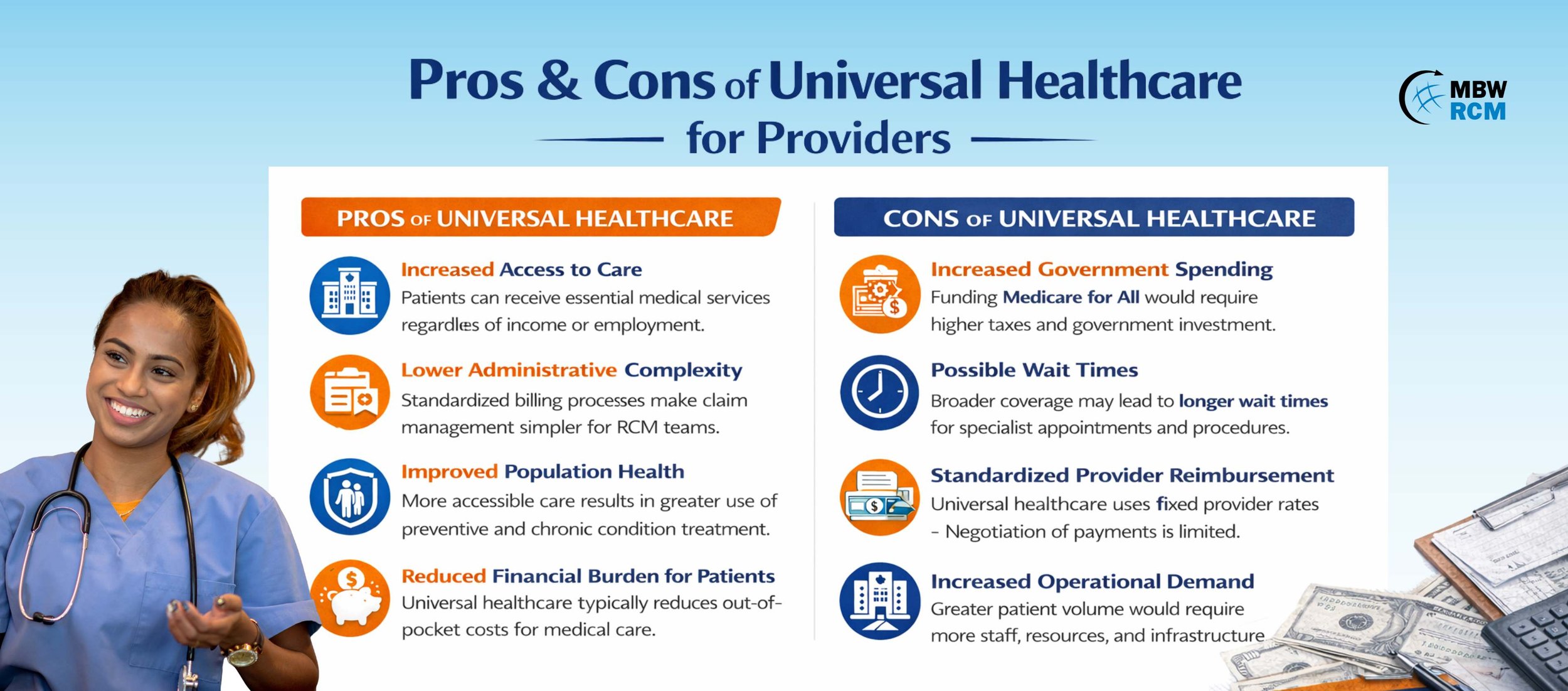
3. Improved Population Health
When healthcare services become widely accessible, individuals are more likely to seek preventive services such as screenings, vaccinations, and routine medical checkups. Preventive care improves overall public health and helps reduce the long-term burden of chronic illnesses.
4. Reduced Financial Burden for Patients
Medical expenses are one of the leading causes of financial stress for many households. Universal healthcare systems typically reduce out-of-pocket costs and protect patients from unexpected medical bills, improving financial stability for families.
Challenges of Universal Healthcare
Although universal healthcare expands access to medical services, it also introduces financial and operational challenges.
1. Increased Government Spending
Funding universal healthcare programs requires substantial government investment. While individuals may spend less on private insurance premiums, taxpayers may contribute more through income or payroll taxes to support nationwide healthcare coverage. Balancing healthcare accessibility with sustainable funding remains a major policy debate.
2. Possible Wait Times
When healthcare services become universally accessible, the demand for medical care may increase significantly. Without sufficient healthcare infrastructure and workforce expansion, patients may experience longer wait times for certain procedures or specialist visits.
3. Standardized Provider Reimbursement
Universal healthcare systems often use standardized reimbursement rates. While this simplifies billing processes, it may limit providers’ ability to negotiate payment rates with insurers. Healthcare organizations may need to adjust operational strategies to maintain financial stability.
4. Increased Operational Demand
Expanding healthcare coverage could result in higher patient volumes across hospitals and clinics. Healthcare providers may need additional staff, resources, and infrastructure to manage the increased demand. This expansion can also create administrative pressures, including provider onboarding and credentialing. Learn more about the top challenges in healthcare credentialing.
Comparison: Current U.S. Healthcare System vs Universal Healthcare
| Feature | Current U.S. Healthcare System | Universal Healthcare (Medicare for All) |
|---|---|---|
| Insurance Providers | Multiple private and public insurers | Single government payer |
| Coverage Access | Depends on employment or insurance plans | Coverage for all residents |
| Administrative Complexity | High due to multiple payer rules | Lower due to standardized processes |
| Out-of-Pocket Costs | Often high for patients | Typically reduced |
| Provider Reimbursement | Negotiated with multiple insurers | Standardized rates |
| Patient Demand | Moderate based on insurance coverage | Higher due to expanded access |
How Universal Healthcare Could Impact Revenue Cycle Management
Universal healthcare could simplify several aspects of revenue cycle management while also introducing new financial considerations.
With fewer payers and standardized claim processes, RCM teams may experience simplified billing operations and fewer payer-related claim variations.
However, healthcare providers would also need to adapt to fixed reimbursement rates and increased patient demand, making operational efficiency even more important.
Strong revenue cycle management strategies will remain essential for maintaining financial stability under any healthcare payment model.
Conclusion
Universal healthcare aims to provide equitable access to medical services while reducing financial barriers for patients. While the system offers benefits such as improved healthcare access and simplified administrative processes, it also introduces financial and operational challenges that healthcare providers must carefully manage.
Understanding these potential changes allows healthcare organizations to prepare for evolving healthcare policies and payment structures.
Need Support Managing Your Revenue Cycle?
As healthcare policies and payment models evolve, efficient revenue cycle management becomes even more critical. MBW RCM helps healthcare providers streamline billing operations, reduce claim denials, and optimize reimbursement with expert-driven RCM solutions.
FAQs: Universal Healthcare & Medicare for All
Optimize Your Revenue Cycle with MBW RCM
Healthcare payment systems continue to evolve, making efficient billing operations more important than ever. MBW RCM helps healthcare providers streamline revenue cycle management, reduce claim denials, and improve reimbursement performance.
With industry expertise and advanced RCM solutions, MBW enables healthcare organizations to optimize financial operations while focusing on delivering quality patient care.
Contact MBW RCM today to learn how our RCM experts can support your practice.