
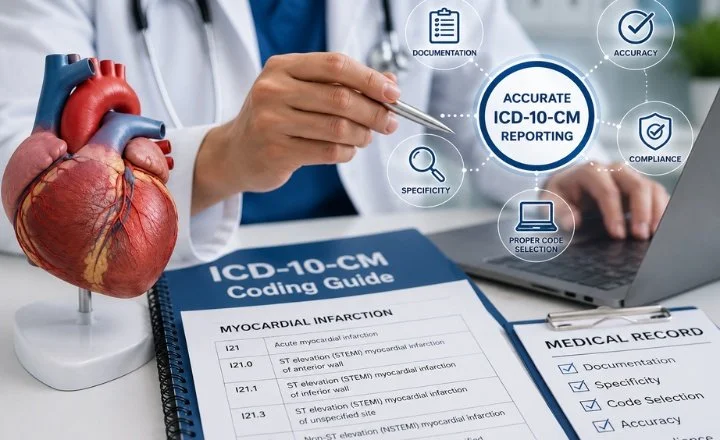
Coding myocardial infarction in 2026 requires a clear understanding of clinical presentation, accurate identification of MI type, proper classification of ST elevation status, detailed anatomical documentation, and correct interpretation of timing to ensure compliant ICD-10-CM reporting and optimized reimbursement outcomes.
Myocardial infarction (MI), commonly referred to as a heart attack, continues to be one of the most critical diagnoses encountered in acute and inpatient care settings. While advancements in clinical care—such as high-sensitivity cardiac biomarkers and rapid intervention strategies—have significantly improved patient outcomes, they have also introduced greater complexity in documentation and coding.
For coding professionals and revenue cycle teams, this complexity translates into a greater reliance on precise, structured, and clinically aligned documentation. Without it, even correctly performed care may not be accurately reflected in coding, which can lead to reimbursement discrepancies and compliance risks.
“In today’s healthcare environment, coding accuracy is directly tied to how well the clinical story is documented. Incomplete documentation leads to incomplete coding—and ultimately impacts both compliance and financial performance.”
Why MI Coding Matters in 2026
The importance of accurate myocardial infarction coding extends far beyond claim submission. It plays a central role in how healthcare organizations measure performance, manage risk, and ensure regulatory compliance.
Accurate MI coding influences several critical areas, including:
Diagnosis-Related Group (DRG) assignment, which determines hospital reimbursement
Risk adjustment models, particularly in value-based care programs
Quality reporting metrics, which affect public reporting and benchmarking
Audit outcomes, especially in high-risk cardiovascular cases
Recent industry analyses show that cardiovascular diagnoses, including MI, are among the most frequently audited conditions, largely due to their clinical complexity and financial impact. As billing for cardiovascular coding continues to evolve, understanding the complexities of cardiovascular billing is essential for maintaining reimbursement accuracy and compliance.
“Cardiovascular coding carries both high reimbursement value and high audit scrutiny, making documentation accuracy essential for both compliance and revenue integrity.”
Understanding Myocardial Infarction Classification
ICD-10-CM classifies myocardial infarction based on a combination of clinical and diagnostic factors. These classifications help ensure that the coded data accurately reflects the severity and nature of the condition.
The primary factors used in classification include:
The type of myocardial infarction (such as Type 1 or Type 2)
The presence or absence of ST-segment elevation
The anatomical location of the infarction
The timing of the event in relation to onset
Defining an Acute Myocardial Infarction
An MI is classified as acute when it occurs within four weeks (28 days) from the onset of symptoms. This time-based classification remains a foundational guideline in ICD-10-CM coding.
Events occurring within this timeframe are coded using the I21 category
Events occurring after four weeks may be classified as old or healed MI (I25.2), depending on documentation
“The 4-week rule continues to be one of the most important coding principles in myocardial infarction classification. Incorrect timing can significantly alter code selection and reimbursement.”
When documentation lacks specificity—such as simply stating “acute MI”—coders may need to assign an unspecified code under Myocardial Infarction classification (I21.9). However, reliance on unspecified codes should be minimized, as it reduces data accuracy and may trigger payer scrutiny.
Type 1 Myocardial Infarction: The Primary Coding Category
Type 1 MI is the most commonly reported form of myocardial infarction and is typically caused by acute coronary artery blockage due to plaque rupture or thrombosis. Because of its clinical severity and frequency, it is a central focus in coding practices.
Type 1 MI is further classified based on electrocardiogram (ECG) findings into STEMI and NSTEMI categories.
Since Type 1 MI classification depends heavily on ECG findings, accurate EKG/ECG reporting is equally essential for cardiovascular coding and billing accuracy. A Cardiology Billing Cheat Sheet can help support accurate reporting.
ST-Elevation Myocardial Infarction (STEMI)
STEMI represents a more severe form of myocardial infarction, where there is a complete occlusion of a coronary artery, resulting in extensive damage to the heart muscle.
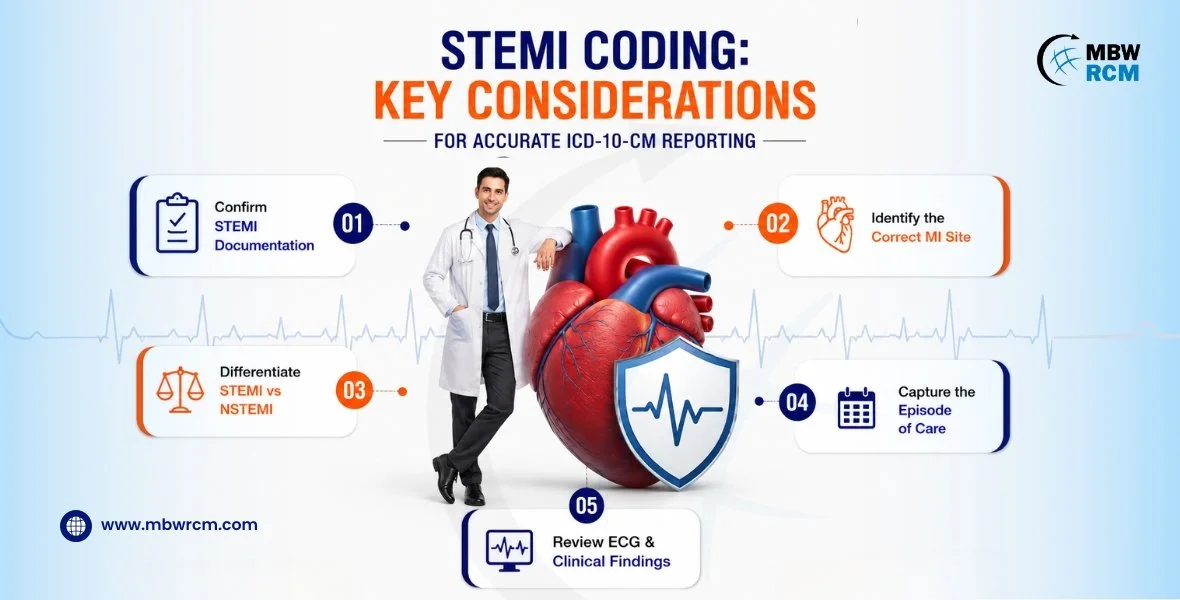
Coding Considerations for STEMI
Codes for STEMI fall within the I21.0 to I21.3 range and require detailed documentation of the anatomical site affected. Common sites include:
Anterior wall
Inferior wall
Lateral wall
Posterior wall
The requirement for site-specific coding makes STEMI documentation particularly important.
“Anatomical specificity in STEMI documentation not only improves coding accuracy but also enhances the clinical data used for performance measurement and reimbursement models.”
Non-ST Elevation Myocardial Infarction (NSTEMI)
NSTEMI occurs when there is a partial blockage of a coronary artery, leading to less extensive myocardial damage compared to STEMI.
Coding Considerations for NSTEMI
NSTEMI is coded using I21.4 and includes nontransmural infarctions. Unlike STEMI, NSTEMI coding does not require anatomical site specificity, but it still requires clear confirmation of diagnosis.
“Although NSTEMI coding is less complex than STEMI, the diagnosis must still be explicitly documented. Elevated biomarkers alone are not sufficient for coding.”
STEMI vs NSTEMI vs Type 2 MI: Coding Comparison
Type 2 MI and Myocardial Injury
Type 2 myocardial infarction is increasingly encountered in clinical documentation and requires careful differentiation. It is caused by an imbalance between oxygen supply and demand, rather than a primary coronary artery event.
Type 2 MI is coded using I21.A1, but only when the provider explicitly documents the diagnosis.
A related but distinct condition is myocardial injury, which involves elevated troponin levels without evidence of infarction.
“One of the most common audit findings in 2026 is the misclassification of myocardial injury as myocardial infarction, which can significantly impact compliance.”
Subsequent and Old Myocardial Infarctions
When a patient experiences another MI within four weeks of an initial event, it is classified as a subsequent MI and coded using the I22 category.
If documentation indicates a past or healed MI beyond the four-week window, it is coded as I25.2 (old MI).
When both acute and subsequent MIs occur within the same timeframe, both categories must be reported.
Real-World Coding Example
Consider a patient who presents with an inferolateral STEMI, with symptoms beginning three days prior to admission.
In this case, the correct code would be I21.19, reflecting a STEMI involving the inferior wall within the acute timeframe.
“Accurate code assignment always requires validation in the Tabular List, even when the Alphabetic Index provides a clear starting point.”
Common Coding Challenges in 2026
Coding teams frequently encounter issues such as incomplete documentation, lack of specificity, and confusion between related conditions.
These challenges often include:
Missing distinction between STEMI and NSTEMI
Absence of anatomical site details
Confusion between myocardial injury and MI
Overuse of unspecified codes
If you are interested to read more about Myocardial Infarction, please have a look at this blog on ‘‘Overcoming Common Myocardial Infarction Coding Challenges’’
“Most coding errors in myocardial infarction cases are not due to lack of knowledge, but due to incomplete or unclear documentation.”
Financial and Compliance Impact
Accurate MI coding has a direct impact on reimbursement and compliance. Errors in coding can lead to:
Incorrect DRG assignment
Reduced reimbursement
Increased audit risk
Inaccurate clinical data reporting
Organizations that invest in documentation improvement and coding accuracy have reported significant improvements in both revenue capture and compliance outcomes.
Best Practices for RCM Teams
Improving MI coding accuracy requires a structured and collaborative approach.
Key strategies include:
Enhancing provider documentation practices
Aligning clinical and coding teams
Implementing Clinical Documentation Improvement (CDI) programs
Conducting regular audits and feedback sessions
Leveraging EHR tools to support accurate documentation
The MBW RCM Perspective
At MBW RCM, we understand that myocardial infarction coding requires a balance between clinical understanding and coding precision.
“When documentation clearly reflects the clinical reality, coding becomes more accurate, and organizations can fully capture the value of the care they deliver.”
Final Thoughts
Coding myocardial infarction in 2026 demands a comprehensive approach that integrates clinical knowledge, documentation accuracy, and coding expertise. Organizations that prioritize these elements are better positioned to improve reimbursement, maintain compliance, and support high-quality patient care.
Improve Accuracy in Myocardial Infarction Coding and Documentation
Managing myocardial infarction coding can be complex, especially when clinical documentation lacks clarity around MI type, ST elevation status, anatomical site, or timing. Even minor gaps in documentation can lead to incorrect code selection, claim denials, compliance risks, and missed reimbursement opportunities.
A structured review of your coding and documentation workflows can help identify inconsistencies in MI classification, improve differentiation between conditions such as STEMI, NSTEMI, and myocardial injury, and ensure alignment with ICD-10-CM guidelines. Strengthening these areas supports more accurate reporting and better financial outcomes.
Connect with our specialists to learn how MBW RCM’s cardiology coding and compliance solutions can help reduce denials, enhance documentation quality, and optimize overall revenue cycle performance.