Mastering CPT Code 76937: Ultrasound Guidance for Vascular Access
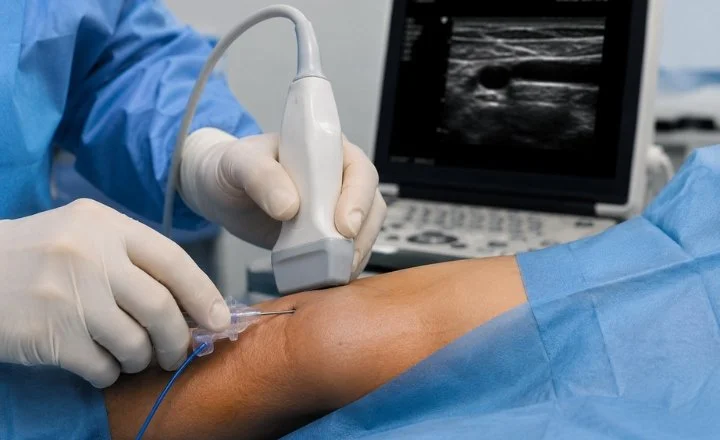
CPT code 76937 is used to report real-time ultrasound guidance during vascular access procedures—but only when strict documentation and imaging requirements are fully met.
In today’s complex healthcare reimbursement environment, precision in coding is no longer optional—it’s essential. Among the many codes that demand careful attention, CPT 76937 is one of the most frequently misunderstood, under-documented, and incorrectly billed.
For revenue cycle leaders, coders, and providers, mastering this code can significantly impact compliance, audit readiness, and revenue optimization.
Table of Contents
Why CPT 76937 Matters More Than Ever
Ultrasound-guided vascular access is now widely recognized as a clinical best practice. It enhances patient safety, improves procedural success, and reduces complications.
Industry data suggests that ultrasound guidance can reduce vascular access complications by up to 70% compared to traditional landmark techniques. Despite this, many healthcare organizations fail to capture appropriate reimbursement—not due to lack of usage, but due to documentation gaps.
If you are interested to read more about Vascular Billing , please have a look at this blog on ‘‘Heart & Vascular Billing Built for High-Volume Cardiology Practices’’.
“The real issue isn’t whether ultrasound is used—it’s whether its use is clearly documented to support coding and billing.”
— Senior RCM Auditor
Understanding CPT 76937
CPT 76937 is an add-on code, meaning it must always be reported alongside a primary procedure. However, its use is conditional—it requires all defined criteria to be met and documented.
👉 If it’s not documented, it didn’t happen—from a coding perspective.
The 5 Non-Negotiable Requirements
To accurately report CPT 76937, the following five elements must be present:
1. Evaluation of Potential Access Sites
Ultrasound must be used prior to the procedure to assess possible vessels.
Confirms clinical decision-making
Demonstrates diagnostic use of imaging
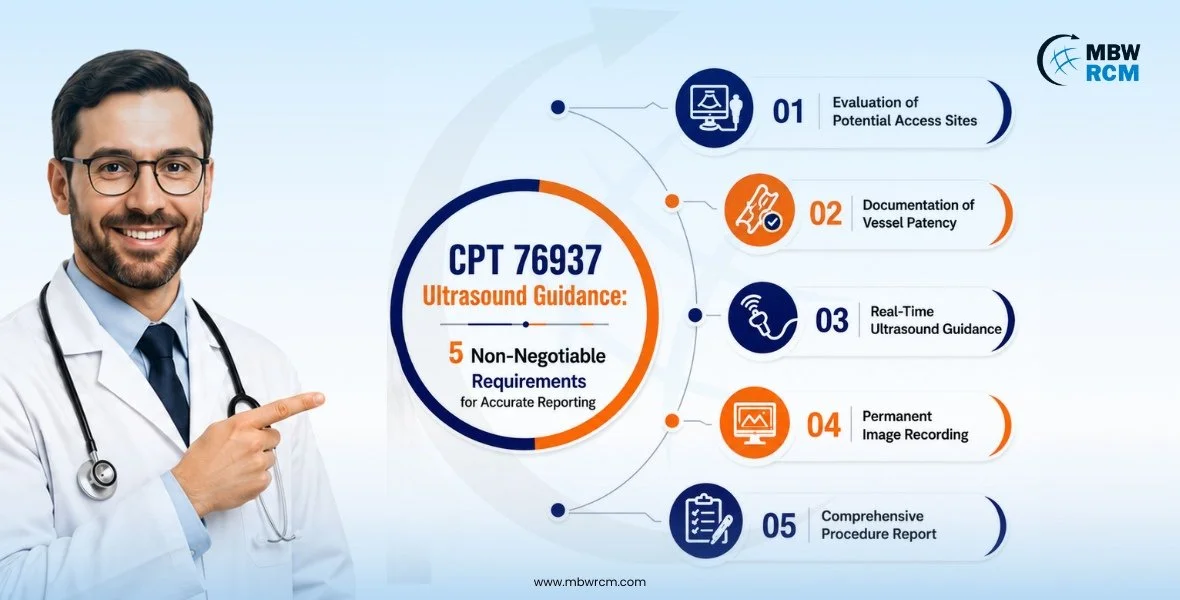
2. Documentation of Vessel Patency
The provider must document that the selected vessel is suitable for access.
Examples:
“Patent vein”
“No thrombosis noted”
“Narrowed but accessible vessel”
“Missing patency documentation is one of the leading causes of denials for 76937.”
— Certified Professional Coder (CPC)
3. Real-Time Ultrasound Guidance
Ultrasound must be used during needle insertion.
🚫 Not acceptable: Using ultrasound only to mark the site
✅ Required: Live visualization of needle entry
Even when ultrasound is used correctly, missing documentation details can still impact reimbursement. See how incomplete ultrasound documentation impacted coding and reimbursement outcomes in this ultrasound documentation case study.
4. Permanent Image Recording
Images must be captured and stored in the patient record.
Critical for audit validation
Missing images can lead to payment recoupment
Industry insights indicate that 25–30% of imaging-related denials are linked to missing or incomplete image documentation.
5. Comprehensive Procedure Report
The procedure note must clearly include:
Use of ultrasound guidance
Vessel selection and patency
Real-time visualization
Confirmation of stored images
Ultrasound vs Technology: Clearing the Confusion
Understanding the difference between imaging modalities and newer technologies is essential for accurate coding.
Below is a simplified comparison:
| Technology / Guidance Type | What Coders Should Know |
|---|---|
| Ultrasound Guidance (CPT 76937) | Uses real-time imaging to guide vascular access. Billable when all criteria are met, including vessel patency documentation, real-time guidance, and permanent image storage, unless bundled with the primary procedure. |
| Fluoroscopy | Uses X-ray imaging to visualize catheter or device placement. May be billed separately if documented and not bundled. |
| Tip Confirmation Systems | Confirms catheter tip location using ECG or other signals. Does not qualify as imaging guidance and is not separately billable. |
“Not all technologies used in procedures qualify as imaging guidance—understanding this distinction is key to compliant coding.”
Bundling: The Hidden Revenue Challenge
Certain procedures include ultrasound guidance, meaning CPT 76937 cannot be billed separately.
Common Bundled Procedures
PICC line placement
IVC filter placement
TIPS procedures
Pacemaker and ICD insertions
Reporting ultrasound guidance for CPT 76937 becomes difficult when documentation does not clearly support real-time visualization. Expert coding guidance can help avoid reimbursement mistakes.
“Bundling affects reimbursement—not documentation. Proper documentation is still required for compliance.”
Real-World Coding Scenario
A provider performs vascular access using ultrasound:
Evaluates the vessel
Confirms patency
Uses real-time guidance
Stores images
Can CPT 76937 be billed?
✔ Yes—this meets all required criteria
Financial Impact: Why Accuracy Matters
Failure to correctly capture CPT 76937 can lead to:
Missed reimbursement opportunities
Increased denial rates
Higher administrative rework
Audit vulnerabilities
Industry benchmarks show that improving documentation accuracy by 10–15% can significantly enhance revenue capture for imaging-related services.
Common Pitfalls to Avoid
Missing vessel patency documentation
Lack of real-time guidance evidence
Failure to store images
Billing despite bundling restrictions
“Most denials tied to 76937 are preventable with better documentation practices.”
Best Practices for RCM Success
To ensure accuracy and compliance:
Educate providers on documentation requirements
Use structured templates in EHR systems
Conduct regular coding audits
Align clinical and coding teams
Leverage automation for image tracking
Struggling with CPT Coding Accuracy and Documentation Gaps?
Missed documentation, bundling errors, and coding inaccuracies—especially for complex codes like 76937—can lead to denials, revenue leakage, and audit risks. At MBW RCM, we help healthcare organizations strengthen coding accuracy, improve documentation workflows, and ensure compliant billing across the revenue cycle.
👉 Explore Our RCM SolutionsThe MBW RCM Perspective
At MBW RCM, we view CPT 76937 as a prime example of how clinical precision and documentation quality directly impact financial performance.
“When documentation is complete and coding is accurate, organizations don’t just stay compliant—they unlock their full revenue potential.”
Final Thoughts
CPT 76937 is not just about using ultrasound—it’s about proving it was used correctly and completely.
When handled properly, it enables:
Stronger compliance
Reduced denials
Optimized reimbursement
When overlooked, it becomes a source of revenue leakage and audit risk.
FAQs on CPT Code 76937 – Ultrasound Guidance for Vascular Access
Strengthen Your Coding Accuracy for Complex Procedures
Managing complex codes like CPT 76937 can be challenging when documentation gaps, bundling rules, and imaging requirements are not consistently addressed. Even small errors in reporting ultrasound guidance can lead to denials, compliance risks, and missed reimbursement opportunities.
A focused review of your coding and documentation workflows can help identify gaps in ultrasound usage documentation, image storage practices, and adherence to coding guidelines—ensuring accurate reporting and improved claim outcomes.
Connect with our specialists to learn how MBW RCM’s coding and compliance solutions can help reduce denials, strengthen documentation, and improve overall revenue cycle performance.