Inpatient vs Outpatient Orthopedic Billing: Key Differences (What Practices Need to Know)

Inpatient vs outpatient orthopedic billing differs in reimbursement structure, coding requirements, documentation complexity, and claim timelines. Inpatient billing is used for complex orthopedic surgeries requiring hospital admission, while outpatient billing focuses on same-day procedures performed in ASCs and specialty clinics.
As more orthopedic procedures shift toward outpatient settings, providers must adapt to changing payer requirements and reimbursement models to reduce denials and improve claim accuracy.
This guide will help healthcare providers understand the key differences between inpatient and outpatient orthopedic billing, common reimbursement challenges, and the growing shift toward outpatient orthopedic procedures.
Table of Contents
What Is Inpatient Orthopedic Billing?
Inpatient orthopedic billing refers to reimbursement for orthopedic procedures requiring hospital admission and at least a 24-hour stay for postoperative monitoring or complication management. These claims are reimbursed under the MS-DRG payment system, where coding specificity directly impacts reimbursement value.
Complex inpatient orthopedic surgeries such as spinal fusion and revision joint replacement can generate reimbursement between $25,000 and $100,000 depending on implant utilization, severity adjustment, and payer contracts.
Hospitals rely on specialized orthopedic medical billing workflows because DRG downgrades, admission denials, and documentation gaps can significantly affect revenue performance.
Common Inpatient Orthopedic Procedures
Total knee arthroplasty (TKA)
Total hip replacement (THR)
Revision joint replacement
Lumbar and cervical spinal fusion
Complex fracture reconstruction
Orthopedic trauma surgeries
Key inpatient billing requirements include:
ICD-10-PCS coding
DRG assignment validation
Implant charge reconciliation
Length-of-stay documentation
How Inpatient Orthopedic Billing Works
Inpatient orthopedic billing follows a documentation-intensive workflow where DRG classification, implant reporting, and surgical complexity directly affect reimbursement outcomes.
The workflow typically includes:
Insurance verification
Prior authorization approval
Inpatient admission validation
ICD-10-CM and ICD-10-PCS coding
Implant charge capture
DRG grouping and denial management
What Is Outpatient Orthopedic Billing?
Outpatient orthopedic billing involves reimbursement for procedures performed without overnight admission, commonly in ambulatory surgery centers (ASCs) and orthopedic specialty clinics.
Nearly 65% of eligible orthopedic procedures are shifting toward outpatient settings due to lower costs, minimally invasive techniques, and faster patient recovery.
Outpatient reimbursement depends heavily on CPT coding accuracy, modifier usage, authorization compliance, and rapid claim submission.
Common Outpatient Orthopedic Procedures
Arthroscopic ACL reconstruction
Rotator cuff repair
Meniscus repair surgery
Carpal tunnel release
Trigger finger release
Outpatient joint replacement
Important outpatient billing components include:
CPT and HCPCS coding
Modifier 59 and RT/LT usage
ASC facility fee billing
NCCI edit management
How Outpatient Orthopedic Billing Works
Outpatient orthopedic billing focuses on faster reimbursement cycles and coding precision using CPT/APC or ASC payment methodologies.
The workflow includes:
Real-time eligibility verification
CPT procedure coding
HCPCS supply coding
Claim scrubbing validation
Electronic claim submission
Payment posting and denial prevention
Most outpatient orthopedic claims are submitted within 24–72 hours after surgery to accelerate reimbursement and reduce AR aging. Practices focused on Accurate Billing for Orthopedic Practices often use coding edits and denial analytics to improve clean claim rates.
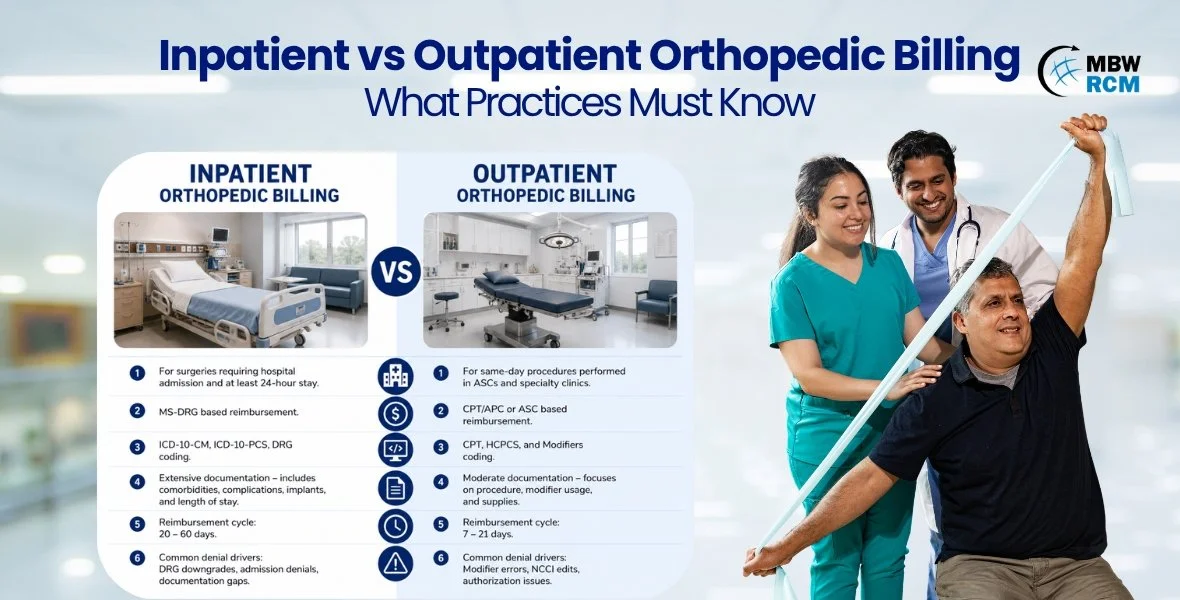
Key Differences Between Inpatient and Outpatient Orthopedic Billing
Inpatient and outpatient orthopedic billing differ in reimbursement, coding requirements, documentation, and claim processing timelines. Understanding these differences is essential for reducing denials, improving reimbursement accuracy, and maintaining efficient revenue cycle performance.
Reimbursement Model and Payment Structure
Inpatient Orthopedic Billing
Inpatient orthopedic claims are reimbursed through the MS-DRG payment model based on diagnosis severity, implant utilization, and hospital resource consumption. Complex orthopedic surgeries can generate reimbursements between $25,000 and $100,000 per case.Outpatient Orthopedic Billing
Outpatient orthopedic procedures are reimbursed through CPT/APC or ASC payment systems, where reimbursement is procedure-based and typically ranges from $2,500 to $30,000.
Strong orthopedic medical billing processes are essential to prevent revenue leakage in both settings.
2. Coding Requirements and Procedure Classification
Inpatient Orthopedic Billing
Hospitals use ICD-10-PCS codes for inpatient orthopedic procedures, requiring detailed surgical documentation for spinal fusion, trauma reconstruction, and revision surgeries.Outpatient Orthopedic Billing
Outpatient orthopedic billing mainly relies on CPT and HCPCS codes along with modifiers like RT/LT and Modifier 59.Accurate orthopedic medical coding helps reduce coding-related denials and reimbursement delays.
3. Length of Stay and Surgical Setting
Inpatient Orthopedic Billing
Inpatient orthopedic procedures require hospital admission with recovery periods ranging from 24 hours to multiple days depending on surgical complexity.Outpatient Orthopedic Billing
Outpatient orthopedic surgeries are performed with same-day discharge in ASCs or specialty orthopedic centers. The shift toward outpatient surgery is influencing Orthopedic Billing Strategies for BPCI Advanced across orthopedic practices.
4. Documentation and Clinical Detail
Inpatient Orthopedic Billing
Inpatient claims require extensive documentation including operative reports, implant records, physician progress notes, and discharge summaries.Outpatient Orthopedic Billing
Outpatient claims require shorter documentation focused on CPT accuracy, authorization records, and modifier justification. Healthcare organizations improve claim accuracy through specialty-focused orthopedic billing and coding workflows.
5. Denial Risks and Audit Exposure
Inpatient Orthopedic Billing
Common inpatient denial reasons include DRG downgrades, medical necessity denials, and inpatient admission validation failures.Outpatient Orthopedic Billing
Outpatient denials are commonly caused by modifier conflicts, NCCI edits, and prior authorization issues. Orthopedic denial rates can exceed 12%–18% without proper coding oversight.
6. Reimbursement Turnaround Time
Inpatient Orthopedic Billing
Inpatient orthopedic claims generally require 20–60 days for reimbursement because of DRG review and utilization audits.Outpatient Orthopedic Billing
Outpatient orthopedic claims are typically reimbursed within 7–21 days due to lower claim complexity. Advanced orthopedic revenue cycle management systems help accelerate reimbursement cycles and reduce AR days.
If you would like to learn more about orthopedic coding and reimbursement workflows, read this detailed guide on Orthopedic Billing and Coding in downloadable PDF format. Download Now!
7. Staffing and Operational Requirements
Inpatient Orthopedic Billing
Inpatient billing operations often require DRG specialists, inpatient coders, and clinical documentation improvement teams.Outpatient Orthopedic Billing
Outpatient billing teams focus more on high-volume CPT coding, authorization tracking, and same-day claim submission.
Many healthcare providers now recognize the Benefits of Outsourced Orthopedic Coding Solutions for achieving the best orthopedic rcm performance and ensuring Accurate Billing for Orthopedic Practices.
Inpatient vs Outpatient Orthopedic Billing Comparison Table
Understanding these billing differences helps orthopedic practices improve coding accuracy, reduce denials, and ensure proper reimbursement across both inpatient and outpatient care settings.
Reimbursement Challenges in Inpatient vs Outpatient Orthopedic Billing
Inpatient and outpatient orthopedic claims face different reimbursement challenges that can affect claim approval, payment timelines, and revenue performance.
Inpatient orthopedic billing commonly faces DRG downgrades, admission denials, implant reimbursement disputes, and missing documentation.
Outpatient orthopedic billing is more vulnerable to modifier misuse, NCCI edits, prior authorization failures, and incorrect CPT code combinations.
Many providers invest in specialized orthopedic revenue cycle management and recognize the Benefits of Outsourced Orthopedic Coding Solutions for improving Accurate Billing for Orthopedic Practices and overall orthopedic rcm performance.
The Growing Shift From Inpatient to Outpatient Orthopedic Procedures
Orthopedic procedures are steadily shifting toward outpatient settings due to lower treatment costs and advancements in minimally invasive surgery.
Medicare removed total knee arthroplasty (TKA) from the inpatient-only list, accelerating outpatient joint replacement procedures.
Orthopedic ASC case volumes continue increasing by nearly 6%–8% annually.
Outpatient orthopedic procedures can reduce total episode-of-care costs by nearly 40%.
ERAS protocols support faster mobilization and same-day discharge after joint replacement surgeries.
Same-day joint replacement programs are becoming more common in orthopedic specialty centers and ASCs.
This shift is reshaping Orthopedic Billing Strategies for BPCI Advanced and changing reimbursement management across orthopedic care settings.
Struggling With Inpatient & Outpatient Orthopedic Billing?
Our specialized Orthopedic Billing Services help reduce denials, improve reimbursements, and streamline orthopedic claims across all care settings.
👉 Get FREE Practice ReviewConclusion:
Understanding the differences between inpatient and outpatient orthopedic billing is essential as orthopedic procedures continue shifting across care settings. From DRG-based inpatient reimbursement to CPT-driven outpatient billing, each setting follows different coding, documentation, and reimbursement requirements that directly impact claim accuracy and payment timelines.
Partnering with experienced Orthopedic Billing Services can help providers manage these differences more effectively, reduce denials, and improve reimbursement across both inpatient and outpatient orthopedic procedures. Contact us today to learn how we can support your orthopedic billing needs.
FAQs on Inpatient vs Outpatient Orthopedic Billing
Manage Inpatient & Outpatient Orthopedic Billing More Efficiently
Differences in DRG reimbursement, CPT coding, prior authorization requirements, modifier usage, and documentation standards can create billing challenges across inpatient and outpatient orthopedic procedures.
Fill out the form below to improve orthopedic billing workflows, reduce denials, strengthen reimbursement performance, and optimize revenue cycle management across all orthopedic care settings.