Credentialing and Enrollment vs Privileging: Key Differences for Every Practice

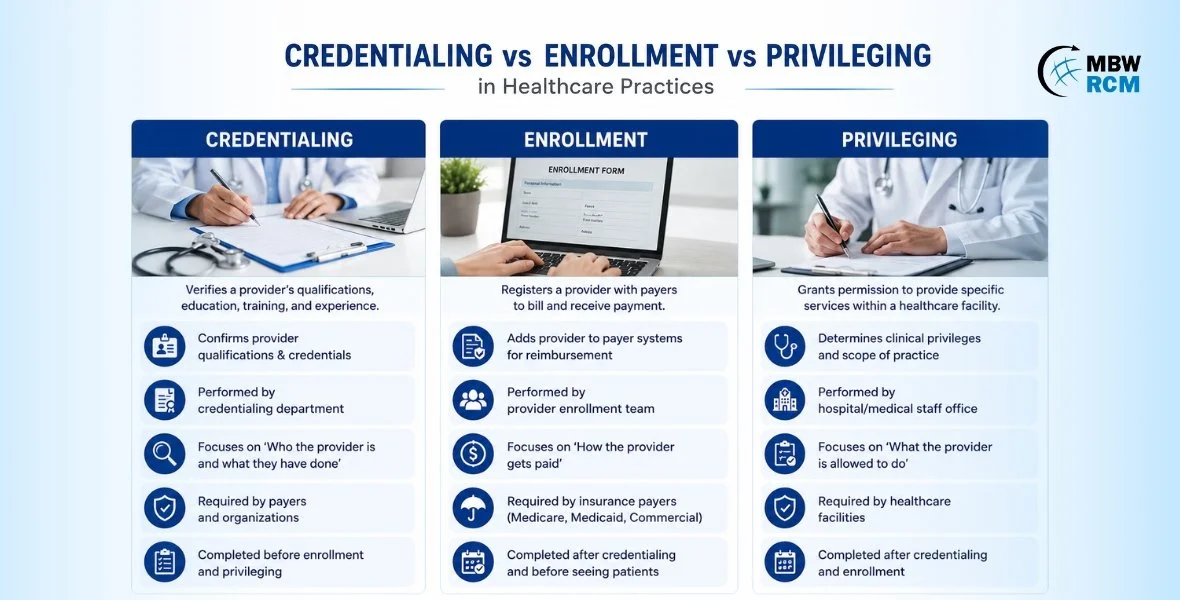
Credentialing verifies provider qualifications, provider enrollment allows providers to bill insurance companies, and privileging authorizes providers to perform specific clinical procedures within a healthcare facility.
Healthcare organizations often confuse credentialing, enrollment, and privileging because these processes are closely connected.
According to industry reports, provider enrollment delays can cost healthcare organizations thousands of dollars in lost monthly revenue for every inactive provider. At the same time, hospitals continue facing increased pressure to improve compliance, reduce onboarding delays, and strengthen patient safety standards.
That’s why understanding these three processes is no longer just an administrative task — it directly affects revenue, operations, and patient care. However, understanding the differences between credentialing and enrollment vs privileging is essential for maintaining compliance, accelerating provider onboarding, improving reimbursements, and ensuring patient safety.
Whether you run a hospital, private practice, ambulatory surgery center, behavioral health clinic, or medical billing company, these processes directly impact:
Revenue cycle management
Insurance reimbursements
Regulatory compliance
Provider onboarding timelines
Clinical operations
Patient safety standards
Healthcare accreditation requirements
A delay in credentialing or provider enrollment can stop a physician from billing insurance companies. Similarly, delays in privileging can prevent providers from performing procedures in hospitals or surgical facilities.
In this comprehensive guide, we’ll explain:
What credentialing means in healthcare
What provider enrollment involves
What medical privileging means
The key differences between credentialing and enrollment vs privileging
How these processes work together
Common healthcare compliance challenges
Best practices to improve operational efficiency
Table of Contents
Why Healthcare Practices Cannot Ignore Credentialing, Enrollment, and Privileging
These processes directly impact:
Insurance reimbursements
Provider onboarding
Healthcare compliance
Revenue cycle management
Patient safety
Hospital accreditation
Without proper credentialing, enrollment, or privileging:
Claims may be denied
Providers may be unable to bill payers
Hospitals may face compliance risks
Patient care may be delayed
Credentialing Explained: Verifying a Provider’s Qualifications
Credentialing is the process of verifying a healthcare provider’s qualifications, education, training, licenses, certifications, work history, and professional background.
The purpose of healthcare credentialing is to ensure that providers are legally qualified, clinically competent, and compliant with industry standards.
Credentialing is one of the most important risk management and compliance processes in healthcare.
What Happens During the Credentialing Process?
Medical education verification
State license verification
Board certification checks
DEA verification
Work history review
Malpractice insurance verification
Sanctions and exclusion screening
Background checks
Credentialing mistakes can quietly delay reimbursements for weeks. Find out how to avoid them in our quick reference guide to successful physician credentialing.
Why Healthcare Organizations Prioritize Credentialing
Credentialing plays a critical role in protecting both patients and healthcare organizations. By verifying provider qualifications, healthcare facilities can reduce compliance risks and ensure providers meet professional and legal standards. Credentialing also helps insurance companies confirm provider eligibility before approving network participation. A strong credentialing process improves patient trust, reduces claim denials, and supports smoother healthcare operations.
It ensures providers:
Meet clinical competency standards
Hold valid licenses and certifications
Comply with payer requirements
Meet healthcare accreditation standards
Are eligible to participate in insurance networks
Credentialing also helps reduce:
Medical liability risks
Fraud risks
Compliance violations
Insurance claim denials
Without proper credentialing, providers may not be eligible to work with hospitals, insurance companies, or government healthcare programs.
Credentialing delays and payer approval issues can disrupt reimbursements. Learn how to avoid them in our guide to credentialing for medical practices.
Provider Enrollment Explained: Getting Approved by Insurance Companies
Provider enrollment is the process of registering healthcare providers with insurance companies and government healthcare programs so they can bill for medical services.
Once providers complete credentialing, they must enroll with payers to become participating or in-network providers.
Provider enrollment is essential for healthcare reimbursement.
Common Insurance Payers for Enrollment
Healthcare providers commonly enroll with:
Medicare
Medicaid
Blue Cross Blue Shield
Aetna
Cigna
UnitedHealthcare
Humana
Tricare
Workers’ compensation programs
Managed care organizations
What Happens During the Provider Enrollment Process?
Payer application submission
CAQH profile management
NPI and taxonomy verification
Insurance contracting
Credentialing document submission
Revalidation and profile updates
Why Provider Enrollment Directly Impacts Revenue
Provider enrollment is essential because healthcare providers cannot receive insurance reimbursements without active payer participation. Delays or errors in enrollment can interrupt cash flow, increase denied claims, and create administrative challenges for healthcare organizations. Proper enrollment management improves reimbursement timelines and helps providers begin billing quickly after joining a practice or facility. It also supports long-term revenue cycle stability and payer compliance.
Enrollment delays can create serious financial issues such as:
Delayed cash flow
Revenue leakage
Claim rejections
Increased patient billing
Operational inefficiencies
Many practices lose thousands of dollars because provider enrollment applications are delayed, rejected, or incomplete.
Efficient enrollment management helps healthcare organizations:
Improve reimbursement timelines
Reduce denied claims
Increase operational efficiency
Accelerate provider onboarding
Maintain payer compliance
Medical Privileging Explained: Approving Clinical Procedures
Privileging is the process through which hospitals and healthcare facilities authorize providers to perform specific procedures or clinical services.
Unlike credentialing, which verifies qualifications, privileging determines what a provider is clinically authorized to do within a healthcare organization.
For example:
A surgeon may receive privileges for laparoscopic surgery
A cardiologist may receive catheterization lab privileges
An anesthesiologist may receive privileges for advanced anesthesia procedures
An orthopedic surgeon may receive joint replacement privileges
Privileging focuses heavily on clinical competency and patient safety.
What Happens During the Medical Privileging Process?
Clinical competency review
Procedure log evaluation
Peer recommendations
Medical staff committee approval
Ongoing quality monitoring
Why Hospitals Use Medical Privileging
Privileging is essential for maintaining patient safety, healthcare quality, and clinical accountability within hospitals and medical facilities. By reviewing clinical competency and procedure experience, healthcare organizations can ensure providers only perform services they are qualified to handle. This process helps reduce medical errors, supports accreditation standards, and improves overall patient care outcomes. Strong privileging programs also minimize malpractice risks and strengthen healthcare compliance efforts.
It helps healthcare facilities:
Reduce medical errors
Improve patient outcomes
Minimize malpractice risks
Meet accreditation requirements
Maintain clinical quality assurance
Hospitals and surgery centers rely heavily on privileging to ensure providers only perform procedures they are properly trained to handle.
Difference Between Credentialing, Enrollment, and Privileging (Comparison Table)
Understanding the differences between credentialing and enrollment vs privileging is easier when viewed side by side.
| Feature | Credentialing | Provider Enrollment | Privileging |
|---|---|---|---|
| Purpose | Verifies provider qualifications | Approves providers to bill insurance | Authorizes clinical procedures |
| Main Focus | Education, license, certifications | Payer network participation | Clinical skills and procedure competency |
| Handled By | Hospitals, payers, employers | Insurance companies and payers | Hospitals and healthcare facilities |
| Outcome | Provider is verified | Provider can receive reimbursement | Provider can perform approved procedures |
| Revenue Impact | Supports payer approval | Directly affects payments | Supports facility-based services |
| Patient Safety Impact | Confirms provider background | Limited direct impact | Ensures safe clinical practice |
Credentialing and enrollment are often used interchangeably, but they serve very different roles in the revenue cycle. Here’s a simple guide to understanding provider credentialing vs enrollment.
Credentialing vs Enrollment vs Privileging: What Makes Them Different?
Credentialing
Credentialing is the process of verifying whether a healthcare provider is professionally qualified to practice medicine or deliver healthcare services. Hospitals, insurance companies, and healthcare organizations use this process to confirm that providers meet professional, legal, and clinical standards before treating patients.
“Strong credentialing processes protect both patient safety and healthcare operations.”
Credentialing also helps organizations reduce compliance risks, prevent fraud, and improve provider onboarding efficiency. Healthcare organizations, hospitals, and insurance companies use credentialing to confirm that providers meet industry standards and regulatory requirements. This process helps reduce compliance risks, improves patient safety, and ensures providers have the appropriate education, training, and certifications required to treat patients. Proper credentialing also supports smoother provider onboarding and minimizes delays in payer approvals and reimbursements.
During this process, healthcare organizations and insurance companies verify:
Medical education and training
State licenses and certifications
Board certifications
Employment history
Malpractice insurance
Compliance records and sanctions
Credentialing helps reduce compliance risks, improves provider verification accuracy, and ensures healthcare professionals meet industry standards before treating patients. If you are interested to read more about Credentialing, please have a look at this blog on ‘‘Reduce Provider Credentialing Errors’’.
Provider Enrollment
Provider enrollment is the process of registering healthcare providers with insurance companies and government healthcare programs. Once enrollment is approved, providers can join payer networks and begin billing insurance companies for medical services.
Many healthcare practices experience payment delays simply because enrollment applications were incomplete or submitted late. Efficient enrollment workflows help organizations reduce denied claims, improve cash flow, and speed up reimbursements. Once enrollment is approved, providers can participate in payer networks and submit claims for reimbursements. This process is essential for maintaining consistent cash flow and avoiding delays in revenue cycle management. Efficient provider enrollment also helps healthcare organizations reduce denied claims, improve operational efficiency, and maintain compliance with payer requirements.
Once enrollment is approved, providers can submit claims to:
Medicare
Medicaid
Commercial insurance companies
Managed care organizations
Provider enrollment is critical for maintaining steady cash flow and preventing reimbursement delays. Incomplete or delayed enrollment can lead to claim denials, lost revenue, and disruptions in the revenue cycle management process.
Privileging
Privileging is the process through which hospitals and healthcare facilities determine which procedures and clinical services a provider is authorized to perform. Unlike credentialing, which verifies qualifications, privileging focuses on clinical experience, competency, and procedure-specific expertise.
“Privileging ensures providers only perform procedures they are trained and experienced to handle.”
Hospitals use privileging to improve patient safety, reduce medical risks, and maintain healthcare quality standards. Unlike credentialing, which focuses on verifying qualifications, privileging evaluates clinical competency, procedure experience, and patient safety standards. Hospitals use privileging to ensure providers only perform services they are properly trained and experienced to handle. This process helps reduce medical risks, improves patient outcomes, and supports healthcare quality assurance programs.
Hospitals review:
Clinical competency
Procedure experience
Case logs
Peer recommendations
Patient safety records
This process helps ensure providers only perform procedures they are properly trained and experienced to handle, reducing medical risks and improving patient safety outcomes.
Provider Enrollment Focuses on Reimbursement
Enrollment allows providers to participate in payer networks and receive insurance reimbursements.
It answers the question:
“Can this provider bill insurance companies?”
Privileging Focuses on Clinical Authorization
Privileging determines whether providers can perform certain procedures within a facility.
It answers the question:
“What clinical procedures is this provider allowed to perform?”
How Credentialing, Enrollment, and Privileging Work Together in Healthcare
Healthcare organizations often complete these processes in sequence.
Step 1: Credentialing
The provider’s education, licenses, certifications, and work history are verified.
Step 2: Provider Enrollment
The provider enrolls with insurance companies to begin billing for services.
Step 3: Privileging
The healthcare facility authorizes the provider to perform approved clinical procedures.
Together, these processes help healthcare organizations:
Improve compliance management
Protect patient safety
Accelerate reimbursements
Reduce claim denials
Streamline provider onboarding
Maintain accreditation standards
Common Delays and Problems During Provider Onboarding
Healthcare organizations often face operational and administrative challenges while managing provider onboarding and compliance workflows.
Delayed Payer Approvals
Insurance companies may take several weeks or months to process applications, delaying reimbursements and provider activation.
Incomplete Provider Documentation
Missing licenses, certifications, malpractice coverage, or supporting documents can slow down approvals.
Enrollment Application Errors
Incorrect payer information, taxonomy codes, or provider data often lead to rejected applications.
Expired Licenses and Certifications
Failure to monitor renewal dates may create compliance issues and interrupt payer participation.
Slow Hospital Committee Reviews
Privileging approvals may be delayed because of internal medical staff committee review timelines.
Revenue Delays From Inactive Enrollments
Providers who are not fully enrolled with payers may be unable to bill insurance companies, resulting in cash flow disruptions.
Simple Ways to Improve Credentialing, Enrollment, and Privileging
Healthcare organizations can reduce delays, improve payer approvals, and streamline provider onboarding by using structured credentialing and enrollment workflows.
Industry studies show that delayed provider onboarding remains one of the leading causes of reimbursement disruptions in healthcare practices. Standardized processes help organizations improve operational efficiency while reducing administrative workload.
Maintain Updated Provider Records
Keep licenses, board certifications, DEA registrations, malpractice insurance, and CAQH profiles updated at all times.
Start Credentialing Early
Begin credentialing and enrollment before a provider’s start date to avoid reimbursement delays.
Use Credentialing Software
Automation tools help manage documentation, track application status, monitor expirations, and improve workflow visibility.
Track Expiration and Renewal Dates
Proactive monitoring prevents compliance issues caused by expired credentials or payer revalidations.
Standardize Documentation Workflows
Centralized document management improves consistency and reduces administrative errors.
Conduct Regular Compliance Audits
Routine internal audits help identify missing information, expired documents, and payer compliance gaps.
Outsource Credentialing When Needed
Many healthcare organizations partner with credentialing specialists to improve turnaround times, reduce administrative burden, and streamline provider onboarding.
How Credentialing and Enrollment Impact Healthcare Revenue
Credentialing and provider enrollment are critical components of healthcare revenue cycle management.
If providers are not properly credentialed or enrolled:
Claims may be denied
Payments may be delayed
Revenue may be lost
Patients may receive unexpected bills
Efficient credentialing and enrollment processes help:
Improve cash flow
Reduce accounts receivable delays
Increase clean claim rates
Improve payer relationships
Strengthen financial performance
Healthcare organizations that optimize provider onboarding often experience better revenue cycle outcomes.
How Privileging Helps Improve Patient Safety and Clinical Quality
Medical privileging directly impacts patient care quality.
Hospitals use privileging to ensure providers only perform procedures they are trained and experienced to handle.
This helps:
Reduce clinical errors
Improve patient outcomes
Support quality assurance initiatives
Minimize malpractice exposure
Maintain hospital accreditation standards
Strong privileging programs create safer healthcare environments for both patients and providers.
Real-World Example: Credentialing vs Enrollment vs Privileging
Imagine a cardiologist joining a hospital system.
| Process | What Happens |
|---|---|
| Credentialing |
The hospital verifies:
|
| Provider Enrollment |
The cardiologist enrolls with:
This allows insurance billing. |
| Privileging |
The hospital authorizes the cardiologist to:
|
This defines the provider’s approved clinical scope.
Strengthen Your Credentialing and Enrollment Workflow
Our Provider Credentialing and Enrollment Services help healthcare practices reduce payer delays, streamline provider setup, and maintain smoother revenue cycle operations.
👉 Get a Free Practice AuditFinal Thoughts: Credentialing vs Enrollment vs Privileging
Understanding the differences between credentialing and enrollment vs privileging is essential for healthcare organizations seeking to improve compliance, patient safety, operational efficiency, and financial performance.
Although these processes are interconnected, each serves a distinct purpose:
Credentialing verifies provider qualifications
Provider enrollment enables insurance reimbursements
Privileging authorizes clinical procedures
Healthcare organizations that streamline these workflows can:
Accelerate provider onboarding
Improve payer approvals
Reduce administrative delays
Strengthen revenue cycle management
Improve patient care quality
Maintain healthcare compliance
As healthcare regulations continue evolving, efficient credentialing, enrollment, and privileging processes are no longer optional — they are critical for sustainable healthcare operations.
FAQs on Credentialing, Enrollment, and Privileging
Need Help With Credentialing, Enrollment, or Privileging?
Managing provider credentialing, payer enrollment, and medical privileging can be time-consuming and complex.
Partner with experienced healthcare credentialing specialists to:
Accelerate provider onboarding
Reduce payer delays
Improve reimbursement timelines
Maintain compliance
Streamline provider data management
Optimize revenue cycle performance
A reliable credentialing and enrollment partner can help your healthcare organization stay compliant, improve operational efficiency, and maximize reimbursements.