How AI Is Revolutionizing Revenue Cycle Management

Revenue Cycle Management (RCM) has never been easy—but over the last few years, it's become even more challenging.
Healthcare providers are dealing with changing payer rules, stricter documentation requirements, growing claim volumes, staffing shortages, and rising patient financial responsibility. At the same time, everyone expects faster reimbursements and fewer billing errors.
That's a lot to manage.
A single missing document, incorrect modifier, or outdated insurance detail can delay payment for weeks or even months. When these issues happen repeatedly, they don't just slow down cash flow—they create extra work for billing teams and take valuable time away from other priorities.
This is exactly why Artificial Intelligence (AI) is getting so much attention in healthcare.
Not because it's replacing medical billers or coders.
But because it's helping them work smarter.
Instead of spending hours reviewing claims manually, AI can quickly identify missing information, flag potential coding issues, predict claims that are likely to be denied, and even highlight underpayments that might otherwise go unnoticed.
Table of Contents
Think of AI as another member of your revenue cycle team—one that works around the clock, processes thousands of claims in minutes, and helps your staff focus on the work that requires experience and critical thinking.
As AI continues to evolve, more healthcare organizations are using it to improve billing accuracy, reduce administrative work, strengthen cash flow, and make better financial decisions.
But where does AI actually fit into the revenue cycle? And is it really changing the way healthcare organizations manage billing?
Let's find out.
What Is AI in Revenue Cycle Management?
Artificial Intelligence (AI) in Revenue Cycle Management is the use of intelligent technology to support and improve the financial side of healthcare.
Instead of relying entirely on manual processes, AI can analyse large amounts of billing and clinical data, recognise patterns, identify potential problems, and recommend the next best action.
Unlike traditional automation—which simply follows predefined rules—AI learns from historical data. That means it becomes better over time at spotting trends, detecting unusual claim activity, and helping billing teams prevent problems before they happen.
Today, AI is being used throughout the revenue cycle to support tasks such as:
Verifying patient insurance eligibility
Assisting with medical coding
Identifying missed charges
Reviewing claims before submission
Predicting claim denials
Detecting payer underpayments
Prioritising accounts receivable follow-up
Supporting payment posting and reconciliation
Forecasting revenue trends
The goal isn't to replace your existing billing process.
It's to make it faster, more accurate, and more efficient.
Why AI Is Becoming Essential in Revenue Cycle Management
The healthcare revenue cycle generates an enormous amount of data every single day.
Patient registrations, insurance information, clinical documentation, diagnosis codes, procedure codes, authorizations, claim status updates, remittance advice, payment records—the list goes on.
Managing all of this manually is becoming harder every year.
That's one of the biggest reasons healthcare organizations are investing in AI.
Instead of asking billing teams to search through hundreds of claims looking for problems, AI can analyse thousands of records in minutes and identify issues that need immediate attention.
Here are a few reasons why AI adoption is growing so quickly.
Claims Are Becoming More Complex
Submitting a claim isn't just about entering the right CPT® and ICD-10 codes anymore.
Every payer has different rules, documentation requirements, modifier guidelines, and reimbursement policies. Missing even one detail can result in a denial or payment delay.
AI helps identify many of these issues before the claim reaches the payer, giving billing teams a chance to fix them early.
Billing Teams Are Doing More with Less
Many healthcare organizations continue to face staffing shortages while claim volumes keep increasing.
AI helps reduce repetitive administrative work by automating routine tasks like eligibility checks, claim reviews, and work queue prioritization. That allows experienced staff to spend more time on appeals, complex coding, and revenue recovery.
Revenue Leakage Is Harder to Spot
Not every financial loss comes from denied claims.
Missed charges, underpayments, coding inconsistencies, and delayed follow-ups can quietly reduce revenue over time.
AI helps uncover these hidden opportunities by analysing billing data that would be nearly impossible to review manually.
Better Decisions Start with Better Data
Revenue cycle leaders need more than monthly reports—they need insights they can act on.
AI can identify payer trends, predict reimbursement patterns, highlight workflow bottlenecks, and support better financial planning using real-time data.
Instead of reacting to problems after they happen, organizations can take action before revenue is affected.
How AI Is Transforming Every Stage of the Revenue Cycle
AI isn't designed to take over the revenue cycle—it makes every step more efficient.
From the moment a patient schedules an appointment until the final payment is collected, AI can help reduce manual work, identify potential problems earlier, and give billing teams better visibility into what's happening across the revenue cycle.
Let's take a closer look at where AI is making the biggest impact today.
1. Patient Registration and Insurance Verification
The revenue cycle starts long before a claim is submitted.
If patient demographics are incorrect or insurance eligibility isn't verified, there's a good chance the claim will be delayed or denied later. These front-end errors often create unnecessary rework and slow down reimbursement.
AI helps by automatically validating patient information against payer databases, identifying incomplete registrations, and verifying insurance eligibility in real time.
Instead of discovering coverage issues after treatment has been provided, practices can resolve them before the patient is even seen.
AI can also alert staff when:
Insurance coverage has changed
A policy has expired
Prior authorization may be required
Patient information doesn't match payer records
By catching these issues early, practices can improve clean claim rates and reduce avoidable denials.
2. Smarter Medical Coding
Medical coding requires accuracy, attention to detail, and a strong understanding of clinical documentation.
AI isn't replacing certified medical coders—but it is making their job easier.
Using Natural Language Processing (NLP), AI can review physician documentation, identify diagnoses and procedures, and suggest appropriate ICD-10-CM, CPT®, and HCPCS codes.
It can also highlight:
Missing documentation
Possible coding inconsistencies
Modifier opportunities
Potential compliance risks
Unspecified diagnoses that need clarification
This allows coders to spend less time searching through documentation and more time reviewing complex cases that require clinical judgement.
For specialties like radiation oncology, spine surgery, cardiology, and orthopaedics, where coding is often highly complex, human expertise remains essential. AI provides valuable recommendations, but experienced coders are still responsible for ensuring coding accuracy and compliance.
Did you know? The American Medical Association (AMA) continues to emphasise accurate clinical documentation and coding as critical to proper reimbursement and regulatory compliance.
https://www.ama-assn.org/practice-management/cpt
3. Better Charge Capture Means Less Revenue Leakage
Not every revenue loss comes from denied claims.
Sometimes services are performed but never billed. Other times, charges are delayed, duplicated, or simply missed.
These small issues can quietly add up to thousands—or even millions—of dollars in lost revenue over time.
AI helps improve charge capture by comparing multiple sources of information, including:
Physician documentation
Operative reports
Procedure schedules
Treatment records
Billing records
If something doesn't match, AI can flag it for review
For example, it might identify:
A procedure documented but never billed
A missed supply charge
Duplicate charges
Incomplete treatment billing
Missing ancillary services
Instead of relying solely on manual reconciliation, billing teams receive alerts that help prevent revenue from slipping through the cracks.
4. AI Makes Claim Scrubbing Smarter
Traditional claim scrubbers follow predefined rules.
If a required field is missing or a modifier is incorrect, the software flags the issue.
AI takes this a step further.
Instead of only checking for standard edits, AI learns from historical billing data, payer behaviour, and previous denials to identify claims that are more likely to run into problems.
It can detect issues such as:
Documentation that doesn't support medical necessity
Diagnosis and procedure combinations with a higher denial risk
Missing modifiers
Coding inconsistencies
Payer-specific billing patterns
This allows billing teams to correct problems before claims are submitted, increasing the likelihood of first-pass acceptance.
5. Predictive Denial Management
Most denial management strategies begin after a claim has already been rejected.
AI changes that approach.
By analysing historical denial trends, payer rules, and previous reimbursement data, AI can estimate which claims have the highest risk of being denied before they ever leave the billing office.
Instead of reacting to denials, billing teams can proactively review high-risk claims and correct potential issues in advance.
Factors AI can evaluate include:
Procedure type
Diagnosis combinations
Missing documentation
Provider history
Payer-specific requirements
Previous denial patterns
This proactive approach helps reduce rework, speeds up reimbursement, and improves overall revenue cycle performance.
According to the Healthcare Financial Management Association (HFMA), using analytics and automation to strengthen denial prevention strategies can significantly improve financial performance and operational efficiency.
6. Smarter Accounts Receivable Follow-Up
Not every unpaid claim deserves the same level of attention.
Some claims have a high likelihood of payment with minimal follow-up, while others require immediate escalation before filing deadlines expire.
AI helps billing teams prioritise accounts receivable by analysing factors such as:
Claim age
Outstanding balance
Payer payment history
Probability of reimbursement
Timely filing deadlines
Previous follow-up activity
Instead of working through A/R queues in chronological order, staff can focus on the claims with the greatest financial impact first.
This improves productivity while helping practices recover outstanding revenue more efficiently.
7. AI Is Making Payment Posting Faster and More Accurate
Payment posting may seem like a routine task, but it's one of the most important parts of the revenue cycle. Every payment, adjustment, denial, and contractual write-off needs to be recorded correctly to maintain accurate financial records.
When payment posting is delayed or inaccurate, it creates a ripple effect across the entire revenue cycle. Accounts receivable grow older, underpayments go unnoticed, and reporting becomes less reliable.
AI helps simplify this process by automatically matching Electronic Remittance Advice (ERA) files with submitted claims, identifying payment discrepancies, and flagging transactions that need manual review.
Instead of spending hours reconciling payments, billing teams can focus on exceptions that genuinely require attention.
AI can also identify:
Incorrect contractual adjustments
Duplicate payments
Missing remittance information
Partial payments
Posting inconsistencies across multiple payers
The result is faster reconciliation, more accurate financial reporting, and better visibility into your practice's cash flow.
8. AI Helps Detect Underpayments That Often Go Unnoticed
A paid claim doesn't always mean it was paid correctly.
Underpayments are one of the most overlooked sources of revenue leakage. With thousands of claims processed every month, it's nearly impossible for billing teams to manually compare every payment against complex payer contracts.
AI makes this process much easier.
By analysing reimbursement contracts, fee schedules, historical payments, and payer trends, AI can quickly identify claims that may have been reimbursed below the contracted amount.
For example, AI can detect:
Incorrect fee schedule calculations
Missing contractual adjustments
Reduced reimbursements
Bundled services paid incorrectly
Inconsistent payer payment patterns
Instead of discovering these issues months later—or not at all—billing teams receive alerts that help them recover revenue sooner.
For practices that process a high volume of specialty procedures, even small underpayments can add up to a significant financial impact over time.
9. Better Revenue Decisions Start with Better Insights
Most practices already have access to reports.
The challenge is turning those reports into meaningful decisions.
AI doesn't just organise billing data—it analyses it.
Instead of showing what happened last month, AI can identify patterns, predict future trends, and highlight opportunities for improvement before they affect revenue.
Revenue cycle leaders can use AI to answer questions like:
Which payers have the highest denial rates?
Which specialties experience the most coding errors?
What are the biggest causes of delayed payments?
Which claims should be prioritised first?
Where is revenue leakage occurring?
Which workflows are slowing reimbursement?
Having these insights available in real time allows healthcare organisations to make proactive decisions instead of reacting after problems have already impacted cash flow.
The Biggest Benefits of AI in Revenue Cycle Management
By now, it's clear that AI isn't improving just one part of the revenue cycle—it's supporting nearly every stage of the billing process.
Here are some of the biggest benefits healthcare organisations are seeing.
Improved Claim Accuracy
AI reviews claims before submission, identifies missing information, and highlights potential coding or documentation issues.
Fewer errors mean fewer preventable denials.
Faster Reimbursements
By reducing claim errors and automating repetitive tasks, AI helps practices submit cleaner claims that move through the reimbursement process more efficiently.
That means fewer delays and healthier cash flow.
Lower Administrative Burden
Routine administrative work often consumes a large portion of a billing team's day.
AI automates repetitive tasks such as eligibility verification, claim reviews, payment matching, and work queue prioritisation, allowing staff to focus on higher-value activities.
Better Denial Prevention
Rather than waiting for denials to happen, AI helps identify claims with a higher risk of rejection before they're submitted.
This proactive approach reduces rework and helps improve first-pass claim acceptance.
Improved Financial Visibility
Revenue cycle leaders gain access to real-time insights instead of relying solely on monthly reports.
This makes it easier to monitor performance, identify revenue trends, and make informed operational decisions.
Better Patient Financial Experience
AI isn't only helping providers.
Patients also benefit from faster insurance verification, clearer billing information, automated payment reminders, and more flexible payment options.
A smoother financial experience often leads to higher patient satisfaction and improved collections.
But AI Isn't Perfect
For all its advantages, AI isn't a magic solution.
Healthcare revenue cycle management involves complex clinical documentation, constantly changing payer rules, and strict compliance requirements.
AI can analyse data and identify patterns—but it doesn't understand clinical intent the way experienced professionals do.
It also depends heavily on the quality of the information it receives.
If documentation is incomplete, insurance information is inaccurate, or coding guidelines aren't followed, AI can only work with the data available.
Some of the biggest challenges organisations should consider include:
Poor data quality
Integration with existing EHR and billing systems
Ongoing model training and updates
HIPAA and data security requirements
Staff adoption and workflow changes
Human oversight for complex coding and appeals
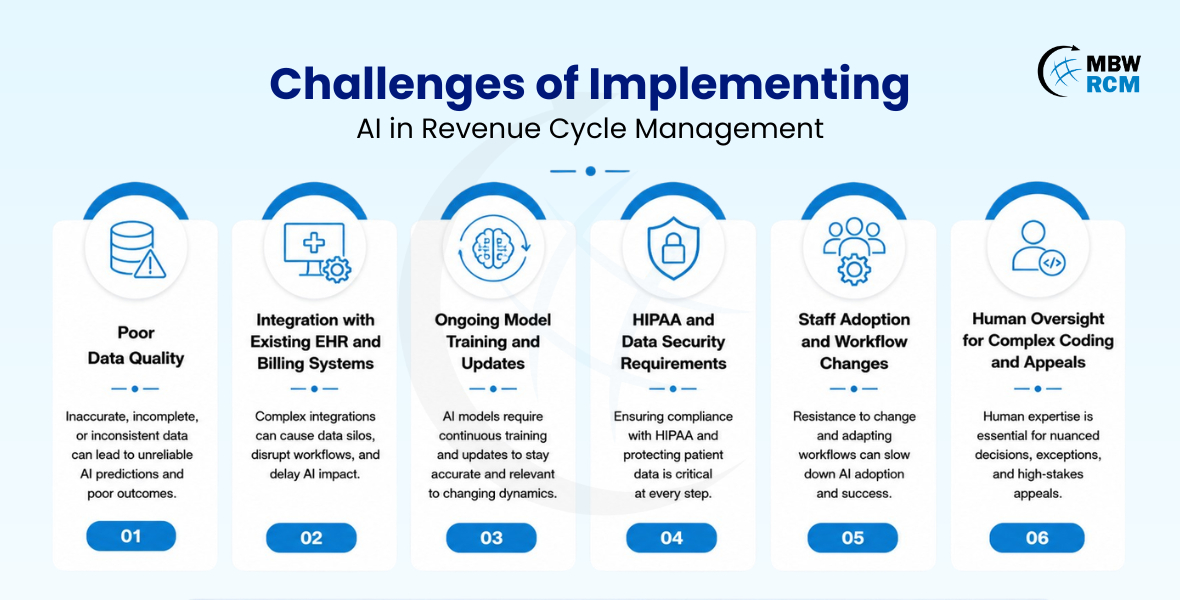
The most successful organisations treat AI as a support tool—not a replacement for experienced revenue cycle professionals.
Why Human Expertise Still Matters
One of the biggest misconceptions about AI is that it can fully automate healthcare billing.
The reality is much different.
AI can review thousands of claims in minutes, identify billing trends, and automate repetitive tasks—but it can't replace the experience required to interpret clinical documentation, manage payer disputes, or navigate complex reimbursement scenarios.
For example:
AI can recommend a medical code.
A certified coder determines whether the documentation truly supports it.
AI can predict a denial.
A denial specialist decides the best strategy to prevent or appeal it.
AI can identify a possible underpayment.
An accounts receivable specialist validates the payer contract and pursues recovery.
The strongest revenue cycle teams combine intelligent technology with experienced professionals who understand the complexities of medical billing.
That's where the real value comes from.
The Future of AI in Revenue Cycle Management
AI has already become an important part of modern revenue cycle management, but we're only scratching the surface of what's possible.
Over the next few years, AI is expected to move beyond automating repetitive tasks and become a true decision-support system for healthcare organizations. Instead of simply identifying problems, AI will increasingly recommend solutions, predict financial outcomes, and help revenue cycle teams make faster, more informed decisions.
As healthcare data continues to grow, AI will play a larger role in helping providers manage increasingly complex reimbursement requirements without adding to their administrative workload.
Some of the biggest developments we're likely to see include:
More Intelligent Denial Prevention
Future AI models will become even better at understanding payer behaviour and reimbursement trends.
Rather than simply predicting whether a claim may be denied, AI will recommend the exact changes needed before submission, helping practices improve first-pass claim acceptance.
Better Clinical Documentation Support
Clinical documentation has a direct impact on coding accuracy and reimbursement.
AI-powered documentation assistants are becoming more capable of reviewing physician notes in real time, identifying missing details, and suggesting improvements that better support coding and medical necessity.
This doesn't replace physicians or coders—it simply helps ensure documentation is complete before the billing process begins.
Smarter Revenue Forecasting
Imagine being able to predict next month's collections before the month even starts.
As AI models become more sophisticated, healthcare organizations will gain better visibility into:
Expected cash flow
Seasonal reimbursement trends
Payer payment performance
High-risk claims
Future staffing requirements
This allows leadership teams to make better operational and financial decisions with greater confidence.
More Personalized Patient Financial Experiences
Patients are becoming more involved in their healthcare costs than ever before.
AI can help create a better financial experience by offering:
Personalized payment plans
Automated payment reminders
Faster insurance verification
Real-time cost estimates
Self-service billing support
Making billing easier for patients often leads to faster collections and improved patient satisfaction.
AI vs Traditional Automation: What's the Difference?
Many people use the terms AI and automation interchangeably, but they're not the same thing.
Traditional automation follows a fixed set of rules.
For example, if a claim is missing a required field, the software flags it. If the field is completed, the claim moves to the next step. It performs exactly as it's programmed.
AI works differently.
| Traditional Automation | Artificial Intelligence |
|---|---|
| Follows predefined rules and fixed workflows. | Learns from historical data and changing patterns. |
| Handles repetitive tasks exactly as programmed. | Identifies trends, risks, and unusual billing activity. |
| Requires manual updates when processes or payer rules change. | Improves as more claims, outcomes, and payer data become available. |
| Reacts after a specific condition is met. | Helps predict denials, underpayments, and workflow issues earlier. |
| Provides limited support for complex decisions. | Offers recommendations and insights to support billing teams. |
Instead of only following predefined rules, it analyses historical data, recognises patterns, and continuously learns from previous outcomes.
Both technologies have an important role in revenue cycle management.
Automation handles repetitive workflows efficiently, while AI adds intelligence by helping billing teams make better decisions.
When combined, they create a faster, more efficient revenue cycle.
AI Is Powerful—But People Still Drive Great Revenue Cycles
Technology can process information faster than people.
It can analyse millions of data points, identify billing trends, and automate repetitive workflows within minutes.
What it can't do is replace experience.
Healthcare reimbursement depends on clinical judgement, payer expertise, regulatory knowledge, and critical thinking—areas where experienced revenue cycle professionals continue to make the biggest difference.
For example:
AI may recommend a code, but a certified coder confirms it's supported by the clinical documentation.
AI may identify an underpaid claim, but an accounts receivable specialist determines whether it meets the payer contract and pursues recovery.
AI may predict a denial, but denial specialists understand the best strategy to prevent or appeal it.
The most successful healthcare organizations aren't choosing between AI and people.
They're combining intelligent technology with experienced revenue cycle professionals to create stronger, more efficient financial operations.
That's where the real value of AI lies.
How MBW RCM Combines AI with Revenue Cycle Expertise
At MBW RCM, we believe AI should support people—not replace them.
While intelligent technology helps automate repetitive tasks and uncover valuable insights, successful revenue cycle management still depends on experienced professionals who understand the complexities of medical billing, coding, compliance, and payer reimbursement.
Our team combines advanced technology with specialty-focused expertise to help healthcare organizations strengthen every stage of the revenue cycle.
Whether it's identifying billing risks before claims are submitted, improving charge capture, reducing denials, recovering underpayments, or providing detailed revenue analytics, we focus on using technology where it adds value while ensuring every claim receives the attention and expertise it deserves.
The result is a smarter revenue cycle that's built around accuracy, efficiency, and long-term financial performance.
FAQs: AI in Revenue Cycle Management
Turn AI Insights Into Better Financial Performance
Artificial Intelligence can identify opportunities, predict risks, and automate routine billing tasks—but it takes experienced revenue cycle professionals to turn those insights into measurable financial results.
At MBW RCM, we combine intelligent technology with decades of revenue cycle expertise to help healthcare organizations reduce claim denials, improve coding accuracy, strengthen collections, and optimize reimbursement across the entire revenue cycle.
Schedule a complimentary consultation to see how MBW RCM can help you build a smarter, more efficient revenue cycle that supports long-term financial success.