Anemia ICD-10 Codes: A Guide for Coders & Providers
Anemia is one of the most frequently coded conditions across hospitals, physician practices, oncology clinics, nephrology centers, and primary care settings. While identifying anemia may be straightforward, assigning the correct ICD-10-CM code often requires a closer look at the underlying cause.
Whether the anemia is due to iron deficiency, chronic kidney disease (CKD), blood loss, cancer, chemotherapy, or a nutritional deficiency, each condition has its own diagnosis code and coding guidelines. Selecting the correct code not only supports accurate reimbursement but also helps reduce claim denials and improve documentation quality.
In this guide, you'll learn the most commonly used anemia ICD-10 codes, when to use D64.9, when to assign a more specific diagnosis code, and the documentation needed for accurate medical coding.
Table of Contents
Understanding Anemia for Medical Coding
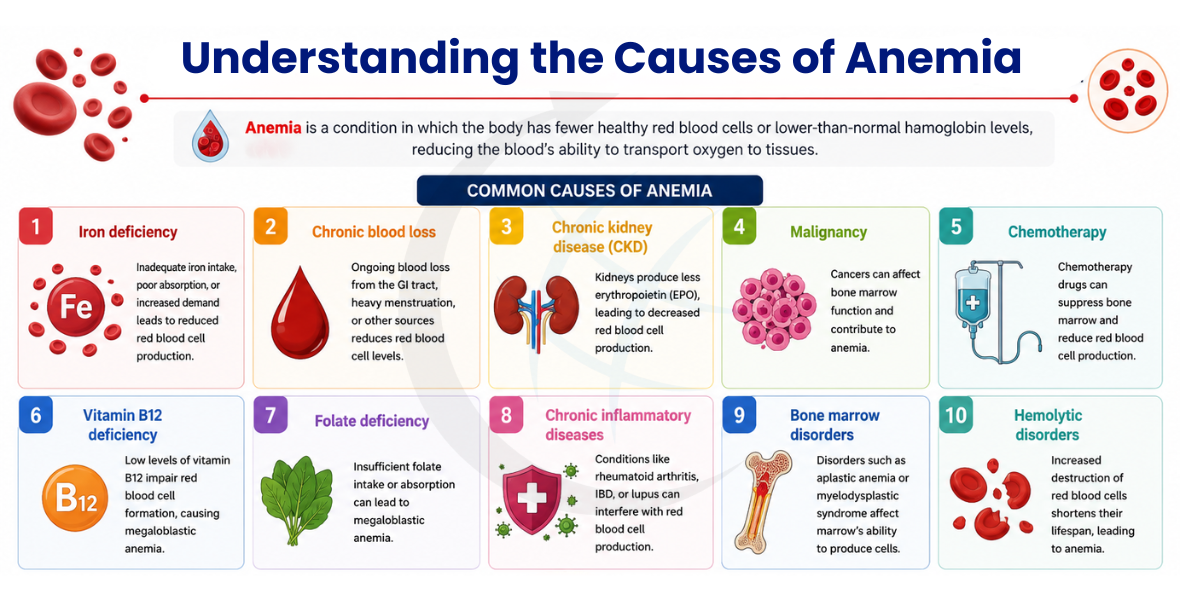
Anemia is a condition in which the body has fewer healthy red blood cells or lower-than-normal haemoglobin levels, reducing the blood's ability to transport oxygen to tissues.
Although anemia is a common diagnosis, it is rarely the primary disease. In most cases, it develops because of another medical condition or nutritional deficiency.
Common causes include:
Iron deficiency
Chronic blood loss
Chronic kidney disease (CKD)
Malignancy
Chemotherapy
Vitamin B12 deficiency
Folate deficiency
Chronic inflammatory diseases
Bone marrow disorders
Hemolytic disorders
Patients with anemia may present with symptoms such as fatigue, weakness, dizziness, shortness of breath, palpitations, and pale skin. However, these symptoms alone do not determine the ICD-10-CM diagnosis code.
Medical coders should always assign the diagnosis based on the provider's documented assessment rather than laboratory findings or clinical symptoms alone.
ICD-10-CM Classification of Anemia
ICD-10-CM classifies anemia under Chapter 3: Diseases of the Blood and Blood-forming Organs and Certain Disorders Involving the Immune Mechanism.
Instead of grouping every type of anemia under a single diagnosis code, ICD-10-CM categorises anemia according to its underlying cause.
Understanding these categories helps coders quickly identify the correct diagnosis code while improving coding specificity.
Nutritional Anemia Codes (D50–D53)
This category includes anemia caused by nutritional deficiencies.
Common diagnoses include:
Iron deficiency anemia
Vitamin B12 deficiency anemia
Folate deficiency anemia
Other nutritional anemias
These diagnosis codes are commonly reported across primary care, gastroenterology, obstetrics, and internal medicine practices.
Hemolytic Anemia Codes (D55–D59)
These codes are used when red blood cells are destroyed faster than they can be replaced.
Examples include:
Hereditary hemolytic anemia
Acquired hemolytic anemia
Drug-induced hemolytic anemia
Correct code selection depends on identifying the specific type of hemolytic disorder documented by the provider.
Aplastic and Other Anemia Codes (D60–D64)
This section contains many of the diagnosis codes used most frequently by medical coders.
These include:
Aplastic anemia
Acute posthemorrhagic anemia
Anemia in chronic diseases
Anemia associated with chronic kidney disease
Anemia in neoplastic disease
Chemotherapy-induced anemia
Other specified anemias
Unspecified anemia
Since providers often document only "anemia" during the initial evaluation, coders frequently review this category to determine whether additional documentation supports a more specific diagnosis.
Common Anemia ICD-10 Codes and Their Uses
The following table lists some of the most commonly assigned ICD-10-CM diagnosis codes for anemia.
| Condition | ICD-10-CM Code | When to Use |
|---|---|---|
| Anemia, unspecified | D64.9 | Type or cause not documented |
| Iron deficiency anemia, unspecified | D50.9 | Iron deficiency documented without further detail |
| Iron deficiency anemia due to chronic blood loss | D50.0 | Chronic blood loss identified as the cause |
| Acute posthemorrhagic anemia | D62 | Acute blood loss documented |
| Pernicious anemia | D51.0 | Vitamin B12 deficiency caused by intrinsic factor deficiency |
| Vitamin B12 deficiency anemia | D51.9 | B12 deficiency anemia without additional specificity |
| Folate deficiency anemia | D52.9 | Folate deficiency documented |
| Nutritional anemia, unspecified | D53.9 | Nutritional anemia without further specificity |
| Anemia in neoplastic disease | D63.0 | Anemia caused by malignancy |
| Anemia in chronic kidney disease | D63.1 | Anemia documented as due to CKD |
| Anemia in other chronic diseases | D63.8 | Anemia associated with another chronic condition |
| Anemia due to antineoplastic chemotherapy | D64.81 | Chemotherapy-induced anemia |
| Other specified anemias | D64.89 | Specific anemia not classified elsewhere |
While this table serves as a quick reference, coders should always verify that the provider's documentation supports the selected diagnosis code.
When to Use ICD-10 Code D64.9 (Anemia, Unspecified)
D64.9 is one of the most commonly reported anemia diagnosis codes. Although it is a valid billable ICD-10-CM code, it should only be used when the provider documents anemia without identifying its specific type or underlying cause.
In many cases, D64.9 is appropriate during the initial evaluation while additional diagnostic testing is underway. However, once the provider identifies the cause of the anemia, a more specific diagnosis code should generally be assigned.
Coding Unspecified Anemia
Assign D64.9 when the provider documents:
Anemia
Unspecified anemia
Anemia NOS
without documenting an underlying condition or specific anemia type.
When no additional clinical information is available, D64.9 accurately reflects the provider's diagnosis.
Coding Anemia During Diagnostic Evaluation
Some patients are still undergoing diagnostic workups when anemia is first documented.
Examples include:
Iron studies pending
Bone marrow biopsy pending
Hematology consultation pending
Additional laboratory investigations pending
Until the provider determines the underlying cause, D64.9 may be the most appropriate diagnosis code.
Normocytic and Normochromic Anemia Documentation
Terms such as normocytic anemia and normochromic anemia describe the size and appearance of red blood cells rather than the reason the patient developed anemia.
Unless the provider links these findings to a specific condition—such as CKD, chronic disease, or blood loss—D64.9 may still be appropriate.
Can You Code Anemia Based on Laboratory Results?
No.
Laboratory values alone should never determine ICD-10-CM code assignment.
Low hemoglobin, low hematocrit, or abnormal complete blood count (CBC) results may indicate anemia, but coders cannot assign an anemia diagnosis unless the provider documents it in the medical record.
Likewise, laboratory findings cannot determine the specific type of anemia. The provider's documented diagnosis always takes precedence over test results. For the official ICD-10-CM code definition & coding details for D64.9, refer to the ICD10Data page for D64.9 (Anemia, unspecified).
When Not to Assign ICD-10 Code D64.9
Although D64.9 is a valid diagnosis code, it should never become the default whenever anemia appears in the chart.
Before assigning D64.9, review the documentation carefully to determine whether a more specific ICD-10-CM code is supported.
Iron Deficiency Anemia
If the provider documents iron deficiency anemia, report the appropriate diagnosis from the D50 category instead of D64.9.
Chronic Blood Loss Anemia
Patients with chronic gastrointestinal bleeding, heavy menstrual bleeding, or other chronic blood loss conditions often qualify for D50.0, provided the provider documents the relationship.
Anemia in Chronic Kidney Disease (CKD)
When the provider documents that anemia is caused by chronic kidney disease, assign D63.1 along with the appropriate CKD stage code.
The causal relationship between CKD and anemia should be clearly documented before assigning this diagnosis.
Cancer-Related and Chemotherapy-Induced Anemia
Patients receiving treatment for cancer may develop anemia because of the malignancy itself or as an adverse effect of chemotherapy.
These situations have dedicated ICD-10-CM diagnosis codes and follow specific sequencing guidelines, making D64.9 inappropriate when the cause is documented.
Vitamin B12 and Folate Deficiency Anemia
When the provider identifies nutritional deficiencies such as:
Iron deficiency
Vitamin B12 deficiency
Folate deficiency
coders should assign the corresponding diagnosis from the D50–D53 categories rather than using an unspecified anemia code.
Documentation Requirements for Accurate Anemia Coding
Accurate ICD-10-CM coding begins with complete provider documentation. Even when laboratory findings strongly suggest a particular diagnosis, coders cannot infer or assume the underlying cause without provider documentation.
To support accurate code assignment, documentation should clearly identify:
The specific type of anemia
The underlying cause or etiology
Whether the anemia is acute or chronic
Any associated conditions, such as CKD or malignancy
Whether chemotherapy, immunotherapy, or radiation therapy contributed to the condition
Any documented nutritional deficiencies, including iron, vitamin B12, or folate deficiency
Complete documentation enables coders to assign the highest level of specificity, improves coding accuracy, reduces payer queries, and helps prevent avoidable claim denials. If you're interested in learning more about medical coding, take a look at this blog on the benefits of outsourcing medical coding services.
Coding Common Types of Anemia
Once the underlying cause of anemia is documented, coders should assign the most specific ICD-10-CM code supported by the medical record. Selecting a cause-specific diagnosis instead of D64.9 improves coding accuracy, supports medical necessity, and helps reduce payer scrutiny.
Below are some of the most commonly encountered anemia scenarios in medical coding.
Iron Deficiency Anemia ICD-10 Codes
Iron deficiency anemia (IDA) is the most common type of anemia worldwide and is frequently reported in primary care, gastroenterology, obstetrics and gynecology, and internal medicine practices.
The ICD-10-CM code depends on the documented cause rather than simply confirming that the patient is iron deficient.
| Condition | ICD-10-CM Code |
|---|---|
| Iron deficiency anemia, unspecified | D50.9 |
| Iron deficiency anemia secondary to chronic blood loss | D50.0 |
| Other iron deficiency anemias | D50.8 |
| Sideropenic dysphagia (Plummer-Vinson syndrome) | D50.1 |
For example, if a provider documents iron deficiency anemia caused by chronic gastrointestinal bleeding, assigning D50.0 is more appropriate than using D50.9 or D64.9.
Medical coders should avoid selecting a diagnosis based solely on low ferritin or serum iron levels. The provider must clearly document iron deficiency anemia before assigning a diagnosis code.
Acute Blood Loss Anemia
Acute blood loss anemia occurs after sudden blood loss caused by surgery, trauma, gastrointestinal bleeding, or obstetric complications.
Assign:
D62 – Acute Posthemorrhagic Anemia
This diagnosis should not be confused with chronic blood loss anemia.
For example:
Postoperative hemorrhage
Traumatic injuries
Acute gastrointestinal bleeding
may support D62, provided the provider documents acute blood loss anemia.
Chronic Blood Loss Anemia
Unlike acute blood loss, chronic blood loss develops gradually over time.
Common causes include:
Chronic gastrointestinal bleeding
Peptic ulcers
Colon cancer
Heavy menstrual bleeding
Long-term anticoagulant therapy
When chronic blood loss results in iron deficiency anemia, the correct diagnosis is typically:
D50.0 – Iron Deficiency Anemia Secondary to Chronic Blood Loss
Provider documentation should clearly identify the relationship between the chronic bleeding and iron deficiency.
Anemia in Chronic Kidney Disease (CKD)
Patients with chronic kidney disease frequently develop anemia because damaged kidneys produce less erythropoietin, a hormone responsible for stimulating red blood cell production.
When the provider documents that anemia is due to CKD, assign:
D63.1 – Anemia in Chronic Kidney Disease
An additional code from the N18 category should also be reported to identify the stage of CKD.
Examples include:
| CKD Stage | ICD-10-CM Code |
|---|---|
| CKD Stage 1 | N18.1 |
| CKD Stage 2 | N18.2 |
| CKD Stage 3 | N18.30–N18.32 |
| CKD Stage 4 | N18.4 |
| CKD Stage 5 | N18.5 |
| End-stage renal disease | N18.6 |
The provider must clearly link the anemia to CKD. Simply documenting both conditions separately does not automatically support assigning D63.1.
Anemia in Neoplastic Disease
Cancer itself can reduce red blood cell production or increase red blood cell destruction, leading to anemia.
When the provider documents that the anemia is caused by the malignancy, assign:
D63.0 – Anemia in Neoplastic Disease
This diagnosis is commonly reported in patients with:
Leukemia
Lymphoma
Multiple myeloma
Metastatic cancers
Solid organ malignancies
Unlike unspecified anemia, D63.0 identifies the underlying malignancy as the cause of the condition.
Chemotherapy-Induced Anemia
Many patients receiving antineoplastic chemotherapy develop anemia as a treatment-related adverse effect.
When the provider documents chemotherapy-induced anemia, assign:
D64.81 – Anemia Due to Antineoplastic Chemotherapy
This diagnosis should only be used when the provider specifically attributes the anemia to chemotherapy.
Coders should avoid confusing chemotherapy-induced anemia with anemia caused by the cancer itself, as both conditions have different diagnosis codes and sequencing requirements.
Vitamin B12 Deficiency Anemia
Vitamin B12 deficiency affects red blood cell production and may result from poor dietary intake, malabsorption disorders, or intrinsic factor deficiency.
Common ICD-10-CM codes include:
| Condition | ICD-10-CM Code |
|---|---|
| Pernicious anemia | D51.0 |
| Vitamin B12 deficiency anemia, unspecified | D51.9 |
Documentation should identify the specific type of B12 deficiency whenever possible.
Folate Deficiency Anemia
Folate deficiency is another nutritional anemia commonly encountered in clinical practice.
Assign:
D52.9 – Folate Deficiency Anemia, Unspecified
Additional specificity may be available depending on the documented cause of folate deficiency.
Nutritional Anemia
Some patients develop anemia because of nutritional deficiencies that do not fall into the common iron, vitamin B12, or folate categories.
When documented, assign:
D53.9 – Nutritional Anemia, Unspecified
Coders should always review provider documentation to determine whether a more specific nutritional anemia diagnosis is supported.
ICD-10-CM Sequencing Guidelines for Anemia
Selecting the correct diagnosis code is only part of accurate coding. The order in which diagnosis codes are reported can also affect claim processing and reimbursement.
Below are some of the most common sequencing scenarios.
Anemia Associated With Chronic Kidney Disease
When anemia is documented as a complication of CKD:
Sequence:
CKD Stage (N18.-)
D63.1
Anemia in Neoplastic Disease
When anemia is caused by the malignancy:
Sequence:
Malignancy
D63.0
The underlying cancer should generally be reported before the anemia diagnosis.
Chemotherapy-Induced Anemia
When the encounter is primarily for managing anemia caused by chemotherapy:
Sequence:
D64.81
Malignancy
Appropriate adverse effect code for the antineoplastic drug
Accurate sequencing helps ensure claims reflect the patient's clinical condition and comply with ICD-10-CM coding guidelines.
Common Coding Mistakes to Avoid
Many anemia-related claim denials stem from documentation gaps and incorrect code selection rather than complex coding rules.
Some of the most common mistakes include:
Assigning D64.9 Too Frequently
Whenever documentation identifies the cause of anemia, a more specific ICD-10-CM diagnosis should generally be assigned.
Coding From Laboratory Results
Low hemoglobin or hematocrit values alone do not justify assigning an anemia diagnosis.
Only the provider's documented diagnosis supports code assignment.
Missing the Link Between CKD and Anemia
If the provider documents CKD and anemia separately without stating that the CKD caused the anemia, coders should not automatically assign D63.1.
A compliant provider query may be necessary.
Incorrect Sequencing
Even when the correct diagnosis codes are selected, placing them in the wrong order may lead to claim edits or reimbursement delays.
Always follow ICD-10-CM sequencing guidance for CKD-related anemia, malignancy-associated anemia, and chemotherapy-induced anemia.
Overlooking Documentation Opportunities
When the documentation suggests a possible cause but does not clearly establish the relationship, querying the provider may help capture a more accurate diagnosis while reducing the use of unspecified codes.
Proper documentation supports better coding, cleaner claims, and fewer payer requests for additional information.
Best Practices for Provider Documentation
Accurate anemia coding begins with complete and specific clinical documentation. Even if laboratory findings strongly suggest a particular type of anemia, medical coders cannot assign a diagnosis that the provider has not documented.
To support accurate ICD-10-CM code assignment, providers should clearly document:
The specific type of anemia
The underlying cause or etiology
Whether the anemia is acute or chronic
Any associated conditions, such as CKD or malignancy
Whether chemotherapy, immunotherapy, or radiation therapy contributed to the condition
Nutritional deficiencies, including iron, vitamin B12, or folate deficiency
The relationship between the anemia and the underlying disease
For example, documenting "Anemia due to Stage 4 CKD" provides coders with enough information to assign the appropriate diagnosis codes. In contrast, documenting only "Anemia" often results in the use of an unspecified diagnosis code or the need for a provider query.
Clear documentation not only improves coding accuracy but also helps reduce payer requests for additional information and supports faster claim processing.
Best Practices for Medical Coders
Coding anemia accurately requires more than selecting a diagnosis from the ICD-10-CM codebook. Coders should carefully review the entire medical record to identify documentation that supports a more specific diagnosis.
Consider the following best practices:
Review the assessment and plan before assigning a diagnosis code.
Code only documented diagnoses, not laboratory findings or clinical assumptions.
Verify whether anemia is linked to an underlying condition such as CKD or malignancy.
Follow ICD-10-CM sequencing guidelines for chronic disease-related and therapy-related anemia.
Query the provider when documentation is incomplete or unclear.
Choose the highest level of specificity supported by the documentation.
These practices help improve coding quality while ensuring compliance with ICD-10-CM Official Guidelines. Want to learn more about medical coding? Explore this blog on the Best Outsourced Medical Coding Solutions
How Accurate Anemia Coding Supports Revenue Cycle Performance
Accurate diagnosis coding plays an important role throughout the revenue cycle. Specific ICD-10-CM codes help payers better understand the patient's condition, reducing unnecessary claim edits and documentation requests.
Benefits of accurate anemia coding include:
Higher first-pass claim acceptance
Fewer coding-related denials
Reduced use of unspecified diagnosis codes
Improved reimbursement accuracy
Better clinical documentation quality
Stronger compliance with payer requirements
More accurate quality reporting and risk adjustment
For healthcare organizations managing a high volume of claims, improving coding specificity can significantly reduce administrative rework and accelerate reimbursement.
How MBW RCM Helps Improve Medical Coding Accuracy
Accurate diagnosis coding requires a combination of clinical knowledge, coding expertise, and continuous quality monitoring. At MBW RCM, our certified medical coders work closely with healthcare providers to improve coding accuracy while ensuring compliance with the latest ICD-10-CM guidelines.
Our Medical Coding Services help healthcare organizations:
Assign accurate ICD-10-CM, CPT®, and HCPCS codes
Improve documentation specificity through coding reviews
Reduce coding-related denials and payer edits
Support Clinical Documentation Improvement (CDI) initiatives
Conduct coding quality audits and compliance reviews
Stay current with annual coding guideline updates
Improve reimbursement while maintaining regulatory compliance
Whether you operate a physician practice, specialty clinic, or multi-location healthcare organization, our experienced coding team helps strengthen documentation quality and optimize coding performance across the revenue cycle.
FAQs: Anemia ICD-10 Codes
Improve Coding Accuracy With MBW RCM
Accurate anemia coding requires more than selecting an ICD-10-CM code—it requires thorough documentation review, correct code assignment, and compliance with the latest coding guidelines. Even small coding errors can lead to claim denials, delayed reimbursements, and increased administrative workload.
At MBW RCM, our certified medical coding specialists help healthcare organizations improve coding accuracy, reduce documentation gaps, strengthen compliance, and support cleaner claims across every specialty.
Schedule a complimentary consultation to learn how MBW RCM's Medical Coding Services can help your practice improve coding quality, reduce denials, and maximize reimbursement.