

Family Practice Medical Billing and Coding converts primary care services into insurance claims using CPT, ICD-10, and E/M codes. Family practice includes preventive care, chronic management, and routine visits, all requiring proper coding for reimbursement. In 2026, updated guidelines and automated billing systems help improve claim processing and reduce denials.

Understanding billing workflows, coding systems, and documentation requirements supports faster reimbursement, typically within 7 to 21 days for electronic claims. This guide explains the key processes, coding systems, and updates in family practice billing services.
Importance of Billing and Coding in Family Practice
Family Practice Medical Billing and Coding converts medical documentation into CPT and ICD-10 codes for insurance claim processing. Family practice services account for over 60% of outpatient primary care visits, and CMS requires claims to be submitted within 365 days from the date of service.
Billing efficiency also supports Family Practice Billing for Faster Payment, with reimbursement typically within 14 days for electronic claims and 30 days for paper claims.
Key Features of Family Practice Medical Billing
The family practice medical billing process includes several structured components that ensure claims are processed correctly. These features support efficient claim submission and reimbursement tracking.
Key features include:
Patient insurance verification before appointments
CPT and ICD-10 coding based on physician documentation
Electronic claim submission through clearinghouses
Payment posting and denial tracking within billing software
Integration with family practice billing solutions for workflow automation
Family practice clinics using automated systems report 15% faster claim turnaround times, which improves operational efficiency.
Step-by-Step Medical Billing Process in Family Practice
The family practice medical billing process follows a structured workflow for preventive care, chronic management, immunizations, and office visits. Each step supports proper coding and reimbursement, and most electronic claims are processed within 14 to 21 days.
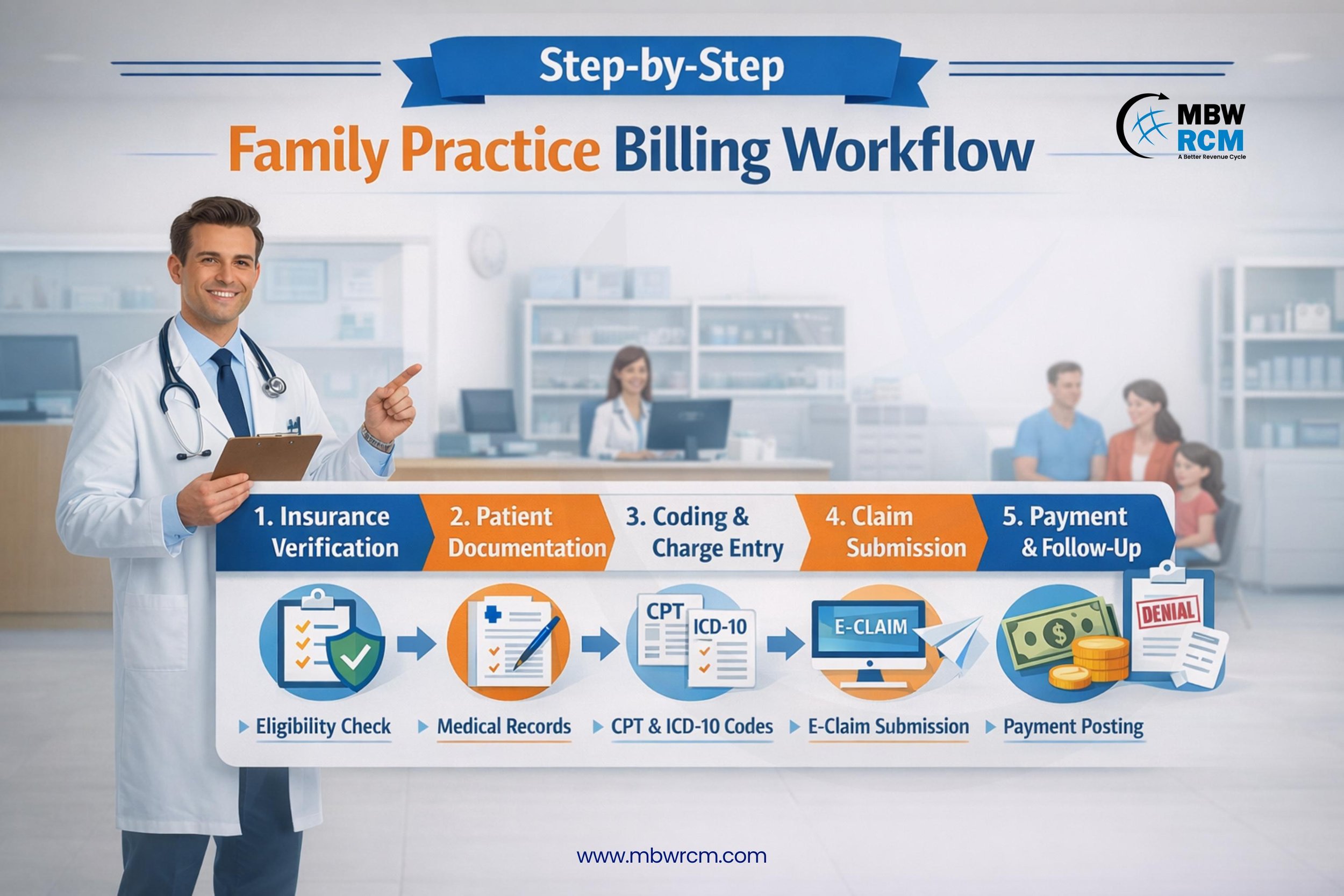
Step 1: Patient Scheduling and Insurance Eligibility Verification
Appointments are scheduled, and insurance eligibility, copay, and coverage are verified using payer portals within 24 hours before the visit to prevent claim rejection.
Step 2: Patient Encounter and Medical Documentation
Providers document diagnoses, procedures, and treatment plans in the EHR. Complete documentation supports correct coding and claim approval.
Step 3: Medical Coding Using CPT, ICD-10, and E/M Codes
Coders assign CPT codes for family practice visits, ICD-10 codes, and E/M codes based on documentation. Primary care medical coding services help ensure correct code selection.
Step 4: Charge Entry and Claim Creation
Codes and provider details are entered into billing software. This converts services into claims within 24 to 48 hours.
Step 5: Claim Submission to Insurance Payers
Claims are submitted electronically through clearinghouses, which check for errors before sending them to insurance payers. Electronic claims have acceptance rates above 95%.
Step 6: Claim Processing and Payment Posting
Insurance providers review claims and issue payments within 7 to 21 days, and payments are recorded in billing systems.
Step 7: Denial Management and Claim Follow-Up
Denied claims are reviewed, corrected, and resubmitted within 7 to 15 days to support reimbursement and reduce delays.
Step 8: Patient Billing and Account Reconciliation
Remaining balances such as copays or deductibles are billed, and reconciliation is completed within 30 days.
Practices using family practice billing services USA improve claim acceptance rates and reduce administrative delays.
Types of Patient Visits in Family Practice Billing
Family practice clinics manage various patient visit types, and each visit requires specific billing codes.
Common visit types include:
New patient visits billed using CPT codes 99202–99205
Established patient visits billed using CPT codes 99211–99215
Preventive care visits billed using CPT codes 99381–99397
Chronic care management billed using CPT code 99490
Accurate CPT codes for family practice visits ensure insurance providers process claims correctly and reduce rejection risks.
Common Coding Systems Used in Family Practice Services
Medical coding systems standardize healthcare services and diagnoses for billing purposes. These coding systems help insurance providers evaluate claims and determine reimbursement.
CPT Coding in Family Practice
CPT (Current Procedural Terminology) codes are used to report medical services provided during patient visits. These codes are standardized by the American Medical Association (AMA) and are required for claim submission and reimbursement.
CPT coding in family practice includes office visits, preventive exams, chronic care management, and immunizations. Proper CPT coding supports correct claim processing and helps reduce rejection rates.
Below are commonly used CPT codes for family practice visits:
For example, CPT code 99213 is used for established patient visits, while CPT code 99396 is used for preventive visits for adults aged 40–64 years.
ICD-10 Diagnosis Coding in Family Medicine
ICD-10 codes describe patient diagnoses and medical conditions. For example:
I10 – Essential hypertension
E11.9 – Type 2 diabetes mellitus
J06.9 – Upper respiratory infection
Correct ICD-10 coding improves claim approval rates and supports medical necessity documentation. Want to know the ICD-10 Clinical Concepts for Family Practice? Download the PDF for more details.
Evaluation and Management (E/M) Coding for Patient Visits
Evaluation and Management codes represent patient visit complexity and physician time. Over 80% of family medicine claims involve E/M codes, making them critical for billing accuracy.
Service-Based Billing in Family Medicine Practices
Family practice billing includes multiple service categories, and each requires proper CPT and ICD-10 code classification for claim submission. Service-based billing helps ensure correct reimbursement based on the type, complexity, and duration of care provided.
Common services include:
Preventive screenings and annual wellness visits
Immunizations and vaccinations
Chronic disease management
Acute illness treatment
Structured billing workflows help improve claim processing efficiency and support family practice billing for growing clinics handling increasing patient volumes.
Documentation Requirements for Family Practice Billing and Coding
Family Practice Medical Billing and Coding requires complete medical documentation to support CPT and ICD-10 coding and insurance claim approval. In 2026, documentation must follow CMS and payer guidelines, and records must be maintained for 7 to 10 years.
Providers must include:
• Patient history, examination findings, and chief complaint
• Diagnosis codes with treatment plans
• Physician notes and follow-up instructions
• Date of service and provider signature
Incomplete documentation contributes to over 20% of claim denials, making proper documentation critical. Using family practice RCM services helps maintain documentation compliance and reduce claim errors.
Common Billing Challenges in Family Practice Billing
Family practice clinics face several billing challenges that affect reimbursement timelines. Around 5% to 10% of primary care claims are denied on first submission, often due to coding or eligibility issues. These delays can extend payment timelines from 14 to 45 days.
Incorrect Evaluation and Management (E/M) Level Selection
Family practice visits commonly use E/M codes like 99213 and 99214. Incorrect level selection based on documentation can result in claim denial or underpayment and delay reimbursement by 15 to 30 days.
Billing Preventive and Problem-Based Visits Together
Preventive and problem-based visits billed on the same day require modifier –25 with CPT codes such as 99396 and 99213. Missing this modifier can cause claim rejection or reduced payment.
Chronic Care Management Billing Errors
Chronic care management using CPT code 99490 requires at least 20 minutes of documented care per month. Missing documentation or eligibility errors can result in claim denial and payment delays.
Many practice outsource family practice billing to reduce these challenges and improve operational efficiency.
HIPAA Compliance & Regulatory Requirements in Family Medicine Billing
Family Practice Medical Billing and Coding must comply with updated HIPAA regulations in 2026, which protect patient health information and electronic billing records. Billing operations must implement:
• Secure billing software systems with multi-factor authentication
• Encrypted patient data storage using AES-256 encryption
• Controlled access to medical records with role-based permissions
HIPAA violations can result in penalties ranging from $137 to $68,928 per violation in 2026, making compliance critical for billing operations.
Trends in Family Practice Billing Services
Family practice billing and coding services continue to evolve in 2026 with updated CPT guidelines and automation tools. Modern billing systems focus on faster claim submission, reduced denial rates, and improved coding compliance for preventive and routine care services.
Key Trends Include:
AI-assisted CPT and E/M coding tools in 2026
Real-time insurance eligibility verification
Automated claim validation using 2026 CPT and ICD-10 updates
Cloud-based billing platforms with secure access
EHR and billing system integration
Increased demand to outsource family practice billing
Conclusion
Family practice medical billing services help ensure proper coding, correct claim submission, and timely reimbursement for primary care services. Using structured billing workflows and updated coding guidelines helps reduce claim denials and improve payment timelines.
Partnering with reliable family practice medical billing services can improve billing efficiency and reduce administrative workload. Contact MBW RCM today to learn how our services can support your billing and coding needs.
Request for Information
Facing family practice billing and coding errors or claim denials? Expert billing services help improve accuracy and increase reimbursements.
Fill out the form below to connect with a specialist and optimize your family practice billing and coding process.