
Case Study: Increasing Charge Capture by 29% for a Freestanding Radiation Oncology Center
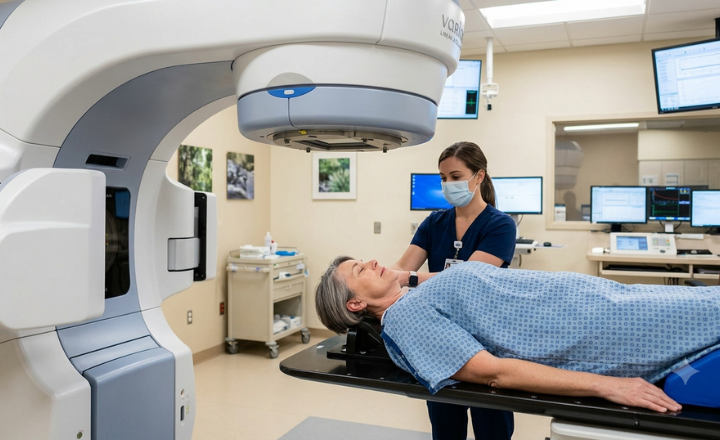
A freestanding radiation oncology center in Maryland was experiencing slower revenue growth despite maintaining consistent patient volumes and timely claim submission. While denial rates remained relatively low, reimbursement growth failed to reflect the volume of high-value technical services delivered throughout the treatment course.
Our Revenue Integrity assessment uncovered significant charge capture gaps across technical component services, including CT simulation, IMRT planning, medical physics, IGRT, treatment delivery, and weekly treatment management. Manual reconciliation between the oncology information system and billing platform resulted in completed services not consistently generating billable charges.
After implementing our Radiation Oncology Charge Capture & Revenue Integrity Services, the center increased charge capture by 29% within 120 days, improved billing accuracy, and protected approximately $418,000 in reimbursement opportunities.
Practice Overview
Location: Maryland, USA
Practice Type: Freestanding Radiation Oncology Center
Providers: 6 Radiation Oncologists
Monthly Claims Volume: ~2,350
Treatment Courses Reviewed: 3,040 (120-Day Assessment)
Revenue Opportunity Identified: $418,000
Key Services Reviewed
77280–77295 – Radiation Treatment Simulation
77301 – IMRT Treatment Planning
77336 – Continuing Medical Physics Consultation
77387 – Image-Guided Radiation Therapy (IGRT)
77412 / 77413 – External Beam Radiation Treatment Delivery
77427 – Weekly Treatment Management
Customer Situation
Practice leadership believed slower reimbursement growth was primarily driven by payer reimbursement changes. Although claims were submitted on time and denial volumes remained manageable, monthly collections continued to fluctuate.
Rather than focusing solely on denied claims, we evaluated the complete technical component billing workflow—from CT simulation through weekly treatment management—to determine whether every completed service generated a corresponding billable charge.
Our assessment found:
Manual reconciliation between ARIA/MOSAIQ and the billing system.
Technical component services were occasionally missed during charge entry.
Treatment delivery charges were not consistently reconciled with completed fractions.
Planning and medical physics services were not always linked to active treatment courses.
Revenue integrity reviews focused on denials rather than identifying unbilled services.
Although claims were submitted promptly, not every completed clinical service was converted into a billable charge.
What Our Charge Capture Review Revealed
Our review of treatment records, physician documentation, ARIA/MOSAIQ data, and billing transactions identified several recurring charge capture issues.
The assessment revealed:
Missing CT simulation charges after completed simulation appointments.
IMRT planning (77301) not consistently billed following physician approval.
Continuing medical physics (77336) omitted during extended treatment courses.
IGRT (77387) not captured for every documented treatment fraction.
Delayed treatment delivery charges (77412/77413) due to incomplete daily reconciliation.
Weekly treatment management (77427) occasionally missed because treatment fractions were not accurately tracked.
Charge exceptions between ARIA/MOSAIQ and the billing system remained unresolved.
Manual charge entry increased the risk of missed technical component billing.
These issues affected both Medicare and commercial payer claims, resulting in preventable reimbursement leakage.
Key Revenue Integrity Challenges
Our assessment identified several workflow gaps affecting charge capture.
▸ Technical component charges relied heavily on manual reconciliation rather than standardized validation.
▸ Simulation, treatment planning, medical physics, treatment delivery, and weekly management services were not consistently reconciled as part of the complete course of treatment.
▸ Limited charge exception reporting made it difficult to identify services documented within ARIA/MOSAIQ that had not generated corresponding charges.
▸ Existing revenue integrity efforts focused on post-submission denial management rather than validating charge completeness before claims were generated.
As a result:
Completed radiation therapy services were omitted from some claims.
Technical component reimbursement was reduced across high-value treatment courses.
Revenue leakage accumulated throughout active treatment episodes.
During our 120-day assessment:
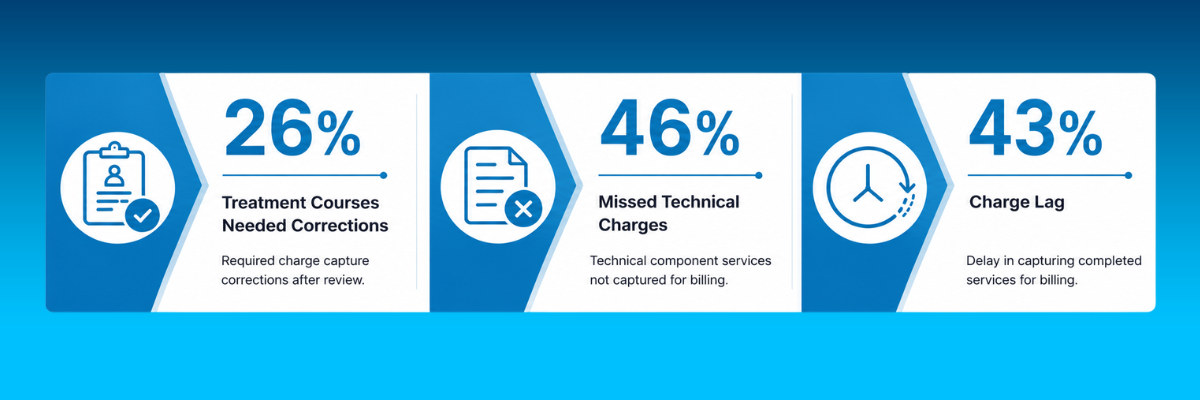
26% of treatment courses required charge capture correction.
Approximately $418,000 in reimbursement opportunities were identified.
Our Solution
We implemented a specialty-focused Charge Capture & Revenue Integrity program to ensure every billable technical service performed during a patient's treatment course was accurately captured and billed.
Course-of-Treatment Charge Reconciliation
We reconciled physician documentation, ARIA/MOSAIQ treatment records, and billing transactions to ensure every completed technical component service generated the appropriate billable charge. Particular attention was given to CT simulation, IMRT planning, medical physics, IGRT, treatment delivery, and weekly management services performed throughout each patient's course of treatment.
Technical Component Charge Validation
Standardized validation checkpoints ensured simulation, planning, physics, image guidance, and treatment delivery services were accurately linked to each treatment course before billing.
Physics, IGRT, and Fraction-Level Verification
Daily reconciliation confirmed completed treatment fractions matched billed treatment delivery, IGRT, and continuing medical physics services, reducing missed fraction-based charges.
Daily ARIA/MOSAIQ-to-Billing Reconciliation
Revenue integrity specialists reviewed charge exception reports daily to identify completed services that had not generated billing transactions before claims were submitted.
Revenue Integrity Performance Reporting
Monthly dashboards monitored:
Charge capture performance
Missing technical charges
Charge lag
Revenue leakage trends
Treatment course reconciliation accuracy
Results
Following implementation, the center achieved measurable improvements in revenue integrity and reimbursement performance.
Key Outcomes
Following implementation, the center achieved measurable improvements in revenue integrity and reimbursement performance within 120 days.
Increased charge capture by 29% within 120 days
Captured approximately $418,000 in previously missed reimbursement opportunities.
Reduced missed technical component charges by 46%
Improved first-pass claim acceptance from 91% to 98%
Reduced charge lag by 43%
Improved reconciliation accuracy across treatment courses
What the Practice Achieved
| Before MBW RCM | After MBW RCM |
|---|---|
| Duplicate physician and facility claims caused frequent component billing denials. | Standardized professional and technical component billing reduced duplicate claim submissions. |
| Modifier 26 and TC were applied inconsistently. | Accurate modifier validation improved coding accuracy before billing. |
| IMRT, IGRT, and Medical Physics claims generated recurring coding edits. | Pre-bill coding reviews reduced edits and improved first-pass claim acceptance. |
| Medicare and commercial payer coding requirements varied across workflows. | Payer-specific coding standards improved compliance and reimbursement accuracy. |
| Coding issues were identified after payer denials. | Continuous coding audits detected issues before claim submission. |
Charge capture in radiation oncology billing requires accurate reconciliation of simulation, treatment planning, medical physics, image-guided treatment, treatment delivery, and weekly management services. Unlike denied claims, missing technical component charges often go undetected because they never reach the payer for reimbursement.
Our Revenue Integrity assessment identified workflow gaps that traditional denial reporting failed to detect. By implementing specialty-focused charge capture services, including course-of-treatment reconciliation and daily charge validation, the practice increased charge capture by 29% and protected approximately $418,000 in reimbursement opportunities within 120 days.
Identify Hidden Revenue Opportunities
Even practices with low denial rates can lose thousands in reimbursement from missed technical component charges. Our specialists will review your charge capture workflow, identify revenue leakage, and recommend practical improvements to help maximize reimbursement.
Complete the form to request your FREE Revenue Integrity Assessment. There's no obligation—just actionable insights to help strengthen your radiation oncology revenue cycle.
