
Case Study: Resolving $865K in Unapplied and Underposted Payments for an ENT Practice

A multi-location ENT practice in California maintained a strong first-pass claim acceptance rate, yet monthly collections consistently fell short of projected reimbursement. While claim submission metrics remained stable, payer remittances were not translating into accurate account balances. Leadership suspected reimbursement issues, but an operational review revealed that the revenue leakage was occurring during payment posting.
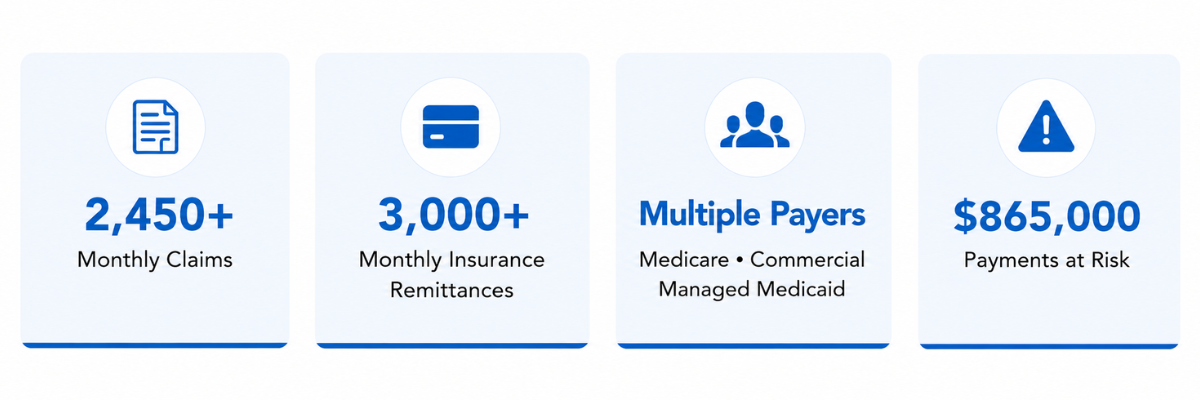
MBW RCM conducted a comprehensive assessment of the practice's payment posting operations to identify reconciliation gaps, posting inaccuracies, and reimbursement variances. Within 150 days, the practice resolved approximately $865,000 in unapplied and underposted insurance payments while significantly improving payment accuracy.
Client Profile
Location: California, USA
Specialty: ENT (Otolaryngology)
Providers: 8 ENT Physicians, 3 Audiologists
Practice Type: Multi-location Physician Group
Monthly Claims: ~2,450
Revenue Opportunity Identified: $865,000
Customer Situation
The practice processed nearly 3,000 insurance remittances every month across Medicare, commercial, and managed Medicaid payers. Although ERA auto-posting was enabled, payment exceptions were routinely bypassed for manual review. Surgical encounters involving septoplasty, sinus surgery, tympanoplasty, and audiology services frequently required multiple payment transactions, making reconciliation increasingly difficult.
Finance teams noticed growing differences between expected payer allowables and posted reimbursement, while billing staff spent several days each month reconciling unapplied cash and unresolved remittance exceptions.
What Our Assessment Revealed
Our payment posting audit included ERA (835) files, EFT deposits, contractual adjustment tables, payment audit trails, and payer reimbursement reports.
The assessment identified the following issues:
2,940 insurance payments remained in unapplied cash because EFT deposits were not matched to corresponding ERA files.
Commercial payer fee schedules for major ENT procedures had not been updated after recent contract revisions.
CARC adjustment codes were incorrectly mapped, resulting in inappropriate contractual write-offs.
Underpayments for CPT 31267, 30520, and 69631 were posted without variance validation.
Medicare crossover claims remained open because secondary remittances were not reconciled.
Payment posting exceptions were reviewed only during month-end close, delaying underpayment recovery.
Critical Payment Posting Issues
Our review identified the following payment posting issues that were affecting reimbursement accuracy and revenue integrity.
➤ Unmatched ERA and EFT Transactions
Electronic funds were received on time, but several remittance files failed automated posting because of payer reference mismatches. These payments accumulated in unapplied cash despite successful reimbursement.
➤ Incorrect Contractual Adjustments
Legacy payer contracts remained active within the billing system after reimbursement updates. As a result, contractual adjustments exceeded negotiated allowable amounts for several commercial ENT claims.
➤ Underpayments Went Undetected
Payment posting focused on recording received payments rather than validating expected reimbursement. Partial payments for high-value sinus and ear surgery claims were accepted without payer variance review.
➤ Surgical Payment Allocation Errors
Multiple CPT procedures billed under the same encounter were not consistently allocated between payer liability, patient responsibility, deductible, and coinsurance, leaving residual balances on completed accounts.
➤ Secondary Insurance Processing Delays
Primary payments were posted promptly, but Medicare crossover activity and secondary payer reimbursements were not reconciled within the same payment cycle, extending account aging.
➤ Limited Exception Monitoring
Posting teams lacked operational dashboards to monitor ERA failures, payment variances, unapplied cash, and unresolved remittance exceptions, causing posting issues to remain undetected until month-end reconciliation.
MBW RCM Solution
Based on the assessment findings, we implemented targeted payment posting improvements to strengthen reconciliation accuracy, payment validation, and overall revenue integrity.
Daily ERA–EFT Reconciliation
A structured reconciliation workflow was implemented to match every EFT deposit against its corresponding 835 remittance before payment posting. Exception queues were reviewed daily, reducing unapplied cash and improving posting turnaround.
Contract Allowable Validation
All commercial payer fee schedules were validated against current reimbursement agreements. Contractual adjustment tables were updated to ensure accurate write-offs for ENT surgical and audiology services.
CPT-Level Payment Verification
Payments for high-value ENT procedures were validated against contracted allowables before final posting. Underpayments were flagged immediately for payer follow-up instead of being posted as complete reimbursement.
Payment Allocation Controls
Posting workflows were redesigned to accurately distribute reimbursement across multiple CPT lines, patient responsibility, deductibles, and coinsurance, eliminating residual account balances after adjudication.
Secondary Payer Reconciliation
Dedicated workflows reconciled Medicare crossover claims with secondary remittance files, ensuring complete reimbursement before encounters were closed.
Payment Posting Quality Dashboard
MBW RCM introduced daily KPI reporting for ERA exceptions, unapplied cash, contractual adjustment accuracy, payment variances, and posting turnaround, enabling supervisors to resolve issues before month-end financial close.
Results Achieved
Within 150 days, the practice established a controlled and accurate payment posting operation that improved reimbursement integrity and reduced manual reconciliation.
Key Outcomes
$865,000 in unapplied and underposted payments identified and resolved.
81% reduction in unapplied cash balances.
Payment posting accuracy improved from 92.1% to 99.4%.
ERA posting exceptions reduced by 74%.
Contractual adjustment accuracy increased to 98.8%.
Manual payment reconciliation time reduced by 58%.
Average payment posting turnaround improved from 4.8 days to less than 24 hours.
Performance at a Glance
| Metric | Before | After |
|---|---|---|
| Payment Posting Accuracy | 92.1% | 99.4% |
| Payment Posting Turnaround | 4.8 Days | <24 Hours |
| ERA Exception Rate | 8.4% | 2.2% |
| Contractual Adjustment Accuracy | 91.5% | 98.8% |
| Unapplied Cash Balance | High | 81% Reduction |
| Revenue Opportunity Recovered | — | $865,000 |
Accurate payment posting is essential for maintaining reimbursement integrity in ENT Billing Services. Unlike denied claims, payment posting discrepancies often go unnoticed because the claim has already been adjudicated.
Our assessment identified workflow gaps that traditional reporting failed to detect. Through structured reconciliation, payment validation, and proactive exception management, our Payment Posting Services helped resolve $865,000 in unapplied and underposted payments within 150 days.
Looking for Reliable ENT Billing Support?
If your ENT practice is experiencing payment posting errors, unapplied cash, or reimbursement discrepancies, we can help you. Complete the form below, and our team will contact you shortly to discuss the right solution for your practice.
