
Case Study: Hidden Coding Risks Found in 13,980 Radiation Oncology Claims

Hidden coding errors in radiation oncology often remain unnoticed until they trigger denied claims, payment delays, or payer audits. Professional and technical component billing, modifier assignment, and payer-specific coding requirements make coding accuracy essential for timely reimbursement.
In this case study, discover how we reviewed 13,980 radiation oncology claims, uncovered coding risks that routine billing reviews had missed, and implemented specialty-focused coding improvements that reduced component-billing denials by 44%, improved first-pass claim acceptance, and protected approximately $465,000 in reimbursement opportunities.
Practice Overview
Location: New York, USA
Specialty: Radiation Oncology
Practice Type: Hospital-Affiliated Physician Group
Providers: 8 Radiation Oncologists
Treatment Centers: 4 Hospital Outpatient Centers
Monthly Claims: ~2,330
Claims Reviewed: 13,980 (6 Months)
Revenue Opportunity Identified:$465,000
Customer Situation
A hospital-affiliated radiation oncology physician group in New York was experiencing increasing coding-related denials despite timely claim submission and stable patient volumes. The practice performed a high volume of IMRT, IGRT, CT simulation, treatment planning, medical physics, and weekly treatment management services.
Although billing operations appeared efficient, recurring payer edits involving professional and technical component billing delayed reimbursement. Duplicate physician and facility claims, inconsistent modifier reporting, and varying payer requirements increased administrative workload while exposing the practice to repayment risk.
To identify the underlying causes, MBW RCM performed a comprehensive Medical Coding & Audit review of 13,980 radiation oncology claims submitted over a six-month period.
Key Findings from Our Coding Audit
Our review of 13,980 radiation oncology claims uncovered several coding risks that routine billing reports had failed to identify.
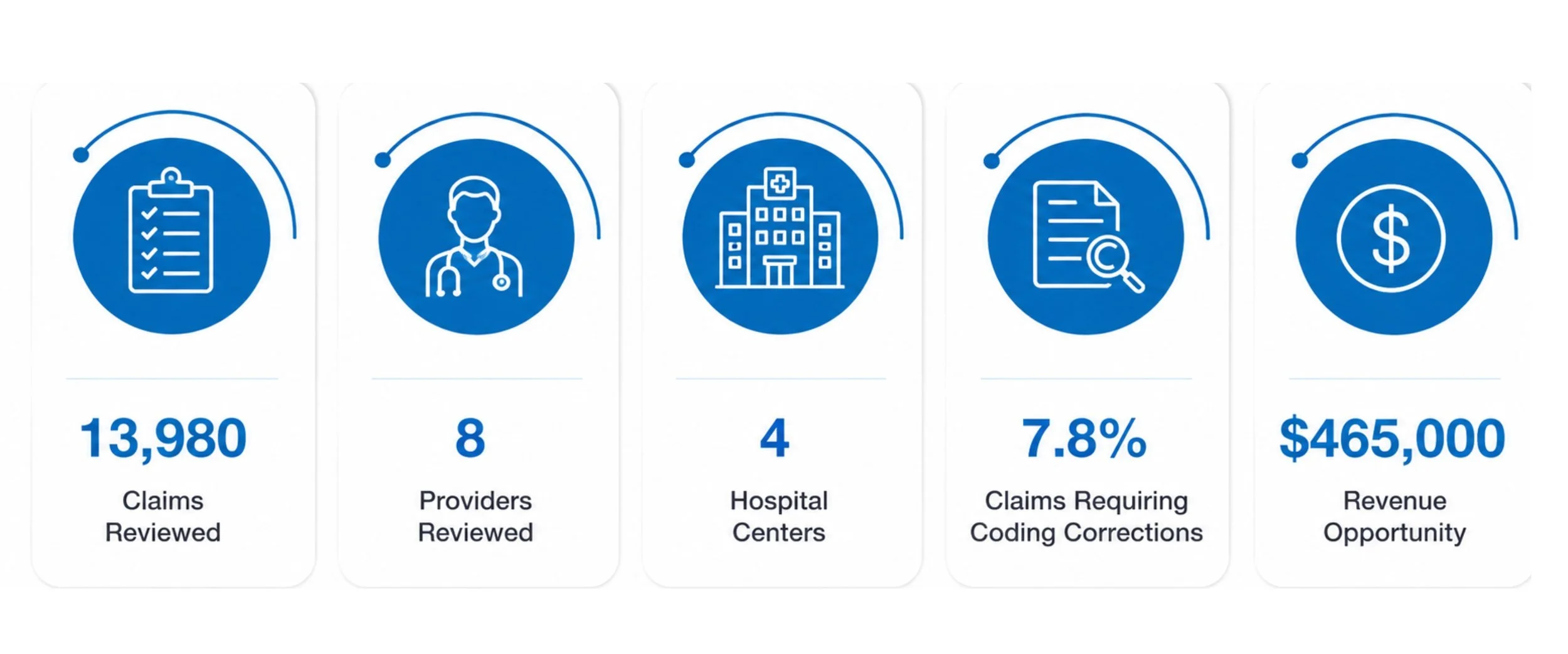
➤ 7.8% of reviewed claims required coding corrections before they met payer billing requirements.
➤ Professional and technical components were inconsistently reported, resulting in duplicate physician and hospital claim submissions for hospital outpatient services.
➤ Modifier 26 and Modifier TC were incorrectly assigned for IMRT Planning (77301), Medical Physics (77336), IGRT (77387), and CT Simulation services, creating duplicate component billing edits.
➤ Physician documentation supporting professional component billing for 77387 and 77427 did not consistently satisfy payer documentation requirements.
➤ Continuing Medical Physics (77336) was occasionally billed by both the physician group and hospital during the same course of treatment, increasing repayment risk.
➤ Medicare and commercial payer policies for hospital outpatient radiation therapy billing were not consistently applied, resulting in avoidable coding edits and reimbursement delays.
Coding Challenges Identified
➤ Duplicate physician and hospital billing for professional and technical component services
➤ Incorrect Modifier 26 and Modifier TC assignment across high-value radiation therapy procedures
➤ Duplicate reporting of 77336 (Continuing Medical Physics) during the same treatment course
➤ Documentation deficiencies supporting physician interpretation for 77387 and 77427
➤ Inconsistent hospital outpatient coding across Medicare and commercial payers
➤ Component billing edits delaying reimbursement and increasing repayment risk
Our Solution
We implemented a comprehensive Medical Coding & Audit strategy tailored to the complex coding requirements of radiation oncology.
Comprehensive Radiation Oncology Coding Audit
Our certified coding specialists reviewed 13,980 radiation oncology claims, validating CPT selection, component billing, modifier usage, physician documentation, and payer-specific billing requirements.
Professional & Technical Component Validation
We standardized professional and technical component billing by validating Modifier 26, Modifier TC, global billing rules, and physician-versus-facility ownership to eliminate duplicate component billing.
Specialty-Focused Coding Review
Pre-bill coding validation was implemented for high-value radiation oncology services, including 77301, 77336, 77387, 77412, and 77427, ensuring coding accuracy before claims were submitted.
Hospital Outpatient Coding Standardization
Coding workflows were aligned with Medicare and commercial payer billing requirements, improving coding consistency across physician and hospital outpatient claims.
Continuous Coding Quality Monitoring
Routine coding audits, payer policy reviews, and coder education helped identify recurring coding trends while strengthening long-term coding compliance.
Results Achieved Within Six Months
Within six months, the practice achieved measurable improvements in coding accuracy, reimbursement performance, and billing compliance, including:
44% reduction in component-billing denials
57% reduction in duplicate component billing errors
41% reduction in Modifier 26 and Modifier TC coding errors
First-pass claim acceptance improved from 89% to 97%
35% reduction in coding-related payment delays
Approximately $465,000 in reimbursement opportunities protected
Performance Transformation: Before vs. After
| Before MBW RCM | After MBW RCM |
|---|---|
| Duplicate physician and facility claims caused frequent component billing denials. | Standardized professional and technical component billing reduced duplicate claim submissions. |
| Modifier 26 and TC were applied inconsistently. | Accurate modifier validation improved coding accuracy before billing. |
| IMRT, IGRT, and Medical Physics claims generated recurring coding edits. | Pre-bill coding reviews reduced edits and improved first-pass claim acceptance. |
| Medicare and commercial payer coding requirements varied across workflows. | Payer-specific coding standards improved compliance and reimbursement accuracy. |
| Coding issues were identified after payer denials. | Continuous coding audits detected issues before claim submission. |
Professional and technical component billing is one of the most complex areas of radiation oncology billing for hospital-affiliated physician groups. Even minor coding inconsistencies involving component billing, modifier assignment, or payer-specific requirements can lead to duplicate claims, delayed reimbursement, and audit risk.
Our Medical Coding & Audit Services review of 13,980 radiation oncology claims identified coding risks across IMRT planning, Medical Physics, IGRT, CT simulation, and weekly treatment management. By strengthening coding validation and component billing workflows, the practice reduced component-billing denials by 44%, improved first-pass claim acceptance, and protected approximately $465,000 in reimbursement opportunities within six months.
Book Your Medical Coding & Audit Review
Hidden coding errors can quietly impact reimbursement and increase audit risk. Fill out the form below, and our team will reach out shortly to discuss your radiation oncology billing process and recommend practical coding improvements for your practice.
