The Real Cost of Poor Orthopedic Revenue Cycle Management

The Real Cost of Poor Orthopedic Revenue Cycle ManagementOrthopedic Revenue Cycle Management directly impacts an orthopedic practice's revenue and profitability. Poor revenue cycle processes can lead to denied claims, delayed reimbursements, missed revenue opportunities, and increased administrative costs.
With complex payer requirements, global surgery rules, modifier-specific billing, and DME reimbursement challenges, even small errors can result in significant financial losses.
This blog explores the real cost of poor Orthopedic Revenue Cycle Management and practical strategies to reduce inefficiencies and improve reimbursement performance.
Table of Contents
1. Lost Revenue from Joint Replacement and Spine Surgery Denials
Joint replacement and spine procedures are among the highest-value services in orthopedics. Procedures such as Total Knee Arthroplasty (CPT 27447), Total Hip Arthroplasty (CPT 27130), and spinal fusions often generate significant reimbursements, making denials particularly costly.
Common denial causes include:
Missing prior authorizations
Insufficient conservative treatment documentation
Medical necessity failures
Diagnosis-to-procedure mismatches
Errors in orthopedic billing and coding
Orthopedic revenue cycle benchmarking studies indicate that 65%–75% of denied claims are recoverable, yet many remain unresolved. Strong Orthopedic Revenue Cycle Management helps reduce denials, accelerate payments, and protect surgical revenue.
2. Failure to Capture Revenue from Global Surgical Packages
Many orthopedic procedures fall under Medicare's 10-day and 90-day global periods. However, practices often fail to identify separately billable services, including unrelated E/M visits, staged procedures, and postoperative complications.
Incorrect use of modifiers 24, 58, 78, and 79 frequently results in missed reimbursement opportunities. Accurate use of orthopedic billing codes and a well-defined Orthopedic Revenue Cycle Management strategy help ensure all eligible services are captured and reimbursed appropriately.
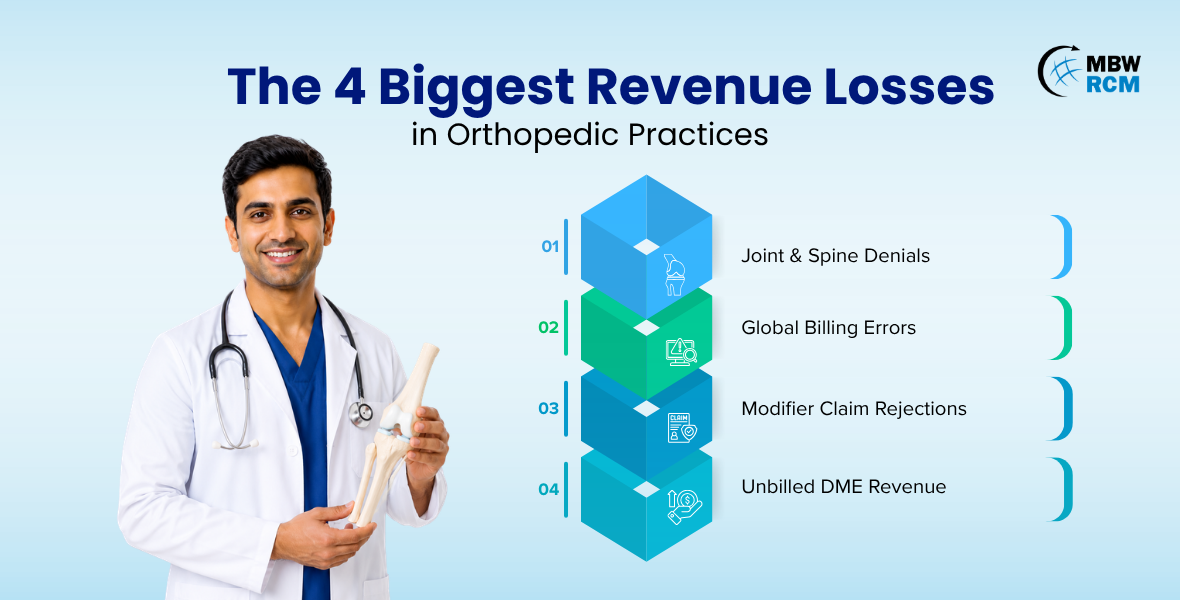
3. Increased Denials for Orthopedic-Specific Modifiers
Modifier-related denials remain a common challenge in orthopedic reimbursement.
Frequent issues involve:
Modifier 25
Modifier 57
Modifier 59
LT and RT modifiers
Modifier 50
Payers increasingly rely on automated claim-editing systems to identify discrepancies involving Orthopedic Coding Modifiers. Since denied claims can cost between $25 and $118 each to rework, accurate orthopedic medical coding is essential for reducing claim rejections and improving reimbursement efficiency.
4. Unbilled Durable Medical Equipment (DME) Revenue
DME services such as knee braces, walking boots, wrist splints, and postoperative immobilizers create valuable revenue opportunities. However, reimbursement is often lost due to missing proof-of-delivery records, incorrect HCPCS coding, inventory tracking issues, or payer-specific filing requirements.
Even minor charge-capture gaps can result in thousands of dollars in annual losses. Effective Orthopedic Revenue Cycle Management helps ensure DME claims are documented, submitted, and reimbursed accurately.
5. Delays in Surgical Scheduling Due to Authorization Failures
Prior authorization requirements continue to increase across commercial and Medicare Advantage plans. Industry surveys indicate that nearly 90% of physician practices experience treatment delays related to authorization processes.
Common consequences include:
Surgery cancellations
Delayed MRI approvals
Rescheduled injections
Reduced operating room utilization
Increased administrative workload
Authorization delays of 7–14 business days can disrupt surgical schedules and postpone revenue collection.
6. Missed Reimbursement for Ancillary Orthopedic Services
Orthopedic practices generate substantial revenue through imaging, ultrasound-guided injections, fracture care supplies, physical therapy, and sports medicine services. However, ancillary services are frequently underbilled due to documentation gaps, delayed charge entry, and inaccurate service mapping.
These issues contribute to Orthopedic Billing Challenges and reduce overall reimbursement despite strong patient volumes. Accurate orthopedic medical billing workflows are essential for maximizing ancillary revenue capture.
7. Higher Risk of Audits for Medical Necessity Documentation
Joint replacements, spinal procedures, and advanced imaging services frequently undergo payer review due to their high reimbursement value. Insufficient documentation of failed conservative treatment, functional limitations, imaging findings, or physician decision-making can trigger audits.
Routine orthopedic coding audits help identify documentation gaps before they result in payment recoupments. Strengthening Orthopedic Billing Compliance protects revenue while reducing audit-related risks.
8. Reduced Profitability of High-Cost Surgical Cases
Orthopedic procedures require substantial investments in implants, biologics, operating room resources, and clinical staffing. When claims are denied or delayed, practices absorb these costs long before reimbursement is received.
Common financial consequences include:
Reduced surgical margins
Higher accounts receivable balances
Cash flow instability
Increased administrative expenses
Without optimized Orthopedic Revenue Cycle Management, even high-volume practices can experience declining profitability. If you are interested to read more about orthopedic billing, take a look at this blog ‘‘4 Effective ways to Improve Surgical Profitability’’
Financial Consequences of Poor Orthopedic RCM
How to Reduce the Cost of Orthopedic Revenue Cycle Inefficiencies
Orthopedic practices often lose revenue through denials, global surgery billing errors, modifier-related claim rejections, and missed ancillary charges. Addressing these issues can significantly improve reimbursement performance.
Prevent Denials for High-Revenue Orthopedic Procedures
Total knee replacements (CPT 27447), total hip replacements (CPT 27130), and spinal fusion procedures generate significant reimbursement. Since denials can delay payments by 30–90 days, strengthening authorization workflows and medical necessity documentation helps protect high-value revenue.
Strengthen Global Surgery Revenue Capture
Many practices lose reimbursement during Medicare's 10-day and 90-day global periods by overlooking separately billable services. Reviewing postoperative encounters, staged procedures, and unrelated E/M visits helps recover revenue that may otherwise be written off.
Improve Modifier Accuracy for Orthopedic Claims
Incorrect use of Modifier 25, 57, 59, LT, RT, and 79 often results in denials and payment reductions. Since denied claims can cost between $25 and $118 to rework, improving modifier accuracy helps reduce administrative costs and improve reimbursement.
Eliminate Revenue Leakage from DME and Ancillary Services
Revenue is often lost when braces, walking boots, imaging services, and injection procedures are documented but not billed correctly. Even small charge-capture gaps can result in thousands of dollars in missed annual reimbursement.
Partner with Orthopedic Revenue Cycle Experts
Many practices choose to outsource orthopedic billing services to access specialized reimbursement expertise. Partnering with the best orthopedic RCM provider can help reduce denials, improve collections, and shorten reimbursement cycles by 15–30 days.
Benefits of Effective Orthopedic Revenue Cycle Management
Investing in effective Orthopedic Revenue Cycle Management delivers measurable financial and operational benefits:
Higher clean claim rates
Faster reimbursements
Reduced denial rates
Improved cash flow
Better revenue capture
Stronger compliance performance
An experienced Orthopedic Billing Company supports effective billing in orthopedic practices through accurate orthopedic medical billing, orthopedic billing and coding, and optimized orthopedic medical coding workflows, helping practices improve reimbursement outcomes and maintain long-term financial stability.
Reduce Revenue Loss With Specialized Orthopedic Billing Services
Our specialized orthopedic billing services help reduce denials, improve collections, and streamline revenue cycle performance for orthopedic practices.
👉 Get a Customized RCM SolutionConclusion
Poor Orthopedic Revenue Cycle Management can result in denied claims, delayed reimbursements, and lost revenue. Improving billing accuracy, coding compliance, and revenue cycle processes is essential for maximizing reimbursements and strengthening financial performance.
Looking to improve your practice's financial performance? Our specialized Orthopedic Billing Services help reduce denials, streamline collections, and optimize revenue cycle operations. Contact us today to learn how our experts can help maximize your revenue potential.
FAQs on Orthopedic Revenue Cycle Management
Strengthen Your Orthopedic Revenue Cycle Performance
Poor orthopedic revenue cycle management can result in claim denials, delayed reimbursements, missed revenue opportunities, and increased administrative costs. With growing payer scrutiny and complex billing requirements, even small revenue cycle inefficiencies can impact profitability.
Fill out the form below to reduce revenue leakage, improve collections, and strengthen your orthopedic revenue cycle management with specialized orthopedic billing services.