

Ophthalmology billing requires precise coding, accurate modifier usage, and strict alignment with payer rules. A South Dakota ophthalmology practice was struggling with repeated coding errors, modifier issues, and NDC discrepancies, leading to growing AR backlogs.

Ophthalmology Practice Cuts Coding Denials by 83% and Reduces AR by $48,760 after partnering with MBW RCM, the practice corrected its coding workflows, reduced denials from 18% to 3%, and positioned itself to recover $110,000–$125,000 from previously denied claims.
Client Overview
Location: South Dakota, USA
Specialty: Ophthalmology Medical Billing Services
Project Start Date: April 2025
Insurance AR at Onboarding: $428,922
AR >120 Days: $215,049 (50%)
Coding-Related Denials Identified: $151,695
Customer Situation
A South Dakota ophthalmology practice onboarded with MBW RCM in April 2025 with significant Accounts Receivable backlogs and high denial rates. The majority of denials were tied to coding errors, incorrect modifier usage, inaccurate diagnosis mapping, and NDC discrepancies for ophthalmic injection drugs.
At the time of onboarding, the practice reported the following:
Total Outstanding Insurance AR: $428,922
AR > 120 Days: $215,049 (50% of total AR)
Coding-Related Denials Identified: $151,695
High volume of denials related to E&M coding, diagnostic imaging, surgical procedures, and drug administration (NDC conflicts)
MBW RCM’s initial audit showed that coding failures contributed to 35% of total AR aging, causing payment delays ranging from 6 to 12 months.
Challenges
During the first 14 days of the AR review, MBW RCM identified several major coding-related denial categories affecting reimbursement:
Coding Denials and Financial Impact
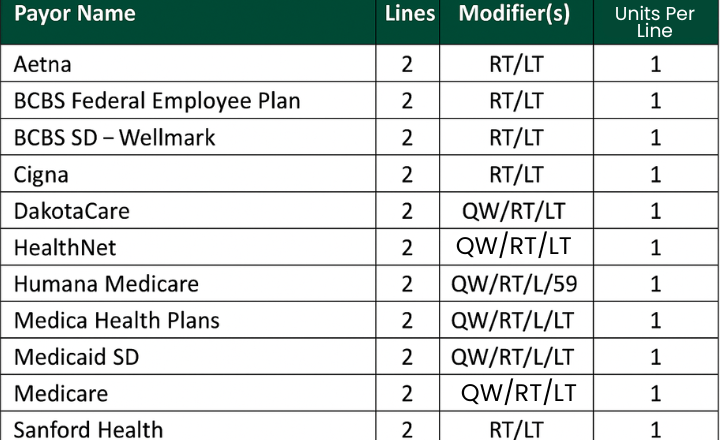
Coding Issue Highlight: CPT 83861 (Corneal Pachymetry)
Multiple payers in South Dakota denied CPT 83861 due to:
Invalid modifier
Incorrect laterality
Bundling when billed with certain E/M or procedure codes
Missing medical necessity or unsupported ICD-10
Action Taken:
MBW RCM created a payer-specific billing matrix for CPT 83861 tailored to South Dakota payer rules and shared it with the billing team to ensure compliance.
Solution
MBW RCM implemented a detailed coding correction strategy and AR recovery plan to reduce denials and improve claim accuracy.
Comprehensive Coding Review & Corrections
Reviewed every denied claim related to coding
Validated clinical documentation, global period rules, and modifier accuracy
Corrected invalid CPT/ICD-10 pairings
Applied appropriate modifiers based on payer policies
Addressed NDC discrepancies, JW/JZ usage, and injection billing errors
Attached supporting clinical files including OCT printouts, VF reports, operative notes, and progression documentation
Appeals & Resubmissions
Prepared detailed appeals with supportive documentation
Resubmitted all corrected claims
Implemented coding guidelines to prevent recurrence of the same errors
Process Workflow Enhancements
Developed payer-specific coding references
Created standardized workflows for imaging, E&M coding, and NDC compliance
Educated internal teams on proper modifier hierarchy, diagnosis mapping, and global period rules
Results
After implementing the coding guidelines and completing AR recovery, the practice achieved significant financial and operational improvements.
Pre-Engagement Baseline (April 2025)
Insurance AR: $428,922
120+ Days AR: $215,049 (~50%)
Denial Rate: ~18%
Rejection Rate: 7%
After Applying Coding Guidelines & AR Recovery
Financial Recovery
Successfully appealed and resubmitted: $151,695
Expected collection recovery: $110,000–$125,000, depending on insurer payment rates
These improvements significantly strengthened the practice’s coding accuracy, reduced AR backlog, and accelerated cash flow performance.
Schedule a consultation
Coding errors, incorrect modifiers, and NDC discrepancies can create significant revenue loss for ophthalmology practices. MBW RCM helps identify and correct these issues at the root, reducing denials and improving reimbursement performance.
To learn how we can help your practice prevent coding-related denials and strengthen your revenue cycle, please fill out the form below and our team will reach out to you shortly.