Understanding Coding “Not Elsewhere Classifiable” (NEC) in ICD-10-CM
Accurate ICD-10-CM coding requires more than matching diagnoses to codes—it demands a solid understanding of coding conventions. One such convention is “Not Elsewhere Classifiable” (NEC). Proper use of “Not Elsewhere Classifiable” (NEC) ensures diagnoses are reported accurately when clinical documentation is specific, but the ICD-10-CM code set does not offer an exact match.

Understanding “Not Elsewhere Classifiable” (NEC) is essential for maintaining compliance, improving data quality, and preventing avoidable claim denials.
Table of Contents
What Is “Not Elsewhere Classifiable” (NEC)?
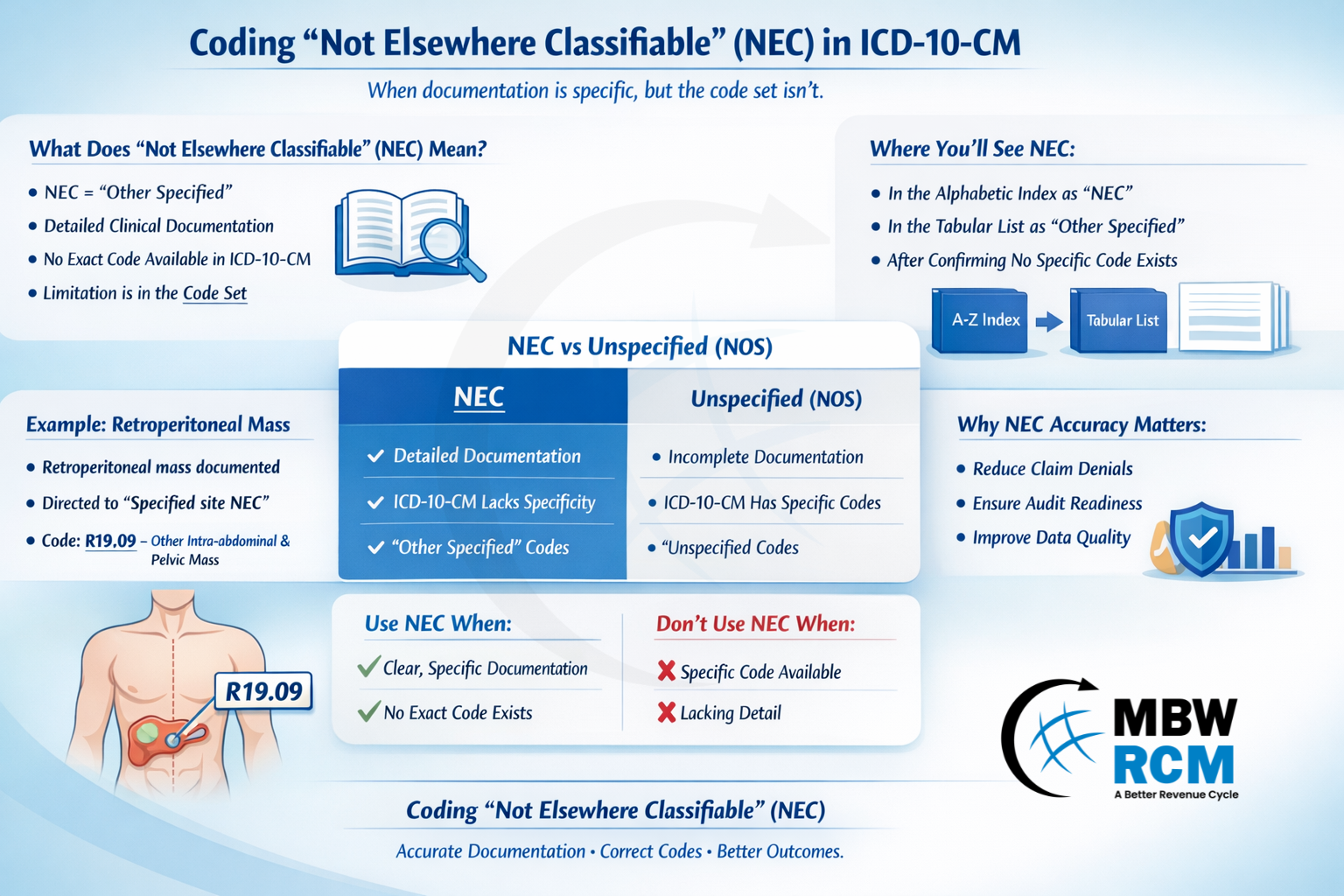
In ICD-10-CM, “Not Elsewhere Classifiable” (NEC) is used when a provider documents a condition with sufficient detail, but no specific code exists to describe that condition precisely. In ICD-10-CM terminology, “Not Elsewhere Classifiable” (NEC) means “other specified.”
When this occurs, the Alphabetic Index directs the coder to an “other specified” code in the Tabular List, indicating that the limitation lies in the code set—not in the documentation.
“Not Elsewhere Classifiable” (NEC) vs. Unspecified Coding
A frequent coding challenge is distinguishing “Not Elsewhere Classifiable” (NEC) from unspecified (NOS) codes. Making the correct distinction is critical for compliance and audit readiness.
| “Not Elsewhere Classifiable” (NEC) | Unspecified (NOS) |
|---|---|
|
Definition: Other specified Use: Documentation is detailed, but ICD-10-CM does not provide a specific code. |
Definition: Not otherwise specified Use: Documentation lacks the detail needed to assign a more specific code. |
Understanding this difference helps coders apply ICD-10-CM guidelines correctly. For additional clarity, reviewing medical billing and coding terminology can be especially helpful.
Example of “Not Elsewhere Classifiable” (NEC) Coding in Practice
A common example of “Not Elsewhere Classifiable” (NEC) involves documentation of a retroperitoneal mass. When researching the diagnosis under the main term “Mass” in the ICD-10-CM Alphabetic Index, no specific subentry exists for retroperitoneal location.
Instead, the Index directs the coder to a “specified site NEC” option, which leads to R19.09 (Other intra-abdominal and pelvic swelling, mass and lump). In this case, the provider clearly documented the anatomical site, but ICD-10-CM does not provide a more specific code, making the NEC-designated “other specified” code appropriate.
Applying “Not Elsewhere Classifiable” (NEC) Correctly
Accurate application of “Not Elsewhere Classifiable” (NEC) requires reviewing both the Alphabetic Index and the Tabular List. Coders must determine whether the lack of specificity is due to documentation gaps or to limitations within ICD-10-CM itself.
When a more specific code exists and documentation is incomplete, a compliant provider query may be necessary. However, when ICD-10-CM lacks a precise option despite detailed documentation, “Not Elsewhere Classifiable” (NEC) is the correct, guideline-supported choice.
Impact of “Not Elsewhere Classifiable” (NEC) on Compliance and Revenue
Correct use of “Not Elsewhere Classifiable” (NEC) plays a significant role in revenue cycle performance. Overuse of unspecified codes can trigger payer scrutiny, while improper NEC assignment may lead to audits or denials.
Partnering with experienced medical coding and audit services helps ensure NEC codes are applied correctly, documentation is reviewed thoroughly, and coding decisions align with ICD-10-CM guidelines.
Role of Professional Medical Coding Services
Professional medical coding services provide the expertise needed to apply “Not Elsewhere Classifiable” (NEC) accurately. Certified coders stay current with ICD-10-CM updates, identify documentation opportunities, and help reduce compliance risks.
For healthcare organizations managing complex diagnoses or high claim volumes, expert coding support improves accuracy, reduces rework, and supports consistent reimbursement outcomes.
Conclusion
“Not Elsewhere Classifiable” (NEC) is not a vague or default coding option—it is a precise ICD-10-CM convention used when documentation is specific but the code set does not offer an exact match. Understanding and applying “Not Elsewhere Classifiable” (NEC) correctly, or working with experienced medical coding professionals, supports compliance, protects revenue, and ensures high-quality clinical data reporting.
FAQs: Coding “Not Elsewhere Classifiable” (NEC) in ICD-10-CM
Request for Information
Facing challenges with NEC or unspecified ICD-10-CM coding? Connect with a medical coding expert to review your current practices, reduce denials, and improve coding accuracy and compliance.