
Nephrology Revenue Cycle Management: In-House or Outsourced RCM?
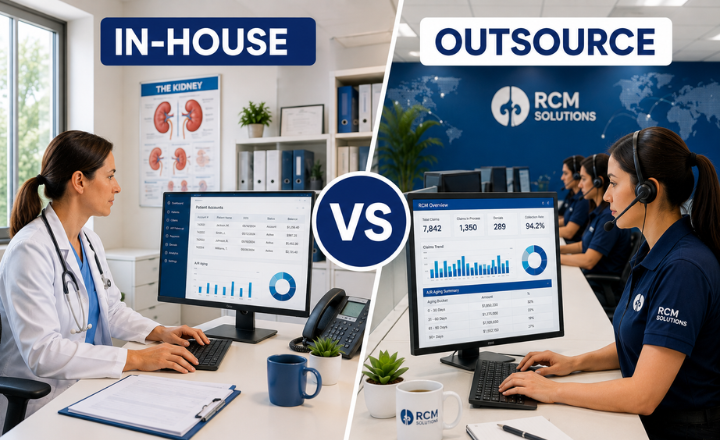
Managing nephrology revenue cycle management in-house provides greater control but requires specialty expertise, staffing, technology, and payer follow-up. Outsourcing can add capacity for coding, denials, A/R follow-up, and reimbursement review.
In-house RCM works when staffing, A/R, denials, and costs remain controlled. Outsourcing becomes more relevant when these areas begin affecting collections.
With 88% of provider executives citing payer challenges among their top RCM concerns and 69% outsourcing some or all RCM functions, choosing the right model has become increasingly important.
Table of Contents
In-House Nephrology RCM: Control Comes With Added Cost
An internal model provides closer oversight of nephrology billing, but the internal RCM operation requires sufficient specialty expertise, staffing, and capacity to manage the revenue cycle consistently.
➤ Direct Control Over Billing Operations
Internal staff can directly manage charge entry, coding queues, claim submission, denials, payment posting, and payer follow-up. Documentation questions can also be escalated quickly to nephrologists when CKD staging, dialysis modality, medical necessity, or another clinical detail is missing.
This control is valuable when the internal billing department has enough resources to keep each function moving consistently.
➤ Specialty Expertise Depends on Your Staff
Nephrology billing requires knowledge of dialysis MCP services, ESRD billing, renal procedures, CPT/HCPCS reporting, modifiers, payer policies, and documentation requirements.
Medicare's current ESRD PPS base rate is $281.71, with approximately $6 billion in payments to about 7,600 ESRD facilities expected under the current payment year.
Internal staff must remain current as payment and coding requirements change.
➤ Staffing Gaps Can Quickly Reach A/R
A vacancy in coding or billing does not stop new encounters.
A capacity problem can move through the revenue cycle:
Coding backlog → delayed claim submission → unresolved denials → slower collections → aging A/R
If current claims take priority, balances can move into the 60-, 90-, and 120+ day aging buckets before sufficient follow-up occurs.
➤ Fixed Costs Extend Beyond Salaries
The actual cost of an internal RCM operation includes salaries, benefits, recruitment, training, management, technology, clearinghouse expenses, compliance resources, and rework.
Medical groups continue to face significant cost pressure: 84% recently reported higher operating costs, with groups experiencing increases reporting an average rise of about 11%.
Outsourced Nephrology RCM: Adding Expertise & Capacity
Outsourced nephrology RCM can address capacity and expertise gaps without requiring the internal billing department to add FTEs across every revenue cycle function.
➤ Specialty Billing and Coding Resources
Specialized resources can support dialysis billing, ESRD requirements, renal coding, payer edits, and claim review.
This becomes particularly relevant when the existing billing staff has general medical billing experience but limited nephrology-specific coding depth.
➤ Denial and Appeal Capacity
Denial resolution can require coding validation, medical records, authorization research, corrected claims, payer communication, and formal appeals.
Payer friction remains substantial: surveyed healthcare providers reported increases in denials (81%), prior authorization delays (74%), and unclear denial reasons or underpayments (73%).
Dedicated denial resources allow recovery work to continue without competing directly with daily claim production.
➤ A/R Recovery Without Competing Priorities
Older accounts often require multiple payer touches and deeper investigation.
Focused A/R resources can prioritize:
High-dollar balances
60-, 90-, and 120+ day A/R
No-response claims
Stalled appeals
Documentation requests
Underpayments
Payer-specific backlogs
Among surveyed healthcare providers using managed services, 67% outsource A/R follow-up and collections, while 39% outsource denial management.
➤ Scalability as Claim Volume Changes
Adding nephrologists, locations, hospital affiliations, or dialysis volume increases RCM workload.
Outsourcing can provide additional capacity without requiring the practice to add another internal billing FTE for every increase in claim volume. That flexibility can be valuable during expansion, acquisitions, staffing shortages, or sudden increases in A/R. If you’re interested in learning more about nephrology billing, take a look at this article on evaluating nephrology billing outsourcing costs, ROI, and billing partners.
In-House vs. Outsourced RCM: Compare More Than Cost
The decision should not come down to employee salaries versus an outsourcing fee.
The better model is the one that produces stronger net collections at a sustainable cost while maintaining coding accuracy, compliance, and payer follow-up.
Signs Your Current Nephrology RCM Model Needs Review
An RCM model may need closer evaluation when several performance problems begin occurring together.
Look for:
A/R over 90 days increasing month over month
Dialysis or ESRD denials repeatedly returning
Coding or charge-entry backlogs
High-dollar claims remaining unresolved
Appeals approaching filing deadlines
Underpayments posted without review
Claim volume exceeding available capacity
RCM costs increasing without comparable collection growth
One isolated problem may require a process correction. Several occurring together can indicate that the existing nephrology RCM operation no longer has sufficient capacity or specialty expertise.
Four Nephrology RCM Metrics Before Outsourcing
Reviewing 6–12 months of RCM performance can show whether the current billing model is delivering the required financial results before a decision is made to outsource.
➤ Days in A/R
Track how quickly receivables convert into payment and segment performance by payer, location, and service.
If days in A/R remain controlled as volume grows, internal capacity may be adequate. A consistent increase can point to delayed claims, payer issues, denial backlogs, or insufficient follow-up.
➤ A/R Over 90 Days
Break 90+ day balances into denials, pending appeals, no-response claims, documentation requests, underpayments, and secondary balances. If current claims are moving while older A/R continues increasing, the issue may be recovery capacity rather than claim production.
➤ Denials and Underpayments
Track denials by both volume and dollars. Then examine the reason, payer, appeal status, resolution time, and reimbursement recovered.
Underpayments require separate attention. Compare:
Expected allowable → payer allowed amount → adjustment → actual payment
A claim can show a paid status while reimbursement remains below the expected contractual amount.
➤ Cost to Collect
Compare the complete internal expense:
Salaries + benefits + recruitment + training + management + technology + clearinghouse expenses + rework
against actual collections.
If internal costs increase while A/R, denials, and collections deteriorate, outsourced nephrology billing services become a more relevant financial consideration
Where In-House RCM Still Makes Sense
Keeping RCM internal can remain the stronger choice when a nephrology practice has experienced billing and coding staff, stable staffing, controlled denials, manageable aging A/R, reliable payer follow-up, and sufficient capacity for expected growth.
A well-integrated nephrology EHR can further support the internal model when clinical documentation, charge capture, coding, and billing information are readily available to RCM staff.
If the internal RCM operation is already producing strong collections at a sustainable cost, outsourcing the entire function may offer limited financial benefit.
When Outsourcing Becomes the Stronger Financial Choice
Outsourcing becomes more compelling when limitations in the current model begin affecting reimbursement. Consider a nephrology practice that submits current claims on time but continues to accumulate 90- and 120+ day A/R. Adding another general billing employee may not solve the problem if the actual need is dedicated denial or payer follow-up capacity.
The financial case becomes stronger when the current billing operation is dealing with several issues at once:
Persistent vacancies + specialty coding gaps + recurring denials + growing aged A/R + unreviewed underpayments + rising cost to collect Across the healthcare market, 67% of surveyed providers using managed services outsource A/R and collections, 50% use outsourced coding, 39% outsource denial management, and 29% outsource billing and claims editing.
A Hybrid RCM Model Can Close Specific Gaps
Full outsourcing is not the only option.A nephrology practice can retain physician communication, patient-facing activities, nephrology EHR oversight, and financial management internally while outsourcing selected functions such as:
Medical coding | Denial management | Payment posting | Aged A/R | Underpayment recovery
The outsourced service should match the financial problem. If coding performance is strong but 120+ day A/R continues increasing, replacing the coding function addresses the wrong issue. Dedicated aged A/R recovery may be the more appropriate intervention.
In-House or Outsourced? Let Financial Performance Decide
The right nephrology revenue cycle management model depends on financial performance, specialty expertise, and operational capacity. In-house RCM can remain effective when staffing is stable, denials and A/R are controlled, and cost to collect is sustainable.
Outsourcing may be appropriate when staffing gaps, ESRD coding complexity, recurring denials, underpayments, or growing 90+ day A/R affect collections. A hybrid model can address specific gaps without shifting the entire revenue cycle.
MBW RCM provides Nephrology Billing Services across coding, denial management, payment posting, A/R follow-up, and reimbursement review. Reviewing 6–12 months of A/R aging, denials, collections, and RCM costs can help determine the right model.
FAQs on Nephrology Revenue Cycle Management
Request a Nephrology RCM Performance Review
Growing A/R, recurring denials, coding backlogs, underpayments, and payer follow-up delays can affect nephrology revenue performance. MBW RCM reviews your nephrology RCM to identify performance gaps and areas that may need additional support. Fill out the form below to request a nephrology RCM performance review.
