Medical Billing Services Cost in the USA: Solo Practice vs. Hospital
Understanding Medical Billing Services Cost is a crucial part of running a financially stable healthcare organization. In the United States, medical billing is not just paperwork—it directly impacts cash flow, compliance, and long-term growth.
Whether you operate an independent practice or manage a hospital system, Medical Billing Services Cost in USA varies widely due to differences in scale, claim complexity, staffing models, and technology requirements.
Pricing context: All figures discussed below reflect common industry ranges used for comparison and planning. Actual costs depend on practice-specific factors and are determined after a detailed review.
What Determines Medical Billing Services Cost in the USA?
Several core factors influence Medical Billing Services Cost in USA. One of the biggest is claim volume. Practices submitting fewer claims often pay more per claim, while high-volume organizations benefit from economies of scale.
Claim complexity is another major driver. Routine outpatient visits are far less costly to bill than inpatient stays, surgeries, bundled payments, or multi-payer encounters. Medical specialty also plays a role—specialties with advanced procedures and strict documentation requirements typically incur higher billing costs.
Other cost drivers include denial rates, reporting needs, payer-specific rules, technology integration, and whether billing is handled in-house, outsourced, or through a hybrid model. Because these factors differ from one provider to another, billing costs should always be evaluated as benchmarks rather than fixed prices.
How Medical Billing Services Cost Is Structured

Medical billing services in the USA are typically priced in one of three ways:
Percentage of collections, often used by small and mid-sized practices
Per-claim pricing, common for stable, predictable volumes
Flat monthly fees, preferred for consistent workloads
Across the industry, billing costs usually fall between 3% and 10% of total collections. Smaller practices tend to be at the higher end of this range, while hospitals benefit from scale and automation that lower cost per claim.
Many providers choose full revenue cycle management services to centralize coding, billing, follow-ups, denial management, and reporting under one streamlined system.
Medical Billing Services Cost for Solo Practices
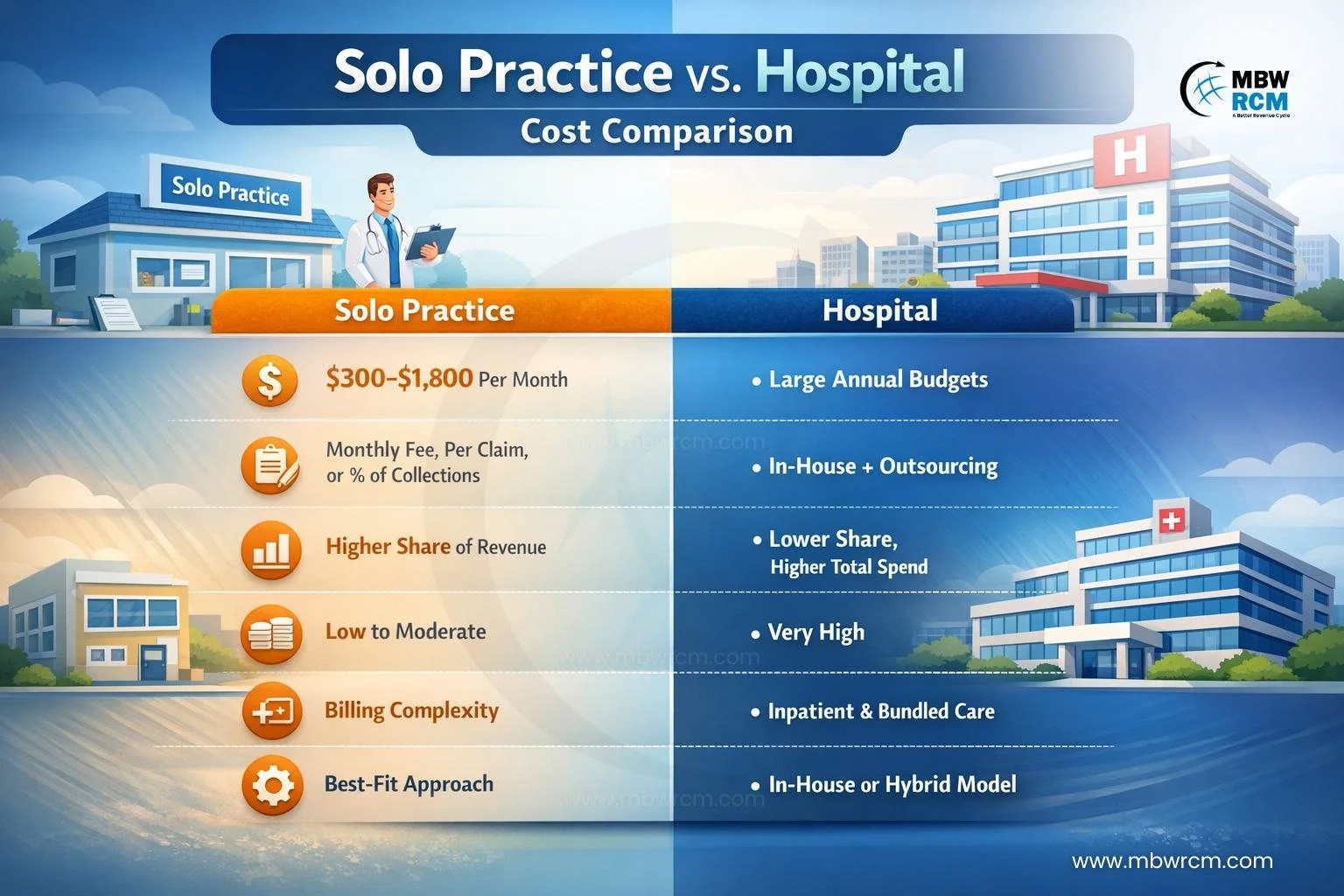
Solo physicians and independent practices often outsource billing due to limited internal staff and resources. In most cases, Medical Billing Services Cost for solo practices falls between $500 to $1,800 per month, depending on claim volume, specialty, and payer mix.
When priced as a percentage of collections, solo practices typically pay 5% to 8% of monthly revenue. Practices that choose per-claim pricing often see rates in the $3 to $7 per claim range.
While the percentage cost may seem higher, outsourcing eliminates expenses related to billing staff salaries, benefits, training, billing software, and compliance updates. Many practices also gain access to specialty-focused expertise, which is especially valuable for complex coding scenarios. You can explore how specialty billing affects cost across different disciplines here: Medical Billing Specialties.
For most solo providers, predictable Medical Billing Services Cost and reduced administrative burden outweigh the higher proportional expense.
Medical Billing Services Cost for Hospitals
Hospitals operate at a completely different scale. With thousands of claims processed across inpatient, outpatient, emergency, and diagnostic departments, billing becomes a large operational function.
Large hospitals in the USA often spend several million dollars annually on billing and revenue cycle operations. Despite the high absolute spend, billing typically represents only 3% to 6% of net patient revenue, which is proportionally lower than what solo practices pay.
Hospitals usually maintain in-house billing departments staffed with certified coders, billers, compliance officers, and revenue cycle managers. In addition to salaries and benefits, hospitals invest heavily in EHR integration, analytics, auditing tools, and regulatory compliance systems. Many also supplement internal teams with outsourced support for denial management or specialty billing to improve efficiency.
This scale-driven efficiency is a defining feature of Medical Billing Services Cost in USA for large healthcare organizations.
Solo Practice vs. Hospital: Cost Comparison
Why Medical Billing Services Cost Varies So Widely
The wide range in Medical Billing Services Cost reflects differences in scale and complexity—not inefficiency. Solo practices manage fewer and simpler claims but lack negotiating power and internal infrastructure. Hospitals process far more complex claims but spread costs across high volumes.
Regulatory and compliance requirements also add to hospital billing expenses, while helping protect large revenue streams. Understanding these structural differences allows providers to compare costs more accurately.
Conclusion
There is no single fixed Medical Billing Services Cost. What a solo practice pays versus a hospital depends on size, specialty, claim complexity, and operational strategy.
Solo practices often prioritize simplicity and predictable costs, while hospitals invest heavily to manage complexity and safeguard revenue. Knowing these industry benchmarks helps healthcare providers budget realistically and choose the billing model that best supports their goals.
FAQs: Medical Billing Services Cost in the USA
Want a Cost Estimate Tailored to your Practice?
Accurate pricing starts with understanding your workflows, claims, and payer mix. Complete the form to receive a custom medical billing quote, a FREE billing and revenue cycle audit, and insights on how to reduce your overall Medical Billing Services Cost—with no obligation or upfront cost.