
Case Study: Closing a $518K Revenue Gap in Spine Surgery Billing
A multi-provider spine surgery practice in Texas partnered with MBW RCM to address a significant reimbursement gap despite performing a consistent volume of complex spinal procedures. Our assessment found that claims involving arthrodesis, decompression, instrumentation, and interbody fusion were under-reimbursed due to fusion CPT reporting errors, documentation deficiencies, NCCI edits, and delayed follow-up on high-value claims.
Within 120 days, we identified $518,000 in recoverable reimbursement, primarily from underpaid fusion procedures, instrumentation claims, and aging surgical accounts. By implementing our specialty-focused spine surgery billing strategy, we helped the practice recover the $518K revenue gap while improving reimbursement accuracy and collections.
Client Overview
Specialty: Spine Surgery
Location: Texas, USA
Practice Type: Multi-provider (7 Spine Surgeons, 4 APPs)
Monthly Claim Volume: ~1,600–2,000 claims
Average Surgical Claim Value: $18,000–$48,000
Payer Mix: Commercial (56%), Medicare (36%), Workers' Compensation (8%)
Challenges in Spine Surgery Billing
Our assessment identified several billing and documentation issues affecting reimbursement for complex spine surgery procedures.
Revenue Leakage from Multi-Level Fusion Coding
Claims involving CPT 22630, 22633, 22614, and 22634 were inconsistently reported when multiple spinal levels were fused, resulting in incomplete reimbursement for additional fusion levels.
Under-Reimbursement of Instrumentation and Interbody Devices
Claims including posterior instrumentation (22842–22847) and interbody devices (22853) lacked documentation supporting implant utilization, vertebral fixation levels, and operative details, resulting in payment reductions and delays.
Insufficient Medical Necessity Documentation
Clinical records did not consistently support failed conservative treatment, neurological deficits, correlating imaging findings, or documented spinal instability required by payer policies.
NCCI Edits and Modifier Validation Issues
Claims combining decompression (63047, 63048) with spinal fusion frequently lacked documentation supporting distinct procedural services, resulting in avoidable NCCI bundling.
High-Value Claims Remaining in A/R
Surgical claims exceeding $20,000 remained in A/R beyond 90 days because payer-specific appeals and escalation workflows were not consistently prioritized.
Our Approach
Our spine surgery billing specialists standardized arthrodesis coding, verified primary and add-on fusion CPT reporting, reconciled operative reports with implant charge capture, strengthened pre-bill medical necessity validation, resolved payer-specific NCCI edits, and implemented structured A/R recovery workflows for high-value surgical claims.
Analysis: Problems and Solutions
| Problem | How We Addressed It |
|---|---|
| Incorrect reporting of multi-level fusion procedures (22630, 22633, 22614, 22634) | Our team standardized primary and add-on fusion coding while validating documentation for each fused spinal level, improving reimbursement accuracy by 32%. |
| Under-reimbursement of instrumentation (22842–22847) and interbody devices (22853) | We reconciled implant documentation with charge capture before claim submission, reducing payment delays by 29%. |
| Insufficient medical necessity documentation | Through our pre-bill clinical validation process, we aligned documentation with payer requirements, increasing approval rates by 35%. |
| NCCI edits affecting decompression (63047, 63048) and fusion claims | Our specialists strengthened NCCI edit review and modifier validation, reducing reimbursement adjustments by 31%. |
| High-value spine surgery claims remaining in A/R | We implemented value-based A/R workflows with payer-specific escalation, reducing A/R over 90 days by 36%. |
Results: Measurable Improvements in 120 Days
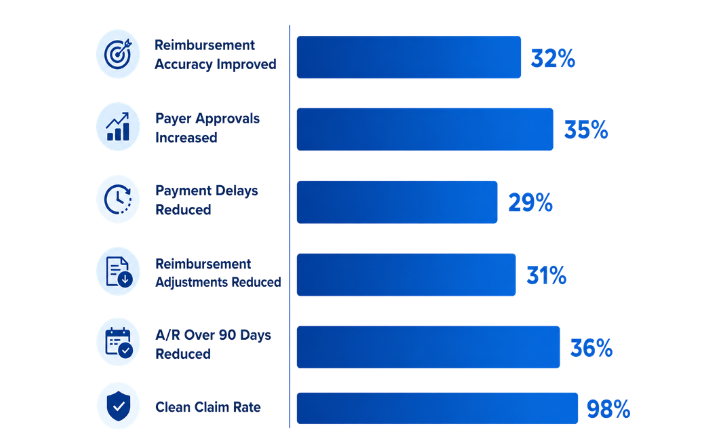
32% improvement in reimbursement for multi-level arthrodesis and fusion claims.
35% increase in payer approvals through stronger medical necessity documentation.
29% reduction in payment delays for instrumentation and interbody device claims.
31% fewer reimbursement adjustments through improved NCCI edit management.
36% reduction in A/R over 90 days for high-value spine surgery claims.
98% clean claim rate, accelerating collections and reducing claim rework.
Conclusion
The spine surgery practice faced reimbursement losses due to fusion coding inaccuracies, documentation gaps, NCCI-related payment reductions, and delayed follow-up on high-value claims. By strengthening coding accuracy, improving documentation, resolving payer edits, and prioritizing A/R recovery, these challenges were successfully addressed.
This case demonstrates that resolving specialty-specific spine surgery billing issues through accurate coding and structured workflows can improve reimbursement, accelerate payments, and strengthen overall revenue performance.
Request a Billing Assessment & Schedule a Consultation
Spine surgery billing involves complex fusion coding, implant reporting, medical necessity documentation, and payer-specific reimbursement requirements. Even small billing inaccuracies can result in significant revenue loss and delayed payments for high-value surgical claims.
Complete the form below to request a billing assessment and schedule a consultation with our Spine Surgery Billing specialists. We'll review your billing workflows, identify revenue leakage opportunities, and recommend strategies to improve reimbursement accuracy and overall financial performance.
