
Anxiety and depression ICD-10 for behavioral health billing

Anxiety and depression ICD-10 refers to using ICD-10-CM diagnosis codes to report anxiety and depressive disorders in behavioral health insurance claims for behavioral health billing. These codes identify the patient’s condition and link it with services such as psychotherapy on claim forms like CMS-1500.
Proper ICD-10 coding helps providers document diagnoses and support treatment services. This guide will help you understand the common ICD-10 codes, documentation requirements, and billing practices used for anxiety and depression in behavioral health care.
Table of Contents
Understanding ICD-10 Codes in Behavioral Health
Anxiety and depression ICD-10 for behavioral health billing involves using diagnosis codes to report anxiety and depressive disorders in clinical documentation and insurance claims. In ICD-10-CM, these conditions fall mainly under F40–F41 (anxiety disorders) and F32–F33 (depressive disorders).
Behavioral health providers assign these codes after evaluating symptoms and severity. The diagnosis code is then used in claim forms like CMS-1500 and linked with services such as psychotherapy or psychiatric evaluations.
ICD-10 Codes for Anxiety Disorders
Anxiety disorders are among the most common diagnoses in outpatient mental health care. ICD-10 classifies anxiety conditions mainly under the F40–F41 category, which includes phobic anxiety disorders and other anxiety-related conditions. Behavioral health providers use these codes to document diagnoses and support insurance claims for therapy services.
Common anxiety disorder codes include:
These codes often appear with psychotherapy CPT codes such as 90834 (45-minute therapy) or 90837 (60-minute therapy) when submitting behavioral health claims. Want to know the ICD-10-CM Code F41 for Other Anxiety Disorders? Explore the details here.
ICD-10 Codes for Depressive Disorders
Depressive disorders fall under the F32–F33 classification in ICD-10-CM, which identifies depression severity and recurrence. Behavioral health providers use these codes to document depressive conditions and support claims for psychotherapy, psychiatric evaluations, and medication management.
Common depression codes include:
Mental health providers may review depression symptoms every 30–90 days during ongoing treatment to adjust diagnosis or treatment plans.
How to Select the Correct ICD-10 Code for Anxiety and Depression
Selecting the correct ICD-10 code requires a clinical evaluation and detailed assessment. Many providers rely on DSM-5 diagnostic criteria when identifying anxiety or depressive disorders.
Symptoms commonly evaluated include:
Persistent worry or panic episodes
Sleep disturbances or fatigue
Loss of interest in daily activities
Mood changes lasting two weeks or longer
Based on the patient’s symptoms and severity, clinicians assign the most appropriate diagnosis. Choosing the correct code helps ensure accurate documentation and supports proper behavioral health billing for anxiety and depressive disorders.
Documentation for Anxiety and Depression ICD-10 Coding
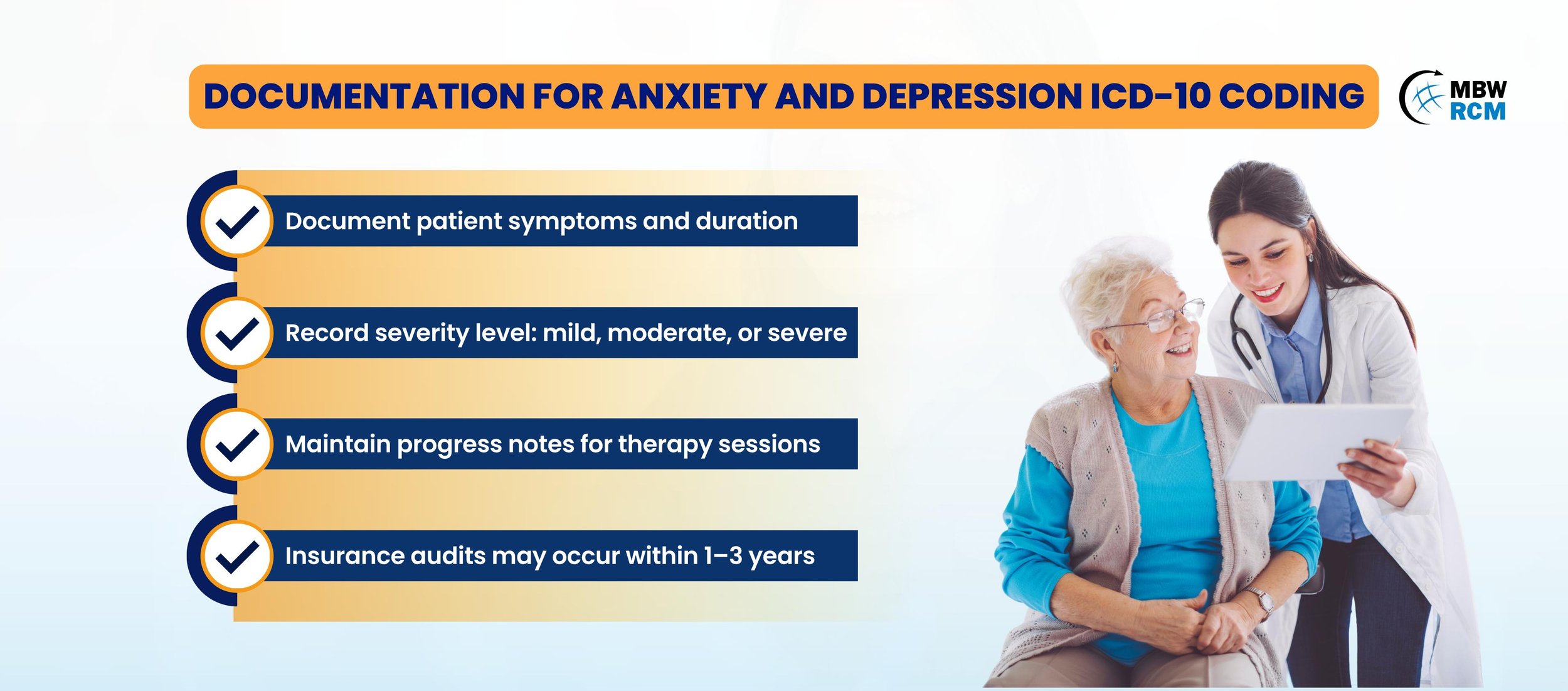
Documentation for anxiety and depression ICD-10 coding should clearly support the diagnosis selected by the provider. Behavioral health records must include details that justify the ICD-10 code used for the patient’s condition.
Key documentation details include:
Symptoms and duration (e.g., depressed mood or anxiety lasting two weeks or longer)
Severity level such as mild, moderate, or severe depression
Clinical evaluation results from the mental health assessment
Assigned ICD-10 diagnosis code for the condition
Treatment plan and therapy goals
Progress notes from therapy sessions
Insurance companies may conduct post-payment audits within 1–3 years, so clear documentation helps verify the ICD-10 diagnosis code. If you are interested to read more about behavioral health, please have a look at this blog on ‘‘Behavioral Health Best Practice Guidelines’’.
Can Anxiety and Depression ICD-10 Codes Be Billed Together?
Yes, providers may report both anxiety and depression diagnoses on the same claim when a patient has symptoms of both conditions. Comorbid mental health disorders are common in behavioral health practice.
For example, a claim may include:
F41.1 – Generalized Anxiety Disorder
F32.1 – Moderate Depressive Episode
The primary diagnosis represents the main reason for the visit, while secondary codes describe additional conditions affecting treatment. This approach is common in anxiety and depression ICD-10 for behavioral health billing when therapy addresses overlapping symptoms.
Common Billing Mistakes with Anxiety and Depression ICD-10 Codes
Errors in anxiety and depression ICD-10 coding can lead to claim denials, delayed payments, or insurance reviews. Behavioral health providers and billing teams should avoid the following common mistakes when submitting claims.
Using unspecified diagnosis codes unnecessarily
Selecting codes such as F41.9 (Anxiety disorder, unspecified) when documentation clearly supports a specific diagnosis like generalized anxiety disorder.
Incorrect severity selection for depression codes
Using the wrong severity level in F32 or F33 codes, such as reporting mild depression when documentation indicates moderate or severe symptoms.
Incorrect primary diagnosis on claims
Listing a secondary condition as the primary diagnosis when the main reason for the visit is anxiety or depression.
Mismatch between diagnosis and billed services
Submitting psychotherapy services when the documented diagnosis does not support the treatment provided.
Identifying these coding mistakes helps improve claim accuracy and reduces billing issues related to anxiety and depression diagnoses. Want to know more about mental health billing challenges? Explore Why Mental Health Billing Is Complex and How to Simplify It.
Conclusion:
Understanding anxiety and depression ICD-10 codes helps providers document mental health diagnoses and submit compliant behavioral health claims. Correct code selection and proper documentation support therapy services and reduce billing errors.
If your practice needs help with coding or claim submission, our behavioral health billing services can assist. Contact MBW RCM today to learn how we can support your behavioral health billing needs.
FAQs: Anxiety & Depression ICD-10 for Behavioral Health Billing
Need Support With Anxiety and Depression ICD-10 Coding?
Selecting the correct ICD-10 code for anxiety and depression depends on clear documentation of symptoms, clinical findings, and patient history. Accurate coding helps maintain organized behavioral health records and proper reporting of mental health diagnoses.
If you are reviewing anxiety and depression ICD-10 codes, understanding when each code should be applied within the ICD-10 classification system is essential. Contact us to learn how our team can support your behavioral health coding and documentation needs.
