
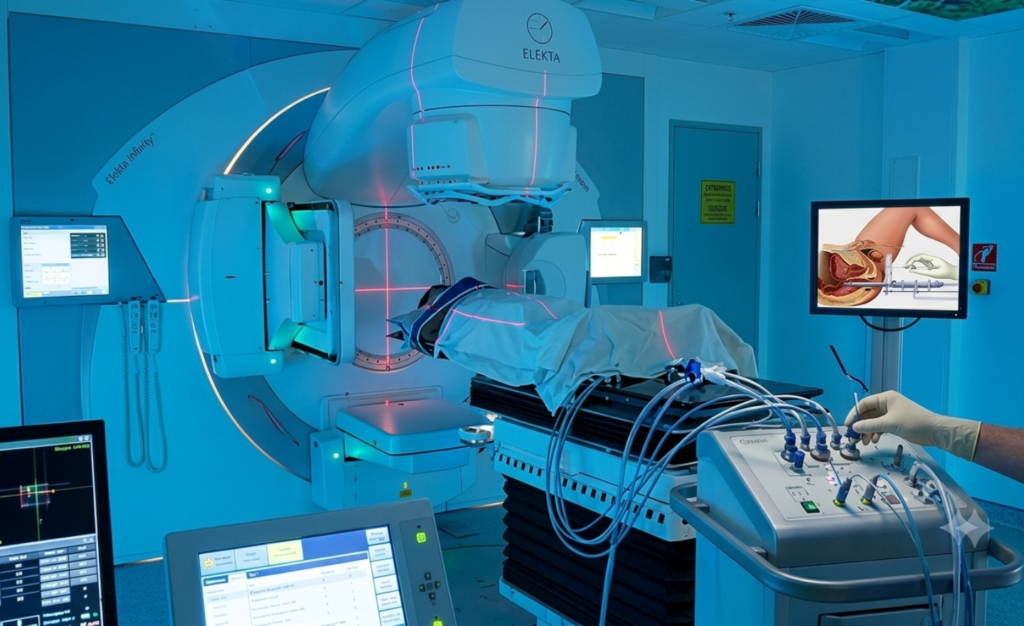
Brachytherapy billing involves more billable pieces than almost any other radiation oncology service: applicator placement, planning, source handling, the sources themselves and the delivery. Miss one and revenue leaks; bill two that bundle and the claim denies. In a hospital, comprehensive APC packaging also changes which services Medicare pays separately.
For 2026 brachytherapy billing, the sections below show how to code high-dose-rate (HDR) and low-dose-rate (LDR) treatment and which codes cannot share a claim. They also cover hospital C-APC rules and courses that combine external beam and brachytherapy.
HDR vs LDR: Two Brachytherapy Billing Paths
HDR brachytherapy delivers a high-activity source, usually iridium-192, through applicators or catheters for a few minutes per fraction, then removes it. Each fraction is a separate delivery, so coders report HDR codes per fraction, and the number of channels sets the price.
LDR brachytherapy leaves sources in place, either permanently, as with prostate seed implants, or for a set period. Because it is usually a single procedure, the delivery code covers the whole implant, and the facility reports the sources by count.
As a result, that difference drives everything else in brachytherapy billing: how often delivery codes repeat, how to count planning, and which source codes apply.
HDR Delivery Codes by Channel Count
Complexity sets the price of both HDR delivery and isodose planning, measured in channels for HDR and in sources for LDR.
| Service | Code | Complexity |
|---|---|---|
| HDR delivery, interstitial or intracavitary | 77770 | 1 channel |
| HDR delivery | 77771 | 2–12 channels |
| HDR delivery | 77772 | More than 12 channels |
| Isodose planning, simple | 77316 | 1 channel or 1–4 sources |
| Isodose planning, intermediate | 77317 | 2–12 channels or 5–10 sources |
| Isodose planning, complex | 77318 | More than 12 channels or more than 10 sources |
HDR skin surface delivery uses 77767 and 77768 instead. Under ASTRO coding guidance, 77300 basic dosimetry is not billable with 77316–77318 or 77770–77772, and decay recalculations are not separately billable. However, when the planning work reaches a 3-D plan, coders may also report 77295 per fraction with documented medical necessity.
LDR Implants and 77778
LDR brachytherapy billing centers on one delivery code and careful source counting.
Interstitial implants
77778 reports complex interstitial LDR brachytherapy, including source loading and supervision. For prostate seed implants, the physician also reports needle or catheter placement with 55875, and the facility reports each source by count.
Source handling
77790 is a technical-only code for receiving, preparing and transporting sources. Because 77778 already includes it, 77790 never goes on the same claim as 77778. However, it can go with other LDR procedures and with HDR cases such as cylinder or tandem and ovoid treatments.
Surface and unlisted applications
77789 covers surface application of a radiation source, such as strontium-90 for eye lesions. Use 77799 only when no specific code fits.
Applicators, Sources and Markers
These charges are the easiest to miss in brachytherapy billing, because different team members document them, not the delivery team. Our post on missing radiation oncology charges shows how those gaps add up.
Applicator placement
Gynecologic cases use 57155 for uterine tandem and/or vaginal ovoids and 57156 for a vaginal cylinder. When tandem and ovoid insertions happen over several encounters, report each insertion for its own encounter.
Sources
Each radioactive source has its own HCPCS C-code, such as iridium-192 for HDR and iodine-125, palladium-103 or cesium-131 for LDR. The claim reports each one by source count or activity, as the code descriptor defines. Under the hospital outpatient system, Medicare pays brachytherapy sources separately, so a missing source line is lost revenue.
Fiducials and markers
Report 49411 for placing interstitial guidance devices once, no matter how many devices the physician places. In contrast, C1879 for non-radioactive markers in gynecologic brachytherapy is billable once per marker.
Electronic brachytherapy
For 2026, the AMA deleted Category III code 0394T. Instead, skin electronic brachytherapy now uses 77436 and 77437, and 0395T covers HDR electronic brachytherapy at other sites; both include basic dosimetry.
Hospital Brachytherapy Billing Under C-APC Rules
In hospital outpatient departments, key brachytherapy procedures such as 57155 carry status indicator J1, which makes them the primary service of a comprehensive APC (C-APC). As a result, a J1 claim packages most other hospital services into one payment instead of paying them line by line.
Three practical points follow:
- Report every service anyway. Packaged lines still need to be on the claim so CMS can set future rates and the payment is correct.
- Bill per encounter. According to ASTRO April 2026 guidance, CMS has indicated that hospitals can report C-APC services delivered over multiple encounters per encounter, instead of holding them for a monthly claim.
- Keep sources on the same claim. Medicare pays source codes separately, so keep them even when C-APC packaging covers the procedure.
Freestanding centers bill under the physician fee schedule instead, with global, technical (TC) and professional (26) splits. Our guide to professional and technical radiation oncology billing explains those splits.
Combined External Beam and Brachytherapy Courses
Many cervical, prostate and endometrial patients receive external beam radiation and a brachytherapy boost. In these courses, brachytherapy billing follows separate rules for each part:
- Planning: 77263 complex treatment planning covers the course. Two physicians may each report it only when different physicians manage the external beam and brachytherapy at separate facilities or locations.
- Management: weekly management (77427) applies to external beam fractions. Brachytherapy delivery codes already include the physician work for each fraction, so brachytherapy days do not count toward 77427.
- Planning per modality: external beam and brachytherapy each have their own plan, and both are billable when documented.
The same discipline applies to stereotactic courses; see our SBRT billing guide.
Codes That Cannot Be Billed Together
| Code | Do not bill with | Why |
|---|---|---|
| 77300 | 77316–77318 or 77770–77772 | These codes include basic dosimetry |
| 77790 | 77778 | Source handling is part of the interstitial implant |
| 49411 | Additional units for extra devices | Reported once per session |
| 0394T | Any 2026 claim | Deleted; use 77436–77437 |
| 77300 | 0395T or 77436–77439 | These codes include dosimetry |
A regular charge reconciliation catches these conflicts before claims go out, as shown in our radiation oncology charge capture case study.
Two Case Scenarios
HDR cervical cancer, hospital outpatient. For each fraction, the hospital reports 57155 for the tandem and ovoid insertion, 77317 for planning (2–12 channels), 77771 for delivery, 77790 for source handling and the iridium-192 source code. 57155 drives the C-APC payment, so the hospital can report each encounter separately.
LDR prostate seed implant, freestanding center. The physician reports 55875 for needle placement and 77778 for the implant, plus 77318 for planning when the implant uses more than 10 sources. The center reports each iodine-125 or palladium-103 seed by count; however, 77790 never goes on the claim with 77778.
Full Payment for Every HDR and LDR Treatment
A single brachytherapy fraction can produce six or more billable lines, and each follows its own rule. Channel count sets HDR delivery and planning, source count drives LDR implants, applicators and markers sit outside the delivery code, and in the hospital, C-APC packaging decides which lines Medicare pays on their own. That is why teams that reconcile those lines after every fraction rarely see brachytherapy denials or missed charges.
For cancer centers that want that reconciliation done the same way every time, MBW RCM provides radiation oncology billing services that check each fraction against 2026 bundling and C-APC rules before the claim goes out.
Brachytherapy Billing FAQs
What are the HDR brachytherapy CPT codes for 2026?
Interstitial or intracavitary HDR delivery uses 77770 (1 channel), 77771 (2-12 channels) and 77772 (more than 12 channels). Skin surface HDR uses 77767 and 77768.
Can you bill 77300 with brachytherapy isodose planning?
No. Basic dosimetry (77300) does not go on the same claim as 77316-77318 or 77770-77772.
Can you bill 77790 with 77778?
No. 77778 already includes source handling, but 77790 is billable with other LDR and HDR procedures.
Is 0394T still valid in 2026?
No. The AMA deleted 0394T for 2026. Instead, skin electronic brachytherapy uses 77436 and 77437, and 0395T covers other sites.
How is 57155 paid in a hospital outpatient department?
57155 has status indicator J1, so it anchors a C-APC payment that packages most other hospital services on the claim. However, Medicare still pays brachytherapy sources separately.
How many times can you bill 49411?
Once per session, no matter how many devices the physician places.