

Anesthesia claims can be particularly vulnerable to denials because reimbursement depends on more than selecting the correct procedure code. Anesthesia time, base units, provider type, medical direction, modifiers, patient physical status, documentation, and payer-specific billing requirements may all affect whether a claim is processed correctly.
A claim can appear accurate at first glance and still contain a billing discrepancy that delays reimbursement.
For hospitals, anesthesia groups, ambulatory surgery centers, and other organizations providing anesthesia services, repeated denials can increase A/R, create additional follow-up work, and make reimbursement less predictable.
Understanding why anesthesia claims get denied is therefore an important part of improving anesthesia revenue cycle performance.
Here are 12 anesthesia billing errors to check when denials begin appearing repeatedly.
Why Are Anesthesia Claims So Prone to Denials?
Anesthesia billing differs from many other medical specialties because reimbursement may depend on several variables within the same encounter.
For Medicare anesthesia services, payment calculations generally incorporate applicable base units and anesthesia time units, with actual anesthesia time reported in minutes. The provider arrangement can also determine which anesthesia modifier belongs on the claim.
That means billing teams may need to reconcile information across:
Anesthesia procedure documentation
Anesthesia start and stop times
Surgical procedure details
Anesthesiologist and CRNA records
Medical direction documentation
Physical status
Diagnosis coding
Payer policies
Authorization requirements
Claim-level modifiers
A discrepancy in any one of these areas can create an anesthesia claim denial, rejection, payment delay, or reimbursement variance.
The following errors deserve particular attention.
1. Incorrect Anesthesia CPT Code Selection
One of the first areas to review on a denied anesthesia claim is the anesthesia CPT code.
Anesthesia procedure codes are generally selected according to the surgical or diagnostic procedure being performed and the anatomical site involved. Choosing a code that does not accurately correspond with the documented procedure can create a mismatch between the anesthesia claim and the surgical claim.
For example, billing teams should verify that the anesthesia code is consistent with:
The procedure performed
The operative report
The anatomical site
The anesthesia record
Applicable CPT coding instructions
Errors can occur when procedure descriptions are interpreted incorrectly or when the anesthesia claim is coded without reviewing sufficient surgical documentation.
What to Check
Compare the anesthesia CPT code against the final operative report rather than relying only on a scheduled procedure or abbreviated procedure description.
When the procedure changes during surgery, the final documentation should also be reviewed before the anesthesia claim is submitted. For a better understanding of anesthesia CPT code selection, explore our Procedure Codes for Anesthesia guide.
2. Incorrect Anesthesia Start and Stop Times
Anesthesia time is one of the most important components of anesthesia billing.
CMS defines anesthesia time as the continuous period during which the anesthesia practitioner is present with the patient. It generally begins when the practitioner starts preparing the patient for anesthesia in the operating room or equivalent area and ends when the practitioner is no longer furnishing anesthesia services and the patient can safely be placed under postoperative care.
Medicare requires actual anesthesia time to be reported in minutes.
Incorrect start or stop times can therefore affect both claim accuracy and reimbursement.
Common problems include:
Missing start time
Missing stop time
Incorrectly transcribed times
Overlapping anesthesia times
Inconsistent times between provider records
Reporting surgical time instead of anesthesia time
Incorrect conversion of hours to minutes
What to Check
Compare the billed anesthesia minutes with the original anesthesia record.
The time submitted on the claim should be supported by documentation and calculated according to the applicable payer’s anesthesia billing rules.
3. Using the Wrong Anesthesia Modifier
Anesthesia modifiers communicate who performed the service and, in many cases, how the anesthesia service was furnished.
Common anesthesia payment modifiers include:
| Modifier | General Use |
|---|---|
| AA | Anesthesia services personally performed by an anesthesiologist |
| QK | Medical direction of two, three, or four concurrent anesthesia procedures |
| QX | Qualified nonphysician anesthetist service with medical direction by a physician |
| QY | Medical direction of one CRNA by an anesthesiologist |
| QZ | CRNA service without medical direction by a physician |
| AD | Medical supervision by a physician involving more than four concurrent anesthesia procedures |
Using the wrong modifier can misrepresent the provider arrangement and lead to incorrect reimbursement or a denied anesthesia claim.
For example, QX should not be selected simply because an anesthesiologist was present in the facility. The documented arrangement must support the modifier being reported.
What to Check
Before claim submission, reconcile:
Rendering provider
Anesthesiologist
CRNA or other qualified anesthesia professional
Medical direction arrangement
Concurrent cases
Provider documentation
Payer-specific modifier requirements
The modifier should reflect what actually occurred during the anesthesia service. Need help distinguishing between anesthesia provider modifiers? Refer to our AA, QK, QX, QY, QZ, and AD modifier guide.
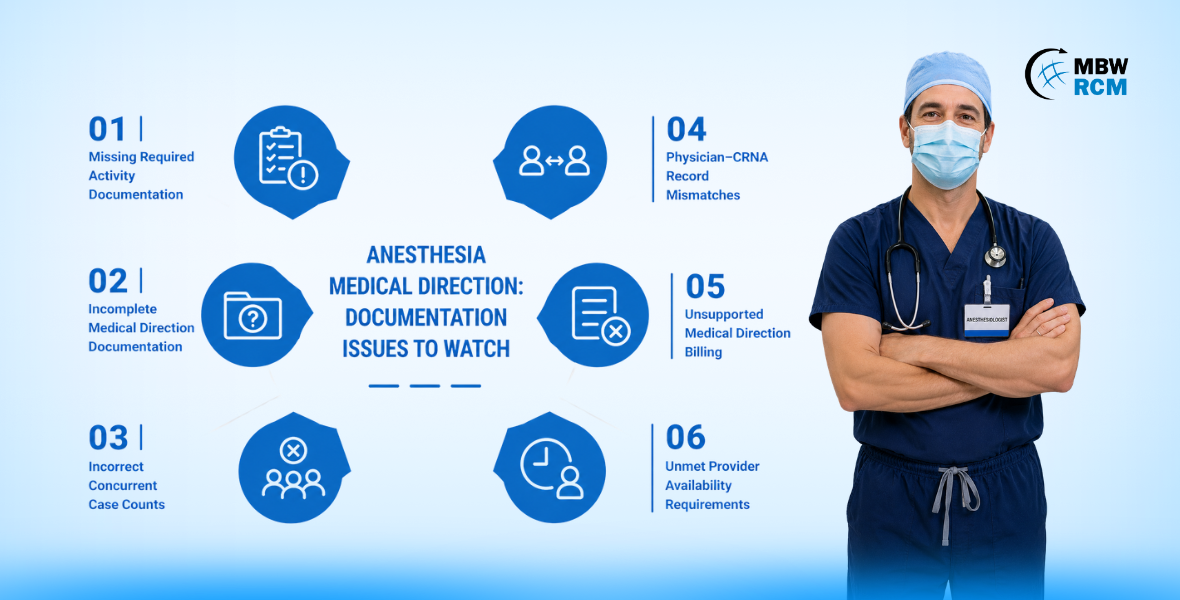
4. Medical Direction Requirements Are Not Supported
Medical direction is another frequent area of anesthesia billing risk.
When an anesthesiologist medically directs qualified anesthesia professionals, the documentation must support the applicable requirements.
Problems may occur when:
Required activities are not documented
Documentation is incomplete
Concurrent cases are counted incorrectly
Anesthesiologist and CRNA records do not reconcile
Medical direction is billed even though documentation does not support it
Provider availability requirements are not met
A claim containing QK, QY, or QX may receive additional payer scrutiny when the underlying documentation does not support the reported medical direction arrangement.
What to Check
Do not review the physician and CRNA claims independently.
Compare both sides of the anesthesia encounter before billing. Provider modifiers, times, concurrency, and documentation should tell a consistent story.
5. Anesthesia Time Overlaps Across Concurrent Cases
Concurrency creates another layer of complexity.
When an anesthesiologist is involved in multiple anesthesia cases, billing teams need to determine whether the cases were personally performed, medically directed, or medically supervised based on the actual circumstances and applicable payer rules.
Overlapping cases can become problematic when:
Case times are entered incorrectly
Concurrency is calculated incorrectly
One case overlaps unexpectedly with another
Provider schedules do not match submitted modifiers
The number of concurrent procedures changes during the service
An apparently small timing discrepancy can change how the anesthesia service should be reported.
What to Check
Create a chronological view of the anesthesiologist’s cases when reviewing concurrency.
Compare:
Case 1 start/stop time → Case 2 start/stop time → Case 3 start/stop time → Case 4 start/stop time
Then verify that the billed medical direction or supervision modifier accurately reflects the documented arrangement.
6. Missing or Incorrect Physical Status Modifiers
Anesthesia claims may also include physical status modifiers P1–P6, which communicate the patient’s condition at the time anesthesia is administered.
These modifiers range from a healthy patient to a declared brain-dead patient whose organs are being removed for donor purposes.
Incorrect assignment can create inconsistencies between the anesthesia claim and the patient’s medical record.
The patient’s documented condition—not assumptions based solely on age, procedure type, or diagnosis—should support the selected physical status modifier.
What to Check
Review the pre-anesthesia assessment and relevant clinical documentation before assigning the physical status modifier.
Also verify payer requirements because treatment of physical status modifiers and any associated additional units can vary.
7. Medical Necessity Is Not Supported
Correct coding alone does not guarantee payment.
The medical record must also support the medical necessity of anesthesia services when required by the payer.
This becomes particularly important for procedures where monitored anesthesia care or separate anesthesia services may not automatically be considered medically necessary.
Depending on the service and payer policy, documentation may need to support factors such as:
Patient condition
Comorbidities
Procedure complexity
History of anesthesia complications
Clinical risk
Need for additional monitoring
Reason anesthesia personnel were required
CMS coverage policies for monitored anesthesia care, for example, can require the patient’s clinical circumstances to support why MAC was reasonable and necessary.
What to Check
Do not rely on the anesthesia CPT code alone.
Review the diagnosis, patient condition, procedure, anesthesia type, and payer coverage policy together.
8. Diagnosis Coding Does Not Support the Anesthesia Service
An ICD-10-CM diagnosis code does more than describe the patient’s condition. It can also influence medical necessity determinations.
An anesthesia claim may encounter problems when:
The diagnosis is too nonspecific
The diagnosis does not match the procedure
Relevant comorbidities are omitted
An outdated diagnosis is carried forward
The anesthesia record and claim contain inconsistent diagnoses
Payer coverage criteria are not met
This can be especially important when anesthesia is being reported for procedures where coverage depends on the patient’s underlying condition.
What to Check
Compare the diagnosis coding against:
Pre-anesthesia evaluation
Operative report
Patient medical history
Documented comorbidities
Payer coverage requirements
The claim should communicate the clinical circumstances supported by the record.
9. MAC Services Are Billed Without Sufficient Documentation
Monitored Anesthesia Care (MAC)is another common area where coding and documentation must align.
CMS recognizes QS as an informational modifier for monitored anesthesia care. Actual anesthesia time and an applicable anesthesia payment modifier must still be reported when required.
Depending on the procedure and payer policy, documentation may also need to establish why MAC was medically necessary.
Additional modifiers such as G8 or G9 may apply under certain Medicare circumstances.
Problems arise when billing teams treat QS as though it replaces the payment modifier or assume MAC is automatically covered for every procedure.
What to Check
For MAC claims, verify:
Procedure performed
Medical necessity
Patient condition
Anesthesia documentation
Actual anesthesia time
Appropriate payment modifier
QS, G8, or G9 when applicable
Payer-specific coverage policy
This can reduce preventable anesthesia denials related to MAC services.
10. Prior Authorization Requirements Are Missed
Not every anesthesia service requires prior authorization, but when authorization is required, missing it can create a difficult denial.
Authorization problems may occur because the surgical procedure receives authorization while the anesthesia component is overlooked.
Other common issues include:
Authorization not obtained
Incorrect CPT code authorized
Authorization expired
Wrong date of service
Incorrect facility
Incorrect rendering provider
Procedure changed after authorization
Authorization number missing from the claim
These errors become particularly difficult when the billing team discovers them only after the procedure has already been performed.
What to Check
Authorization workflows should connect the scheduled procedure with the anesthesia service before the date of service whenever payer requirements make authorization applicable.
If the procedure changes, verify whether the authorization also needs to be updated.
11. Provider Enrollment or Credentialing Information Is Incorrect
Sometimes the anesthesia coding is correct, but the claim still does not get paid because of a provider enrollment or credentialing issue.
Potential problems include:
Rendering provider not enrolled
Provider not credentialed with the payer
Incorrect NPI
Incorrect billing provider
Provider effective date mismatch
Incorrect taxonomy
Group affiliation issue
Facility/provider mismatch
These problems can be especially disruptive when anesthesiologists and CRNAs work across multiple facilities or payer networks.
What to Check
Before billing a new provider, confirm:
Enrollment → Credentialing → Effective Date → NPI → Taxonomy → Group Affiliation → Facility
Credentialing data should also be reviewed whenever providers change locations, groups, or contractual arrangements.
12. Payer-Specific Anesthesia Billing Rules Are Overlooked
One of the biggest anesthesia billing mistakes is assuming every payer follows exactly the same rules.
Medicare policies provide an important framework, but commercial payers and Medicaid programs may have different requirements involving:
Time-unit calculations
Modifier combinations
Physical status modifiers
Medical direction
MAC
Authorization
Diagnosis requirements
Claim formatting
Reimbursement methodology
Supporting documentation
A claim configuration accepted by one payer may not produce the same result with another.
What to Check
Maintain a payer-specific anesthesia billing matrix covering the requirements most likely to affect reimbursement.
For each major payer, track:
Time Rules | Modifiers | Medical Direction | MAC | Authorization | Physical Status | Documentation | Claim Edits
Update the matrix when payer policies change.
Quick Anesthesia Denial Checklist
Before an anesthesia claim goes out, billing teams should be able to answer these questions:
| Billing Check | Question to Ask |
|---|---|
| CPT Code | Does the anesthesia code match the final procedure? |
| Anesthesia Time | Are start and stop times documented correctly? |
| Time Units | Were anesthesia minutes reported according to payer rules? |
| Provider Modifier | Does AA, QK, QX, QY, QZ, or AD match the service? |
| Medical Direction | Does documentation support the reported arrangement? |
| Concurrency | Do overlapping cases support the modifier used? |
| Physical Status | Is the P1–P6 modifier supported by documentation? |
| Medical Necessity | Does the record support why anesthesia was required? |
| Diagnosis | Do ICD-10-CM codes support the documented condition? |
| MAC | Are MAC documentation and modifiers appropriate? |
| Authorization | Was required authorization obtained and matched correctly? |
| Provider Data | Are NPI, enrollment, credentialing, and payer data correct? |
What to Review When an Anesthesia Claim Is Denied
A denial should not automatically move straight into an appeal.
First determine where the problem originated.
A structured anesthesia denial review can follow this sequence:
Denial Reason → Claim Data → Anesthesia Record → Operative Report → Provider Arrangement → Time → Modifiers → Diagnosis → Authorization → Payer Policy
This approach can help distinguish between a one-time claim error and a recurring process problem.
For example, repeated QX-related denials may indicate a medical direction documentation problem rather than isolated coding mistakes.
Repeated medical necessity denials may point to diagnosis selection or documentation gaps.
Repeated time-related denials may indicate problems in charge capture or the transfer of anesthesia minutes from the clinical system to the billing system.
The goal should be more than correcting the individual denied claim.
The underlying error should be identified before it reaches the next claim.
How to Reduce Anesthesia Claim Denials Before Submission
The strongest anesthesia denial management process begins before claim submission.
Hospitals and anesthesia organizations can strengthen their workflows by building claim-level validation around the areas most likely to create reimbursement problems.
That includes:
Validating anesthesia CPT codes against final procedures
Reconciling start and stop times
Checking anesthesia minutes
Validating provider modifiers
Reviewing physician and CRNA documentation together
Checking concurrency
Confirming physical status modifiers
Reviewing medical necessity
Verifying prior authorization
Validating provider enrollment information
Applying payer-specific edits
Tracking denial trends by root cause
This shifts the revenue cycle from repeatedly correcting denied claims to identifying errors while they are still correctable.
Why Anesthesia Denial Prevention Matters
An anesthesia denial does more than delay one payment.
Repeated billing errors can lead to:
Higher denial volumes
Additional appeals
Increased A/R follow-up
Delayed cash flow
More manual rework
Incorrect reimbursement
Greater administrative cost
Increased compliance exposure
For organizations managing a large volume of anesthesia cases, even small recurring errors can affect revenue cycle performance.
That is why anesthesia billing should be evaluated across the complete claim lifecycle—from documentation and charge capture through coding, submission, payment posting, denial management, and A/R follow-up.
Stop Anesthesia Billing Errors Before They Become Denials
If the same anesthesia denials keep returning, correcting claims one at a time may not address the source of the problem.
MBW RCM’s Anesthesia Billing Services help hospitals, anesthesia groups, and healthcare organizations review anesthesia coding, time reporting, modifiers, medical direction, payer requirements, denials, and reimbursement workflows across the revenue cycle.
Identify where anesthesia claims are breaking down before another billing cycle adds to your denied A/R.
Request an Anesthesia Billing Review →
FAQs on Anesthesia Claim Denials and Billing Errors
Why do anesthesia claims get denied?
What are the most common anesthesia billing errors?
Can incorrect anesthesia time cause a claim denial?
Can the wrong anesthesia modifier cause a denial?
Why are medical direction anesthesia claims denied?
Can physical status modifiers cause anesthesia billing problems?
Why are monitored anesthesia care (MAC) claims denied?
How can anesthesia claim denials be reduced?
Stop Anesthesia Billing Errors Before They Become Denials
If recurring anesthesia claim denials, time discrepancies, modifier errors, or medical direction issues are increasing rework and delaying reimbursement, a focused billing review can help identify where those problems are entering the revenue cycle.
How many of your anesthesia denials could have been prevented before the claim went out?
Request an Anesthesia Billing Review →