
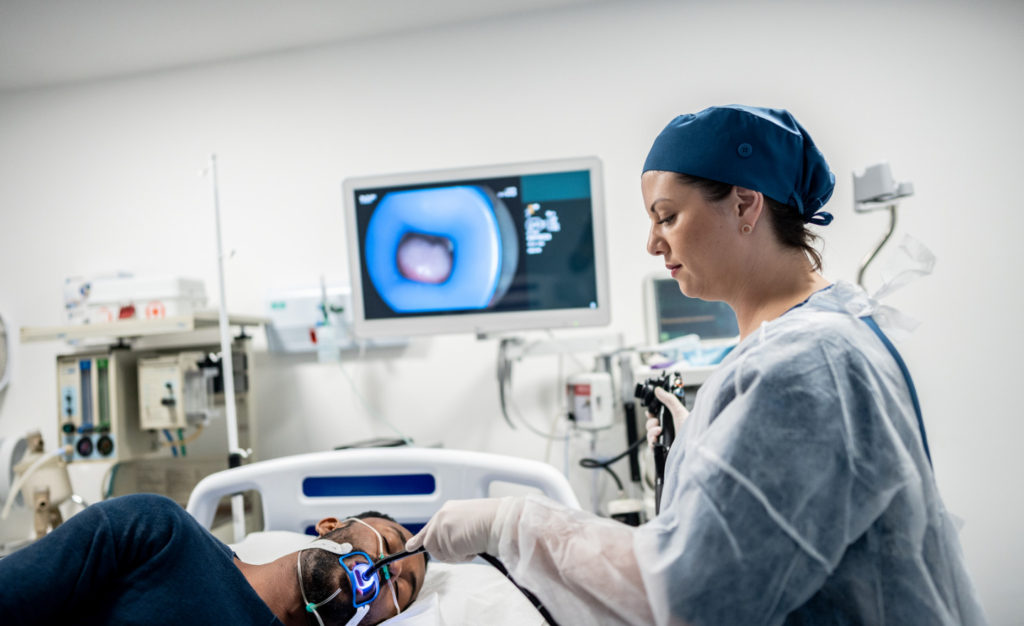
Endoscopy center billing means sending several claims for one GI case and making sure they agree.
The facility bills for the room, staff and supplies. The anesthesia provider bills for sedation, and the pathologist bills for each specimen.
Gaps appear when these claims tell different stories. One missing modifier, mismatched time or uncounted specimen can deny or underpay the case.
Closing those gaps takes correct facility coding, matching anesthesia claims and full pathology charge capture. This guide covers each, then shows how to check them together.
One Endoscopy Case, Several Claims
Take a screening colonoscopy where two polyps are removed under propofol sedation. That one case can produce four bills.
The physician sends a professional claim and the center sends a facility claim. The anesthesia group and the pathology lab each bill separately.
The Oregon Clinic tells patients to expect bills from up to five sources for one procedure.
Each bill may come from a different team or system. That is why the endoscopy center revenue cycle needs a case-level view.
Facility Billing at the Endoscopy Center
The facility claim usually carries the most dollars per case. These five points decide whether it is paid in full.
Claim Form and Payer Rules
Medicare ASCs bill facility fees on the CMS-1500 (837P) format. Some commercial and Medicaid plans want the institutional format instead.
Set each payer’s form rule in the billing system to avoid clearinghouse rejections.
Screening Codes on the Facility Side
The facility claim needs the same screening codes as the physician claim, such as G0121 or G0105 for Medicare.
When a polyp is removed, both claims change codes together. See our guide to screening vs diagnostic billing.
Multiple Procedure Reductions
Payers reduce payment for the second and later procedures in one session. Related endoscopy codes follow special family rules.
List the highest-paying code first and check each reduction against the contract.
Discontinued Procedures
If a colonoscopy stops early, the center uses modifier 73 (before anesthesia) or 74 (after). The physician uses modifier 53.
Putting the physician modifier on the facility claim is a common, costly error.
Same-Day Upper and Lower Procedures
An EGD and colonoscopy on the same day are billed as two procedures on both claims.
Our post on same-day EGD and colonoscopy billing explains the pairing rules.
Anesthesia Claims for GI Procedures
Anesthesia billing depends on who gives the sedation.
Moderate sedation by the endoscopist goes on the physician claim. Medicare uses G0500 with GI endoscopy; many commercial plans use 99152 and 99153.
Monitored anesthesia care by an anesthesiologist or CRNA is billed on its own claim. Common codes are 00811, 00812, 00813 and 00731.
Use 00811 for lower GI endoscopy and 00812 for screening colonoscopy. Use 00813 for combined upper and lower cases, and 00731 for upper GI.
Anesthesia pays on base units plus time, so start and stop times must match the procedure record.
A Becker’s ASC review of GI anesthesia billing notes that time mismatches can flag both the GI and anesthesia claims.
Medical direction modifiers, such as AA, QK, QX and QZ, show who gave the care. Each one changes payment.
Anesthesia costs are rising for centers, so missed revenue hurts more each year. Check each payer contract before setting defaults.
Pathology Charges After Polyp Removal
Every specimen sent from the procedure room should become a charge. These five checks keep that revenue from slipping.
Bill Per Specimen
Surgical pathology, usually 88305 for GI biopsies and polyps, is billed per separately identified specimen.
Three jars mean three units, not one.
Split Global, Technical and Professional
If the lab processes tissue and another pathologist reads it, the charge is split.
The lab bills the technical part (modifier TC). The pathologist bills the professional part (modifier 26).
Match Jars to the Procedure Note
Specimen counts on the pathology claim should match the procedure note. A mismatch signals missed charges and invites payer review.
Support Special Stains
Extra stains such as 88342 need a documented reason in the report. Without one, they often deny as not medically necessary.
Use the Final Diagnosis
Many centers hold the physician claim until pathology returns. An adenoma code supports the claim better than a general polyp code.
Our post on 45380 vs 45385 polypectomy coding shows how removal technique changes the code.
Screening-to-Diagnostic Changes on Each Bill
When a screening colonoscopy finds a polyp, every claim for the case must show the change. If one does not, the patient may be billed wrongly. For Medicare, the physician, facility and anesthesia claims all use modifier PT. Commercial plans usually use modifier 33.
List the screening diagnosis (Z12.11) first and the finding second, on every claim. Anesthesia often moves from 00812 to 00811 with the modifier. Payer rules differ, so confirm each major plan.
Medicare patients now owe 15% coinsurance when a polyp is removed. That drops to 10% in 2027 and zero in 2030. Update patient estimates each year so the front desk quotes the right amount.
A Case-Matching Check Before Submission
The simplest fix is to compare all claims for a case before any are sent.
The table shows what should match and where gaps usually appear.
| Check | What should match | Common gap |
|---|---|---|
| Date of service | Same date on all claims | Pathology billed on the read date |
| Procedure codes | Same codes on physician and facility claims | Facility keeps the screening code after polypectomy |
| Screening modifier | PT or 33 on every claim | Anesthesia claim sent without it |
| Diagnosis order | Screening code first, finding second | Finding listed first on one claim |
| Times | Anesthesia time fits the procedure record | End time later than recovery start |
| Specimens | Pathology units equal jars sent | Two jars sent, one unit billed |
This check takes minutes per case and prevents most cross-claim denials.
Our post on high-volume colonoscopy claims shows how to keep it fast at scale.
Running an endoscopy center? MBW RCM can match a week of your cases against facility, anesthesia and pathology claims and show where the gaps are.
Who Should Run Endoscopy Center Billing?
Most centers choose one of three setups. Each works only if it covers every claim for every case.
Software alone suits centers with experienced billers. Gastroenterology billing software scrubs claims, but it cannot compare claims sent by other groups.
Our guide to GI EMRs with integrated billing covers what to look for in a system.
An in-house team gives the most control but is hard to staff. Facility, anesthesia and pathology rules each need specialized knowledge.
An outsourced billing team fits when claims are split across groups or denials repeat. It can run the case-matching check daily.
Clean claim data also helps growth. GI leaders tell Becker’s ASC that strong payer partnerships are key to building a center.
Billing Every Endoscopy Case Without Gaps
Endoscopy billing works when every claim for a case tells the same story. Facility claims need the right form, codes and modifiers. Anesthesia claims need matching times and sedation codes.
Pathology claims need one charge per specimen and a final diagnosis. Check all of them together before submission. For centers that want help, MBW RCM provides gastroenterology billing and coding services and GI ASC billing that cover every claim for each case.