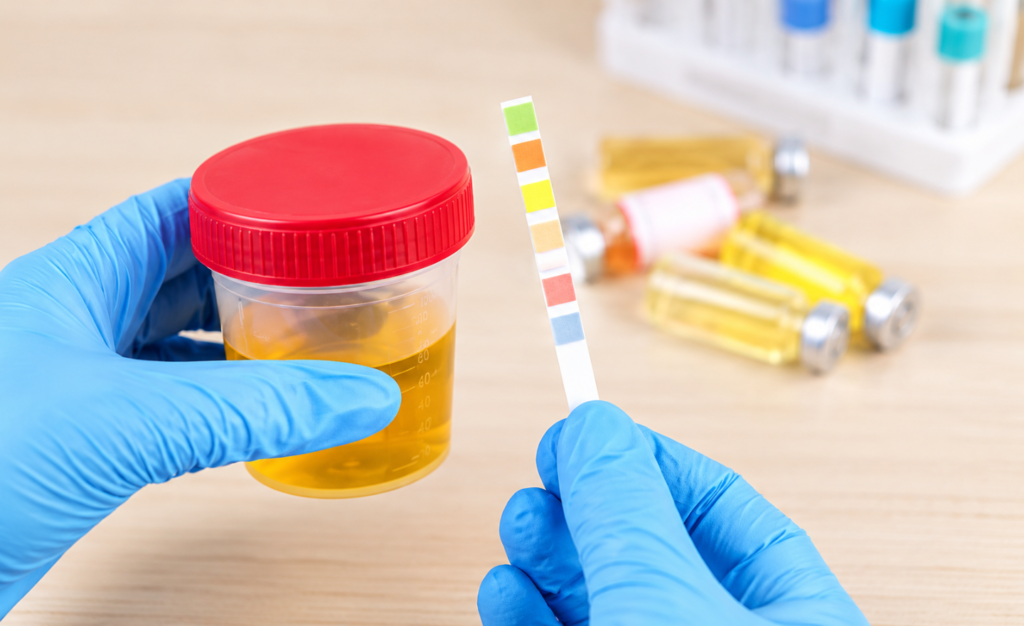
Urine drug testing billing in pain management uses two code families. Presumptive tests, coded 80305, 80306 or 80307, show whether a drug class is likely present and are billed once per day. Definitive tests, coded G0480 to G0483 for Medicare, identify the exact drug and are billed by the number of drug classes tested.
Compliance depends on individualized orders, a documented risk assessment and your contractor’s frequency limits. In addition, every code must match a test actually performed, since unsupported tests drive most audits.
Urine Drug Testing Billing: Presumptive vs Definitive
The two test types differ in method, purpose and how payers count them. Here is the difference in plain terms.
| Point | Presumptive | Definitive |
|---|---|---|
| Method | Cup, reader or analyzer | LC-MS or GC-MS lab test |
| Result | Drug class likely present | Exact drug or metabolite |
| Codes | 80305, 80306, 80307 | G0480–G0483, G0659 or CPT 80320–80377 |
| Billing unit | One per day, any classes | One per day, by class count (Medicare) |
| Novitas limit | 12 per year | 12 per year for opioid therapy |
When each fits: a presumptive result guides the visit in real time. In contrast, a definitive test confirms an unexpected result, rules out a false positive or checks for a drug the screen cannot detect well, such as fentanyl.
In other words, a definitive test should follow a clinical question, not a routine schedule.
Presumptive Codes 80305, 80306 and 80307
Each presumptive drug test 80305 80306 80307 code covers any number of drug classes per date of service. The code depends only on how the result is read.
| Code | How it is read | Typical setting |
|---|---|---|
| 80305 | By eye (cup, card, dipstick) | Office point of care |
| 80306 | By an instrument reader | Office with a reader |
| 80307 | By a chemistry analyzer | In-house or reference lab |
Therefore, an office that reads a 12-panel cup by eye bills one unit of 80305, not twelve. Likewise, Novitas pays only one presumptive result per patient per day, even when two providers test the same patient. So if your office runs a cup and also sends a screen to a reference lab on the same day, one of those claims will deny.
Definitive Codes: G0480–G0483 vs CPT 80320–80377
Medicare and many commercial plans code definitive testing differently, so check the payer before you choose the code set.
Medicare: Count Drug Classes Per Day
For Medicare, definitive drug testing G0480 G0481 G0482 G0483 codes are chosen by the number of drug classes tested on one date of service. G0480 covers 1 to 7 classes, G0481 covers 8 to 14, G0482 covers 15 to 21 and G0483 covers 22 or more. Only one G code is billed per patient per day, and metabolites count within their parent class.
For example, a physician orders definitive testing for opiates, oxycodone, fentanyl, benzodiazepines, buprenorphine, methadone, cocaine and amphetamines. That is eight classes, so the lab bills G0481 once. If the order had stopped at seven classes, the claim would drop to G0480.
G0659 Drug Testing
G0659 drug testing covers definitive testing that does not meet the full lab standards of G0480. That means a lab method without drug-specific calibration, matrix-matched quality control or internal standards. It is billed once per day, regardless of the number of drug classes.
Commercial Payers: CPT 80320–80377
Some commercial and Medicaid plans still accept the CPT definitive codes, 80320 through 80377. These are billed per drug class, so the same eight-class test would appear as eight separate lines. For instance, 80365 reports oxycodone and 80354 reports fentanyl. Check each contract, because billing CPT codes to a payer that requires G codes will deny the claim.
Medical Necessity and Testing Frequency
Every Medicare contractor applies its own controlled substance monitoring LCD. For example, the Novitas policy, L35006, sets clear limits that show how contractors think about frequency. Before any test, walk through these four questions.
- Is there a documented risk assessment? The order should follow a history, an exam and a risk score, ideally from a validated tool. Without it, the test lacks support.
- Is the frequency within limits? Novitas allows up to 12 presumptive tests per calendar year. For urine drug screen frequency chronic opioid therapy patients, it allows up to 12 definitive tests a year, generally 1 to 3 random tests every three months.
- Does the diagnosis support the test? Z79.891, long-term use of opiate analgesics, supports monitoring. Our guide to opioid use disorder ICD-10 codes covers patients in treatment, who may be tested more often.
- Does a definitive test answer a question? It fits when a presumptive result conflicts with the prescribed plan or self-report, or when the screen cannot detect the suspected drug.
Finally, drug testing medical necessity documentation must show the clinician’s reason for each definitive test, the classes ordered and how the results changed care.
CLIA Rules for In-Office vs Reference Lab Testing
Who runs the test decides who bills it. Equally important, the lab certificate decides which tests the office can bill at all.
Point-of-Care Testing in the Office
A point-of-care drug test CLIA waived device, such as a cup or dipstick read by eye, needs only a Certificate of Waiver. Bill it as 80305, and add modifier QW when Medicare requires it for waived tests. However, an analyzer billed as 80307 needs a moderate or high complexity certificate. So confirm the certificate on file covers every code before the first claim goes out.
Sending Specimens to a Reference Lab
When a reference lab performs the test, the lab bills for it, and the practice bills only for its own services. In addition, reflex testing follows strict rules. A lab may reflex a presumptive positive to definitive testing without a new order. But if the presumptive test was done at point of care, the clinician must order any definitive follow-up directly.
Drug Testing Audit Triggers to Avoid
Auditors look for patterns, not single claims. The triggers below come straight from Medicare policy language.
- Blanket orders: the same test ordered for every patient. Medicare does not cover them, so each order must reflect that patient.
- Routine standing orders: standing orders drug testing Medicare allows are patient-specific and limited to a set number of visits. A standing order applied to the whole practice is not reasonable and necessary.
- One custom panel for everyone: a definitive profile is fine when built for one patient’s history and local drug trends. Using it for all patients turns it into a non-covered panel.
- Specimen validity billed separately: pH, creatinine and specific gravity checks are included, not separately payable.
- Two presumptive results on one day: a cup in the office plus a lab screen for the same date pays only once.
Our list of common pain management billing mistakes covers other errors that draw payer review.
What False Claims Settlements Teach Pain Practices
In 2019, a Connecticut interventional pain practice and its owner paid $427,691.90 to resolve False Claims Act allegations, according to the U.S. Attorney’s Office. The case offers two lessons that still apply in 2026.
Lesson 1, bill only what was performed. The practice allegedly billed Medicare and Connecticut Medicaid for quantitative testing that was never done. So match every definitive code to a lab result in the chart.
Lesson 2, do not unbundle the screen. It also allegedly billed alcohol and amphetamine tests separately, although they were already part of the screen it was paid for. As a result, one presumptive code per day should cover every class on the panel.
Together, these lessons point to a simple control: compare the codes billed to the lab report and the order before each claim goes out. Our post on OIG compliance in RCM explains how to build that review into the billing workflow.
Every Drug Test Needs a Reason, a Code and a Record
Urine drug testing billing that pain management practices can defend comes down to three links. The order names a clinical reason. The code matches the method, either one presumptive code per day or one definitive code by class count. Then the chart holds the result and shows how it shaped care. When any link breaks, the claim becomes an audit risk. For related procedure codes, see our pain management CPT, ICD-10 and HCPCS guide. For coding review of drug testing claims, explore our pain management billing services.
Urine Drug Testing Billing FAQs
Can 80305 be billed once per drug class?
No. 80305 covers any number of drug classes and devices, so a 12-panel cup is one unit per date of service.
What is the difference between G0480 and G0481?
Both are definitive Medicare codes. G0480 covers 1 to 7 drug classes, while G0481 covers 8 to 14 classes on the same day.
How often can a chronic opioid therapy patient be tested?
It depends on the contractor and the patient’s risk. Novitas, for example, allows up to 12 definitive tests a year for these patients.
Can a practice bill a cup and a lab screen on the same day?
Only one presumptive result per patient per day is paid, so the second claim will deny.
Is specimen validity testing billed separately?
No. Medicare treats pH, creatinine and specific gravity checks as part of the drug test, not as separate services.